 Skip to content
Home - Spanish Universities Guide
Spanish Universities for International Students: Complete Guide
We explain the admission process, the top institutions for foreign learners, and how the new work regulations benefit your international career.

Exploring Spanish universities for international students is a strategic investment in a global career that combines academic excellence with a high quality of life.
Since 2016, our team has helped more than 1,000 students navigate bureaucratic hurdles to find their ideal Spanish universities for international students. We understand the system because many of our team members were international students here themselves.
This guide provides a clear roadmap to navigate admissions, costs, and the recommended universities in Spain for international students.
(Last Updated: March 2026)
Key Takeaways
- Extended Work Rights: International students in Spain are now authorized to work up to 30 hours per week under new work regulations.
- Affordable Education: Public university tuition remains a budget-friendly option, ranging between 800€ and 6,000€ per year for many programs.
- Expert Guidance: Go! Go! España offers professional, free application support for over 100 partner institutions.
- Entrance Exams: The PCE entrance exams for 2026 now focus on competency-based testing and critical thinking.
- Residency Pathway: Graduates can stay for up to two years post-studies to find a career via the Job Search Visa.
- Global Credit Standards: Spanish degrees utilize the ECTS (European Credit Transfer and Accumulation System), making your credits globally recognized and transferable.
- Location Variety: Spain offers diverse academic environments, from the tech hubs of Barcelona to the affordable immersion of Murcia.
- Employability: Leading institutions are distinguished by high graduate employability and strong industry connections.
- Academic Prestige: Studying in Spain offers a strategic balance of academic excellence and global prestige.
Spain for your international degree
Is Spain the Right Choice for Your International Degree?

For international students, studying at a Spanish university offers a strong balance of academic quality, international recognition, and an excellent quality of life. Spain is not only an attractive place to live, but also home to a well-regarded higher-education system.
Several Spanish universities for foreign students regularly appear in major global rankings such as Times Higher Education, which assess academic reputation, research impact, and international outlook.
At the European level, Spain stands out for having one of the highest numbers of institutions included in the QS Europe Rankings, reinforcing its position as a key hub for international student programs in Spain.
Spanish degrees follow the ECTS credit system, making qualifications widely recognized and easily transferable across Europe and many other regions.
Many programs place a strong emphasis on practical learning, combining academic theory with internships, applied projects, and industry collaboration. This is an important advantage for graduate employability.
In addition, students have the opportunity to become fluent in Spanish, one of the most widely spoken languages in the world. Graduates leave with both a respected qualification and valuable global skills.
Apply to our partner universities
Why Should You Apply To Our Partner Universities?
Applying to our partner university in Spain through our service allows students to pay the same tuition as applying independently while receiving expert guidance for international students in Spain.
We act as a direct link between students and more than 20 respected Spanish institutions, helping ensure each application is complete, competitive, and aligned with university expectations. As a trusted advisor, we offer personalized support throughout the entire process, from choosing the right degree to preparing visa and enrollment documentation.
Because our guidance is free of charge, students gain dedicated, one-to-one support from professionals who are genuinely invested in their academic success.
Did You Know?
Applications submitted through official partners are often processed more quickly, as we ensure all documentation meets each university’s specific requirements from the outset.
Fill out our contact page to get started today!
Find our academic fit in Spain
Spanish Universities for International Students: Which Best Fits Your Goals?
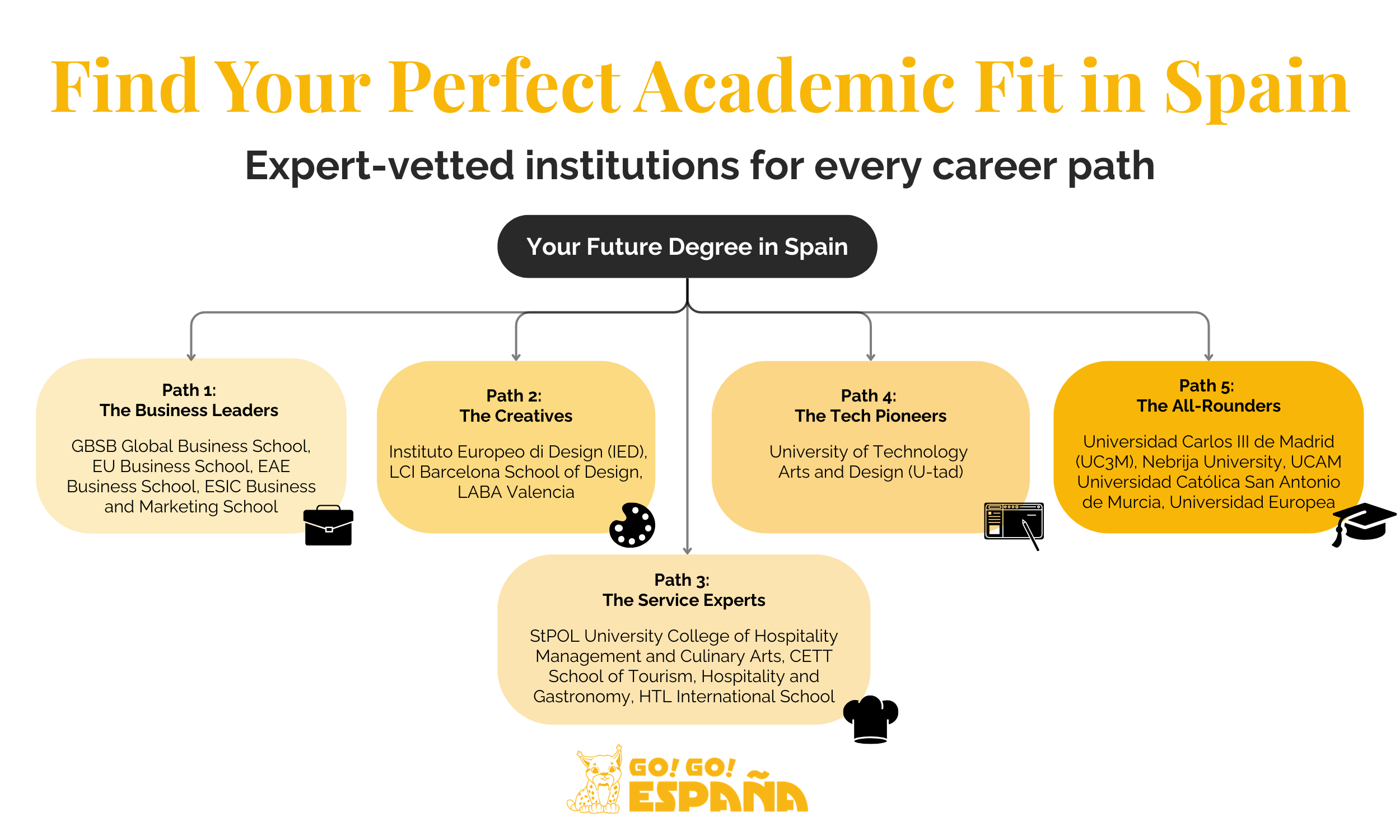
Go! Go! España can help you find a school that aligns with your career goals, whether you are aiming for business leadership, creative arts, or technical expertise.
These institutions stand out for their strong graduate employability and vibrant international communities. By choosing from this carefully selected list, you gain access to a balanced mix of global recognition and practical industry connections.
Recommended Schools in Spain for Business & Management
These Spanish universities are ideal for students pursuing careers in finance, marketing, and leadership.
They emphasize hands-on, practical learning through a “learning by doing” approach and are known for strong employment outcomes. This is largely due to close ties with industry and robust career services, including executive job fairs and networking opportunities.
- GBSB Global Business School: A leading school with campuses in Madrid and Barcelona, officially recognized as a Microsoft Showcase School; students benefit from a high employment rate with many finding jobs within one month.
- ESERP Business School: A prestigious institution with over three decades of experience that emphasizes networking through annual executive job fairs and a practical “Learning by Doing” methodology.
- EU Business School: An international high-ranking school in Barcelona where all courses are taught in English and students participate in company visits to major corporations like Tesla and Amazon.
- ESIC Business & Marketing School: Known for its strong focus on marketing and its extensive alumni network of more than 62,000 professionals. The school maintains strategic partnerships with over 125 universities worldwide and operates three international campuses in Spain, located in Madrid, Barcelona, and Valencia.
- EAE Business School: Ranked among the top 25 business schools globally, providing access to a job portal with over 8,000 offers per year and a practical career development methodology.
- C3S Business School: A Barcelona-based school providing dual degree programs with UK universities, allowing students to earn a UK diploma for one-third of the cost.
Recommended Schools in Spain for Design & Creative Arts

Specializing in fields like fashion, visual arts, and digital media, these schools focus on project-based learning. They often provide students with professional tools, such as Adobe Creative Cloud licenses or access to prototyping workshops with 3D printers, to prepare them for the global creative industry.
- IED Istituto Europeo di Design: An international network focusing on a “Learning by Doing” philosophy through projects commissioned by private companies and maintaining a 120,000+ alumni network.
- LCI Barcelona School of Design: Part of a global network specializing in design excellence, featuring a specialized job bank and a prototyping workshop with 3D printers.
- LABA Valencia: The first international branch of the prestigious Italian university LABA; international students receive a 1,500€ mobility grant and an individual Adobe Creative Cloud license.
Recommended Universities in Spain for Hospitality and Tourism Schools
These schools train students for leadership roles in gastronomy and hotel management, leveraging Spain’s position as a global tourism hub. The curriculum typically integrates hands-on experience, sometimes within the school’s own training hotels, allowing students to work with real customers from their first year.
- CETT School of Tourism, Hospitality and Gastronomy: Affiliated with the University of Barcelona, students gain real practical experience through internships starting in their first year.
- StPOL University College of Hospitality Management and Culinary Arts: A pioneer school on the Barcelona coast where students work with real customers in a training hotel and attend the top-ranked university for Hospitality in Spain.
Recommended University in Spain for Technology and Digital Arts
Exclusively focused on the digital economy, this serves students interested in animation, cybersecurity, and gaming development. These institutions are often led by industry professionals and maintain hundreds of internship agreements with major tech giants to ensure students are at the cutting edge of the digital industry.
- U-tad (University of Technology Arts and Design): A Madrid institution dedicated entirely to the digital industry; it is the most awarded university of its kind in Spain with over 700 internship agreements with tech companies.
Recommended Universities in Spain for General and Multi-disciplines
These institutions offer a wide breadth of academic programs across multiple disciplines. This includes prestigious public universities with high international profiles and private universities known for low student-to-faculty ratios, personalized education, and extensive corporate partnerships for internships.
- Universidad Carlos III de Madrid (UC3M): A top-ranked public university with a graduate employability rate over 90% and a unique International Foundation Program that bypasses entrance exams.
- Nebrija University: A private Madrid university with a low 10 to 1 student-faculty ratio that guarantees internships for 100% of its students.
- Universidad Europea: A leading private university with campuses in Madrid and Valencia, home to the Real Madrid Graduate School and offering over 300 international internship agreements.
- Camilo Jose Cela University (UCJC): Focused on an innovative “open education model,” featuring “The Hive” for professional skills and one of the largest university sports clubs in Spain.
- UCAM (Universidad Católica San Antonio de Murcia): Known as the “Sports University of Spain,” it offers a low 6.7 to 1 student-to-staff ratio and access to international partners like Stanford.
View our full list of partner schools to compare institutions by city and program.
Places in Spain to study
Where are the Best Places in Spain to Study at a University?

Choosing the right city is essential, as Spain’s major academic hubs each offer unique academic strengths and cultural experiences. From global capitals to affordable coastal cities, Spain provides options for every type of international student.
- Madrid: Spain’s capital and largest city, Madrid is the country’s center for business, politics, and international organizations. It is home to some of Spain’s most prestigious universities and offers excellent networking opportunities, internships, and career prospects, particularly in finance, law, and management.
- Barcelona: Known for its architecture, design, and creative industries, Barcelona also has a strong technology and startup ecosystem. The city appeals to students interested in innovation, digital fields, and entrepreneurship, while offering a vibrant Mediterranean lifestyle.
- Valencia: Combines high-quality education in science, engineering, and health-related fields with a more relaxed and affordable coastal lifestyle. It is an attractive option for students seeking strong academic programs without the higher living costs of larger cities.
- Murcia: Ideal for students focused on affordability, language immersion, and cultural authenticity. With lower tuition and living expenses, smaller class sizes, and a traditional Spanish environment, it is well suited for students looking to fully integrate into Spanish life.
Admission requirements for Spanish universities
What are the Latest Admission Requirements for Spanish Universities?
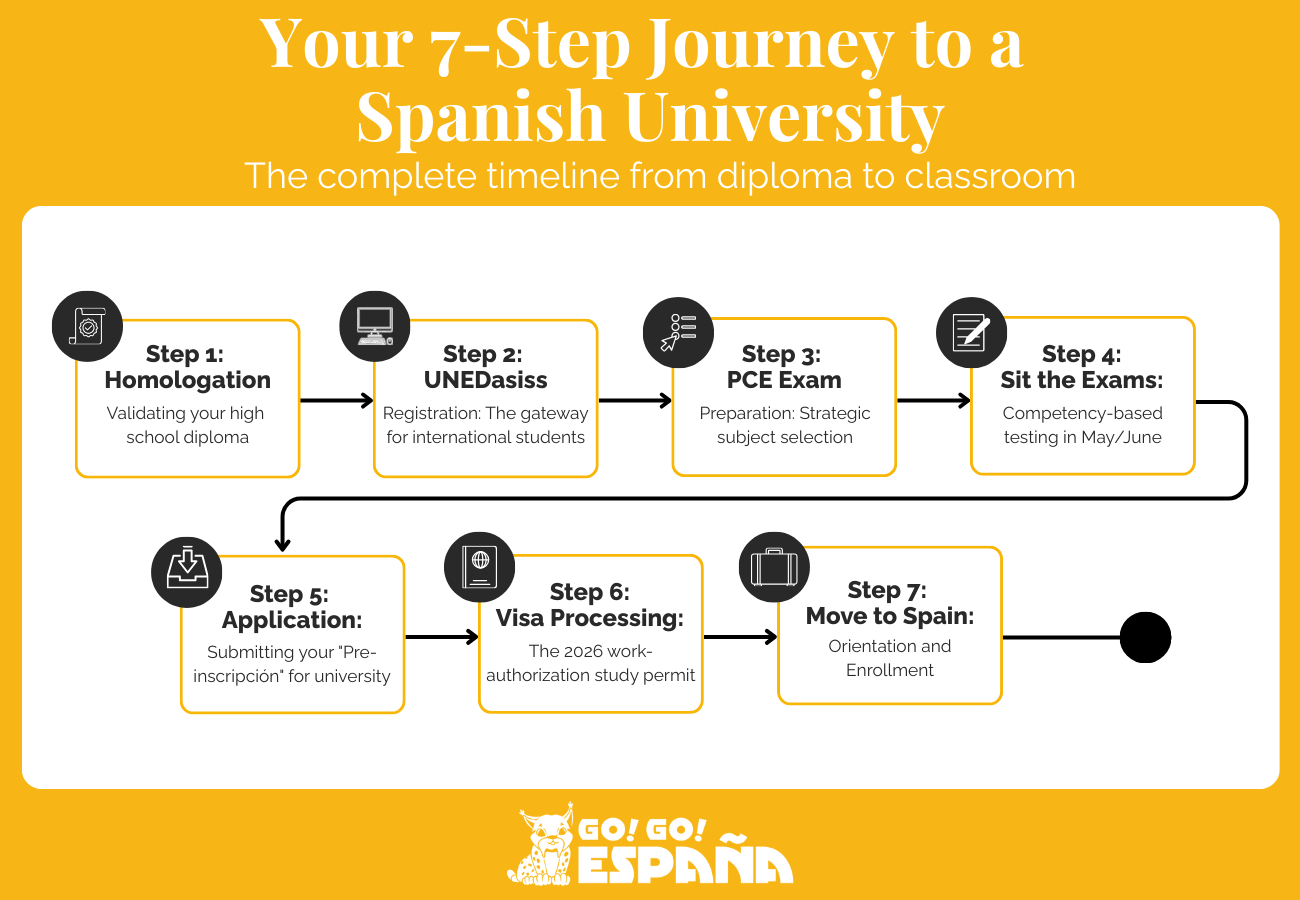
University admission requirements in Spain vary significantly depending on whether you apply to a public or private university. Understanding this distinction is key for international students planning their application strategy.
Admission to Public Universities in Spain
Public universities follow a regulated admissions process and typically have stricter academic and legal requirements. Most non-EU students must complete degree homologation, which is the official recognition of a foreign high school diploma by the Spanish Ministry of Education. You can read our full guide on homologation here.
In addition, applicants are usually required to take the PCE (Specific Competency Tests) administered through UNEDasiss. These exams allocate approximately 20–25% of the final score to competency-based questions, designed to assess how well students apply knowledge to real-world scenarios under the LOMLOE education law.
Language proficiency is also essential. Students must generally demonstrate at least a B2 level in the language of instruction, in either Spanish or English.
Public institutions rely heavily on entrance exam scores for non-EU applicants. Learn more about the testing structure and subject choices by reading our pruebas de competencias especificas pce guide.
Admission to Private Universities in Spain
Private universities offer a more flexible and streamlined admissions process. In many cases, PCE exams are not required, and evaluation is based on academic records, interviews, and entrance assessments conducted by the institution itself.
While homologation may still be requested, some private universities allow students to begin their studies while the process is ongoing.
Language requirements remain important, and most private institutions also ask for a B2 level in Spanish or English, depending on the program’s language of instruction.
Learn more about the UNEDasiss process, entrance exams, and how to prepare successfully.
Cost of studying in Spain
How Much Does It Cost To Study In Spain?
Spain is one of the most affordable study destinations in Europe, especially for international students enrolling in public universities. Tuition fees remain relatively low compared to other popular study destinations, while the quality of education and international recognition remain high.
Public universities are heavily subsidized by the Spanish government, making them an excellent option for students seeking academic prestige at a lower cost. Private universities and elite business schools typically charge higher tuition, but they often offer smaller class sizes, personalized academic support, strong career services, and a wider range of English-taught programs.
In many cases, students can earn internationally recognized degrees at a fraction of the cost they would pay in countries like the US or the UK.
| Institution Type | Estimated Yearly Tuition | Best For |
| Public Universities | 800€ – 6,000€ | Prestige and low cost |
| Private Universities | 6,000€ – 20,000€ | Flexibility and English programs |
| Business Schools | 10,000€ – 30,000€ | Networking and employability |
Learn more about calculating real-world budgets for accommodation, groceries, and leisure in our detailed look at the cost of studying in Spain.
Setting up your local finances early protects you from excessive international transaction fees. Learn more about setting up your access before classes start in our guide on how to open a bank account in Spain.
Working in Spain while studying
Can You Work While Studying in Spain?

International students in Spain are allowed to work up to 30 hours per week, provided the employment does not interfere with their academic obligations. However, the process for obtaining permission to work depends on the type of studies you are enrolled in.
For University Students
Students enrolled in official university degree programs (Bachelor’s, Master’s, or PhD) generally receive automatic authorization to work as part of their student residence permit. In most cases, no separate work permit application is required for part-time jobs, making it easier to gain professional experience and help cover living expenses while studying.
For Language and Non-University Students
Students enrolled in language courses or other non-university programs do not receive automatic work authorization. In these cases, a separate work permit application is required, and approval is granted only if the job is compatible with the student’s course schedule and academic commitments.
Important Considerations:
Regardless of your program type, employment must always remain secondary to your studies. Your work hours cannot conflict with class attendance, exams, or academic performance, and authorities may request proof that your primary purpose in Spain is education.
While part-time employment rights are now automatically tied to official degrees, your initial entry still requires a valid passport stamp. Learn more about consulate documentation processing in our updated Spanish student visa guide.
FAQ
FAQ: Spanish University For International Students
- Is Spain good for international students?
Spain is an excellent destination for international students, offering a high quality of life, affordable tuition, and prestigious degrees recognized across the EU. Many programs are taught entirely in English, allowing students to study without full proficiency in Spanish. - Is Spain friendly for international students?
Spain is known for its welcoming culture and diverse international student environment, particularly in major hubs like Barcelona and Madrid. - Are Spanish universities good for international students?
Yes, Spanish universities are highly accessible to international students, with many offering dedicated support and English-taught programs. - How much does it cost to study in Spain for International students?
Tuition ranges from 800€ at public universities to 25,000€ at elite private business schools. - Can I work while studying in Spain?
Yes, most university students in Spain are automatically allowed to work up to 30 hours per week with a student visa, while students in language or non-university programs must apply for separate work authorization. - Is Spain expensive to study in universities?
Compared to the US or UK, Spain is considered very affordable, especially regarding public tuition and regional living costs. - How do I apply to a university in Spain as an international student?
For public universities, most non-EU students must apply through UNEDasiss, have their high school diploma officially validated (homologation), and may need to take PCE exams.
Private universities handle admissions independently, typically evaluating academic records, interviews, and entrance tests, without requiring UNEDasiss.
Summary
In Summary: Spanish University for International Students
Choosing among the top Spanish universities for international students is a strong step toward a global career and personal growth.
With the work rights allowing 30 hours of employment per week and tuition that remains highly affordable, the value proposition is stronger than ever. Success in this system requires careful planning regarding the PCE exams and city selection to match your budget.
Ready to start? If you are ready to find the perfect Spanish university for international students, Contact Us for free, personalized support today.