 Skip to content



A step-by-step manual to legalizing your foreign studies, paying the Tasa 079, and starting university before your certificate arrives.
Homologation in Spain (homologación), the legal validation of your foreign high school diploma, is often the biggest hurdle for international students. The process can take months, and without it, you cannot finalize university enrollment.
The good news is that you do not always have to wait for the final certificate to start university. By obtaining the Volante de Inscripción Condicional (Conditional Enrollment Flyer), you can take entrance exams and attend lectures while the Ministry of Education processes your paperwork.
This is not a loophole. Article 15.2 of Real Decreto 104/1988 allows universities to admit students conditionally if homologation is still in progress at the end of the admissions period.
This guide will walk you through the entire process, from preparing your documents and paying the Tasa 790/079 to securing conditional enrollment so you can start university on time without unnecessary delays.
To view the broad educational system context and analyze different types of degrees before starting your paperwork, see our complete guide to Spanish universities for international students.
(Last Updated: April 2026)
Key Takeaways
- Non-EU Only: Homologation depends on where you completed high school, not your nationality. Diplomas from the EU, EHEA, IB, and European Schools, China and Colombia access university through UNEDasiss. Most other systems, including the U.S. and much of Latin America and Asia, typically require homologation.
- The “Volante” Strategy: The Volante de Inscripción Condicional is a document issued immediately upon application. It allows you to legally enroll in university and take PCE exams while your file is “pending.”
- Timeline Reality: The official homologation certificate takes 9 to 12 months to arrive. Do not plan your life around waiting for it, use the volante.
- Legalization is Mandatory: Documents from non-EU countries (like the USA) must have the Hague Apostille. Without it, your application will be rejected instantly.
- Sworn Translations: Any document not in Spanish must be translated by a Traductor Jurado (Certified Sworn Translator). Google Translate is not accepted.
- Cost: The government administrative fee (Tasa 790-079) is approximately €46, but you must budget extra for apostilles and translations.
- Grade Conversion: This process doesn’t just validate your degree; it converts your foreign GPA into a Spanish grade (0-10) which determines your admission score.
Table of Contents
What is Homologation in Spain (and Do You Actually Need It)?

Homologation in Spain (homologación) is the legal process of validating that your foreign high school diploma is equivalent to the Spanish Título de Bachiller.
It is not just a translation. It is a decree by the Spanish Ministry of Education that gives your foreign studies the same legal validity as a Spanish diploma.
Homologation vs. Credencial vs. Equivalence
It is easy to get confused by similar terms. Ensure you are applying for the right one:
| Term | Target Audience | Purpose & Speed |
| Homologación | Students from education systems not covered by UNEDasiss agreements (this generally means non-EU systems without specific agreements, such as the United States). | University Access. This is the full legal validation required for high school diplomas. It is slow (9–12 months). |
| Credencial UNEDasiss | Students from EU education systems, IB Diploma holders, and specific systems with agreements (including European Schools, Colombia, and China) per UNEDasiss. | University Access. A fast-track digital accreditation specifically for the European Higher Education Area. |
| Equivalencia | University Graduates (Professionals) | Professional Use. Validates foreign university degrees (Bachelor’s/Master’s) for work purposes. Do not use this for high school. |
The Homologation Grade Conversion: How Your GPA Changes
A key part of homologation is the calculation of your “Nota Media” (Average Grade). The Ministry of Education converts your foreign grades to the Spanish 0–10 scale.
- The Scale: 5.0 = Pass, 10.0 = Distinction.
- The Impact: This grade counts for 60% of your final University Access Score (CAU).
- The Formula: The Ministry uses conversion tables based on international agreements. For example, a US GPA of 4.0 usually translates to a Spanish 10, while a 3.0 might convert to roughly 7.5.
Important Note: If you do not provide complete transcripts for the required years, the Ministry may assign a default grade of 5.0 (Pass). This can significantly reduce your chances of university admission. Make sure every year of schooling is documented to receive the grade you deserve.
To analyze historical cutoff grades and find which top state schools match your projected point profile, review our updated Spanish university rankings.
Required Documents for Homologation in Spain
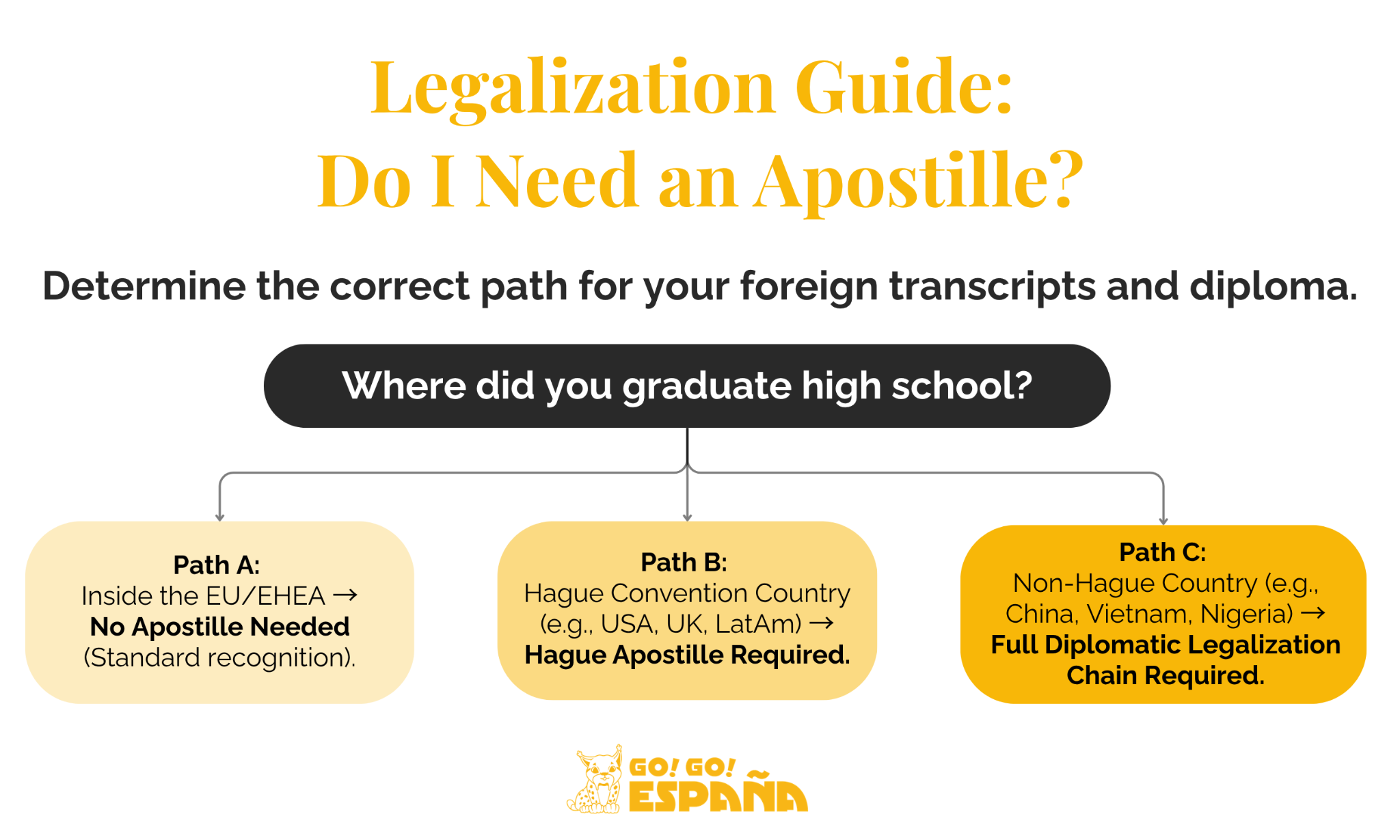
You cannot simply upload a scan of your diploma. The documents must be legalized and officially translated into Spanish to be valid in Spain.
Spain Homologation Document Checklist

- Passport: A clear scan of the ID page.
- High School Diploma: The official certificate of graduation.
- Academic Transcripts: Your grades from the last 3 or 4 years of high school (ex: Grades 9, 10, 11, and 12).
- Proof of Payment: The receipt for Tasa 790-079 (see below).
Requirements for diplomas and transcripts vary depending on your country of origin. The table below summarizes the main documents and key notes for students from the USA, UK, Canada, and Australia. Full country-specific details can be found on the Ministry of Education website.
| Country | Diploma | Transcript / Academic Records | Notes |
| USA | High School Diploma | Official High School Transcript (Grades 9–12, including all schools attended if you changed schools) | Diploma must be the actual ceremonial diploma signed by the Principal. A transcript simply saying “Graduated” is not sufficient. |
| UK (England/Wales) | General Certificate of Education (GCE) A-Level Certificates AND General Certificate of Secondary Education (GCSE) Certificates | Academic Transcripts / Exam Board Certificates | Must submit final certificates issued by the Exam Boards (AQA, Pearson/Edexcel, OCR). “Statement of Results” from results day is not valid. Internal school transcripts can be included but do not replace official Exam Board certificates. |
| Canada | Ontario: Ontario Secondary School Diploma (OSSD); British Columbia: Dogwood Diploma; Quebec: Diplôme d’études secondaires (DES) | Ontario: Ontario Student Transcript (OST); British Columbia: Transcript of Grades; Quebec: Relevé de notes (Secondary V) | As of 2024, documents require Hague Apostille. Consular legalization is generally not needed. |
| Australia | NSW: Higher School Certificate (HSC); Victoria: Victorian Certificate of Education (VCE); Queensland: Queensland Certificate of Education (QCE) | NSW: Record of Achievement; Victoria: Statement of Results; Queensland: Senior Statement | Do not submit your ATAR notice. Only the official government record listing your subjects and grades for Years 11 and 12 is accepted. |
Requirements for diplomas and transcripts vary depending on your country of origin. If you possess a high-ranking diploma from an international track or an EU state, you can often sidestep traditional testing altogether.Review your degree choices and check out which institutions offer tracks taught fully in English in our guide to English universities in Spain.
Cost of Homologation (Form 790 Code 079)
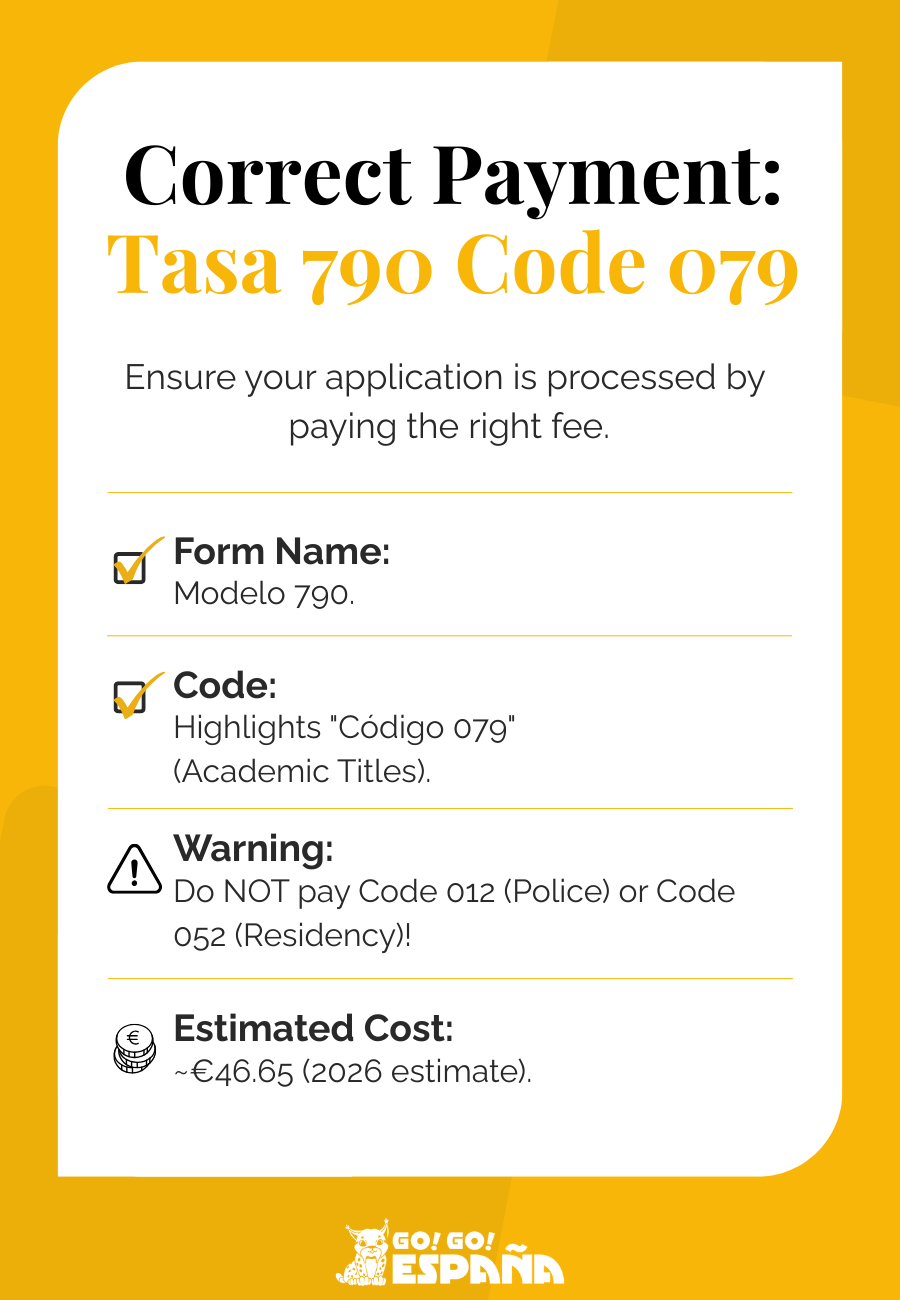
The Tasa 790, Code 079 is the mandatory administrative fee required to initiate your homologation in Spain. Without proof of this payment, the Ministry will not process your file.
This fee covers the official evaluation of your documents and is an essential step that must be completed before the application can proceed.
- The Form: Modelo 790 Código 079.
- Warning: Do not confuse this with Code 012 (Police/Immigration) or Code 052 (Residency). Code 079 is specifically for “Academic Titles.”
- The Cost: The fee is updated annually but is approximately €46.65.
- Hidden Costs: While the tax is low, the real cost comes from preparation:
- Apostilles: ~$20–$100 per document (depends on your country).
- Sworn Translations: ~€40–€80 per page.
To view standard yearly tuition expectations for non-EU learners across different regions, see our detailed guide on the cost of university in Spain.
Can I Register for the PCE Exams Without Homologation?
Yes. This is a crucial strategic point. You do not need the finished homologation to register for the PCE Exams (Selectividad).
UNEDasiss allows you to register as long as you can prove you have initiated the homologation process.
- Registration: Upload your Volante or proof of application to the UNEDasiss portal when asked for your documentation.
- Results: UNED will let you take the exams and will give you a provisional score. However, they cannot issue your final official “University Access Grade” until the Ministry of Education approves your homologation. Review the official testing syllabus, 14-point grade calculators, and testing center locations in our complete Pruebas de Competencias Especificas guide.
To make sure you register for the correct international path rather than the rigid local option, see our side-by-side comparison of PCE exams vs EBAU exams.
How to Prepare Your Documents for Homologation in Spain
Step 1: Legalization (The Hague Apostille)
Before you scan anything, your original paper documents must be legalized.
- Hague Convention Countries (Such as the USA, Canada, Australia, UK, and most of LATAM): You need to get the Hague Apostille stamp on your Diploma and Transcripts. In the US, this is usually done by the Secretary of State in the state where you graduated.
- Non-Hague Countries (Such as Vietnam and Nigeria): You must go through the “Diplomatic Chain” (Ministry of Education in your country -> Ministry of Foreign Affairs -> Spanish Consulate).
Step 2: Sworn Translation (Traducción Jurada)
If your documents are not in Spanish, they must be translated. You cannot use a normal translator. You must use a Traductor Jurado appointed by the Spanish Ministry of Foreign Affairs. They will stamp and sign the translation, giving it legal validity.
We offer professional sworn translation services for English–Spanish documents to ensure your homologation paperwork is accepted without delays. You can learn more and request a translation here.
Step-by-Step: How to Apply for Homologation
The process of homologating your degree in Spain can be complex, but following these steps carefully will make it much easier and help ensure your application is processed smoothly.
1. Access the Application Portal
Start by visiting the Ministry of Education Sede Electronica.
If you do not yet have an account, you can register here by clicking “Registro de persona física.” You likely will not have a NIE, so you can complete your registration with other forms of identification, such as a passport. When prompted to enter documentation, select “Otro” and enter the corresponding information.
Once you have an account, you can access the Sede Electrónica and select “Homologación / Convalidación de títulos extranjeros no universitarios.” Here, you can submit your application and enter your personal and academic information.
For detailed guidance, you can download the Ministry’s official PDF instructions for completing the application.
Important Note: You also have the option to complete the application in person at a Ministry of Education office in Spain or at a Spanish consulate abroad. Be aware that in-person applications are slower and usually take longer to process than submissions through the online portal.
2. Upload Your Documents
Upload PDF scans of the required documents, including:
- Apostilled academic documents
- Official sworn translations (if the originals are not in Spanish)
Make sure all files are clear and legible before submitting them.
3. Pay the Application Fee (Tasa 790)
(Tasa 790 — Modelo 790, Código 079)
Most homologation applications require payment of an administrative fee. The payment method depends on whether you are paying in Spain or from abroad.
Payment in Spain
- Complete and print Form 790 from the official portal.
- Take the form to a bank, savings bank, or credit union that collects government fees.
- Pay the fee in cash at the bank.
After payment:
- The bank keeps page 3 of the form.
- Pages 1 and 2 are stamped or signed by the bank to confirm payment.
These stamped pages must be submitted with your documents at a registry office.
Payment from Outside Spain
If paying from another country, the fee must be sent via international bank transfer to the Ministry of Education’s restricted account at the Bank of Spain.
When making the transfer:
- Include your expediente number in the payment reference so the payment can be matched with your application.
- Ensure the full fee amount arrives, as any bank transfer fees must be paid separately by the sender.
The official bank account details are available on the Ministry of Education’s website.
Pro tip: Always keep your payment confirmation or transfer receipt. You will need it for submission at the registry office.
4. Download Your Volante (Online Submission Receipt)
After completing the online application, uploading your documents, and paying the fee, go to the “Mis Expedientes” section of the portal.
Locate your Resguardo or Volante, which confirms that your application has been successfully submitted, and download it immediately. This document proves your application is officially in the Ministry’s system and is needed for in-person submission.
5. Submit Your Application in Person at a Registry Office
With your Volante/Resguardo, documents, and proof of payment ready, submit your application in person to an official registry office.
Where to submit:
- In Spain: Ministry of Education offices, authorized town halls (Ayuntamientos), or other public administration offices listed on the Ministry’s website
- Abroad: Spanish consulates usually act as authorized registry offices and forward your documents to the Ministry
What to bring:
- Printed Volante/Resguardo
- Printed application form from the Sede Electrónica
- Identification (passport, national ID, or NIE)
- Academic documents (apostilled and translated if required)
- High School Diploma: The official certificate of graduation.
- Academic Transcripts: Your grades from the last 3 years of high school
- Artistic or Sport Study Certificates
- Proof of fee payment (Tasa 079)
Pro Tip: You can check the exact academic documents required for your country on the Ministry of Education’s website.
After submission, the registry office will record your application and provide a duplicate receipt. Keep this receipt safe. It serves as proof that your documents were officially received. Check the complete documentary savings thresholds and consulate appointment parameters by following our updated Spanish student visa guide.
The Timeline: How Long Does Homologation Take in Spain?
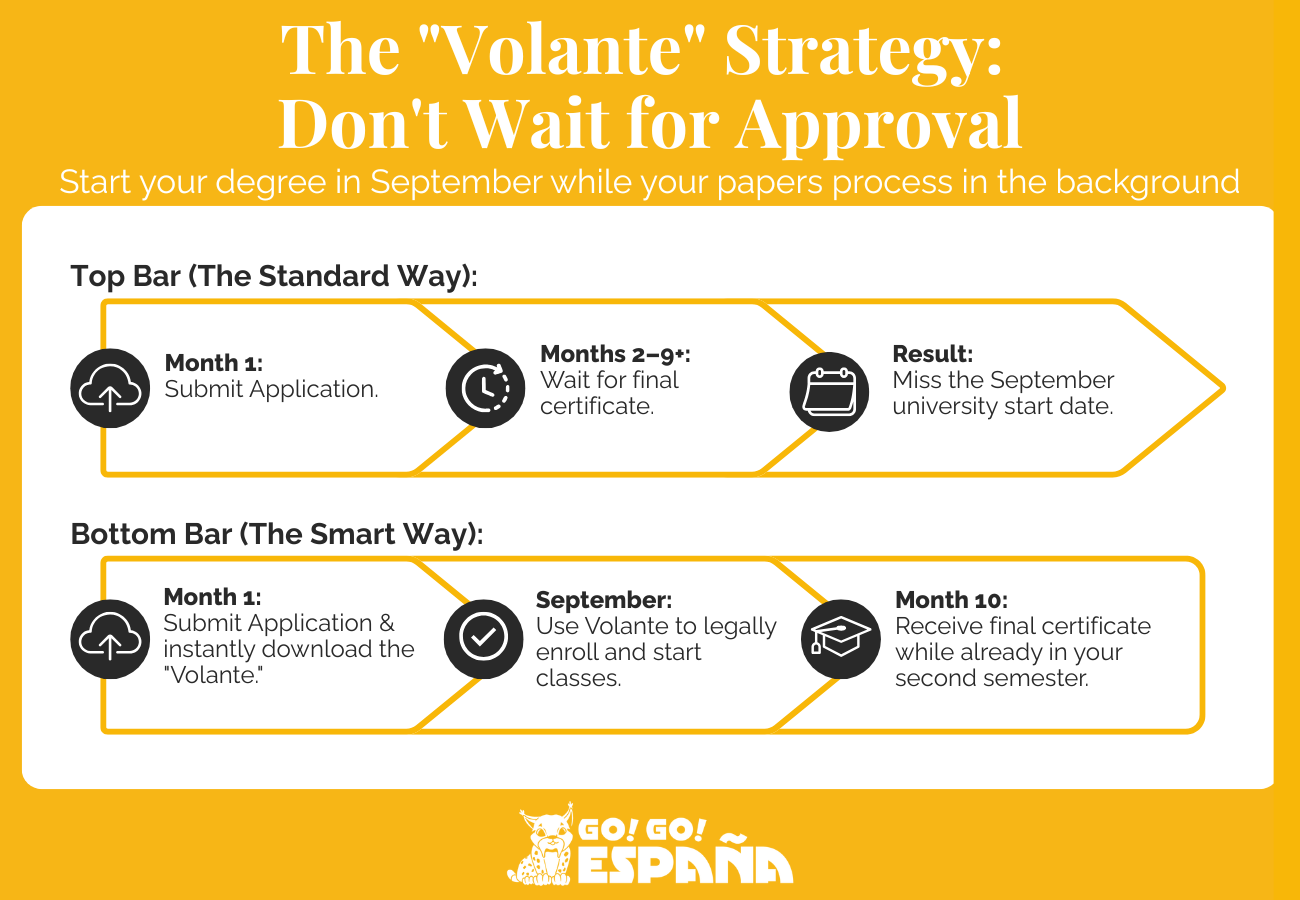
If you look at official estimates, you might panic. Official estimates for 2026 put the average processing time at 9 to 12 months.
If classes start in September and you apply in June, the timing doesn’t add up. This is where the Volante de Inscripción Condicional strategy comes in; it allows you to start university while your homologation is still being processed.
The “Volante” Solution
When you submit your application correctly through the Ministry’s online portal (Sede Electrónica), you can instantly download a document called the Volante de Inscripción Condicional.
- What it does: It proves to the university that you have started the process.
- The Power it holds: Spanish law allows universities to conditionally enroll you based on this flyer. You can attend classes and take exams. You simply need to present the final certificate once it arrives, even if that is months later.
Pro Tip: Check your notifications weekly to avoid delays!
FAQ: Homologation in Spain
1. Can I start university while waiting for homologation?
Yes. Spanish law allows for “Conditional Enrollment” (Matrícula Condicional). If you present the Volante, the university will let you start classes. However, if your homologation is eventually denied (which is very rare), your enrollment will be cancelled.
2. What is the difference between Homologation and Convalidation?
Homologation validates your entire degree (ex: High School Diploma). Convalidation is for transferring partial credits (ex: you did 1 year of Biology in the UK and want to transfer those specific credits to a Spanish university).
3. Does the American GED work for homologation?
It is difficult. The Spanish system prefers the standard High School Diploma. The GED is not always automatically recognized as a direct equivalent to the Bachillerato. It is best to consult with an academic specialist if you hold a GED.
4. How do I check the status of my application?
Log in to the Ministry’s Sede Electrónica and go to the “Mis Expedientes” (My Files) tab. You will see statuses like “En trámite” (Processing), “Pendiente de documentación” (Missing documents), or “Resuelto” (Resolved).
5. What happens if my homologation is denied?
The most common status update is “Subsanar” (Rectify). This usually means your application is paused because a document is missing, a scan is blurry, or a translation is incorrect. It does not mean your application has been rejected.
You typically have 10 to 15 days to upload the missing or corrected document in the notification area of the portal. If you miss this window, your application will be archived, and you will need to start over and pay the fee again.
In Summary: Validating Your Diploma In Spain
Homologation in Spain can be slow and bureaucratic, but the Volante de Inscripción Condicional lets proactive students start university on time while their application is processed.
The key is precision: make sure your documents are Apostilled and sworn translated before submitting anything to the Ministry.
Feeling overwhelmed? We work with trusted partners who can handle Apostilles, sworn translations, and Ministry submissions to help you get your Volante quickly. Contact us for free.
While you wait for your document processing to conclude, you can use your time productively. Check out our detailed Pruebas de Competencias Especificas PCE guide to find the best pathways, study techniques, and curriculum benchmarks to get ahead before your classes start.


