Skip to content



A comprehensive financial and academic comparison to help you choose between the “Prestige” of the public sector and the “Employability” of the private sector.
When analyzing public vs. private universities in Spain, international students face a choice between two distinct educational models, each with its own specific set of pros and cons.
Public universities offer historic prestige and deep research capabilities, but they often come with complex bureaucracy and rising tuition costs for non-EU citizens. On the other hand, private universities prioritize employability, speed, and English-taught curriculum, but require a higher investment upfront.
Nowadays, the decision is no longer just about price, it is about value. While the public sector remains the gold standard for traditional academic careers, the private sector has emerged as a streamlined “concierge” alternative for students seeking immediate access to the global labor market.
This guide breaks down the critical differences in cost, admission speed, and campus culture to help you decide which system fits your profile. To view all university tracks and system requirements, read our complete guide to Spanish universities for international students.
Key Takeaways
- The “Free” University Myth: While EU citizens pay ~€1,200/year, non-EU students in Madrid now face “3rd and 4th enrollment” penalty rates, pushing public tuition to €6,800–€8,200/year, comparable to “budget” private universities.
- Admission is “Rigid” vs. “Holistic”: Public admission is a mathematical calculation based on your EBAU exam score. Private admission is a profile assessment based on your interview, motivation, and potential.
- The “Language Trap” in Public Schools: Many “Bilingual” public degrees only offer the first year in English, requiring B2 Spanish fluency to finish the degree. Private partner schools are often the only guarantee of a 100% English curriculum.
- Time is Money (The Hidden Cost): Accessing a top public university often requires a “Gap Year” to study for entrance exams (academy fees ~€5,000). Private universities offer Direct Admission, allowing you to start immediately.
- Bureaucracy vs. Concierge Service: Public university students must often navigate the Homologation and visa process alone. Private universities provide dedicated support teams to fast-track your paperwork under the new Royal Decree 1155/2024.
- Theory vs. Employability: Public universities excel in research and theoretical depth (great for academia). Private universities prioritize soft skills, internships, and networking (great for corporate careers).
- Partner Schools Offer the “Sweet Spot”: Institutions like UCAM or C3S offer the low cost of the public sector (~€6,000) with the English accessibility and service of the private sector.
Table of Contents
The Latest Landscape Shift
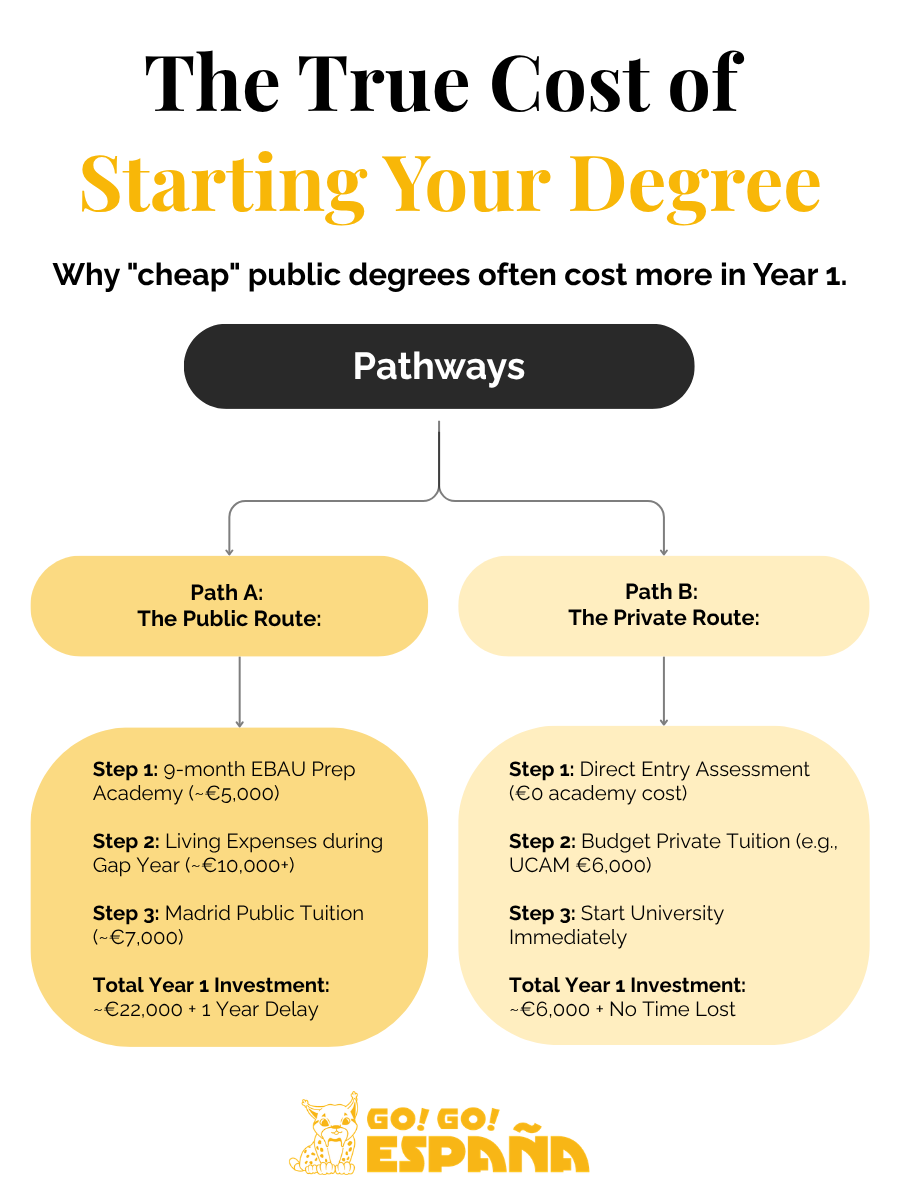
For non-EU students, the rules have changed. Historically, Spain was a low-tuition destination regardless of your passport. But recently, the Autonomous Communities of Madrid and Catalonia have aggressively restructured their public pricing models.
They now differentiate between Resident Taxpayers (who pay subsidized rates), and International Students (who pay full fees).
This means the “Public Option” is no longer synonymous with “Low Cost.” You must now weigh the Total Cost of Ownership:
- Public: Tuition (€7k) + EBAU Prep (€5k) + 1 Year Delay.
- Private: Tuition (€6k–€20k) + Zero Prep + Immediate Start.
How Do Public Universities in Spain Compare to Private Ones in Terms Of Tuition Fees?
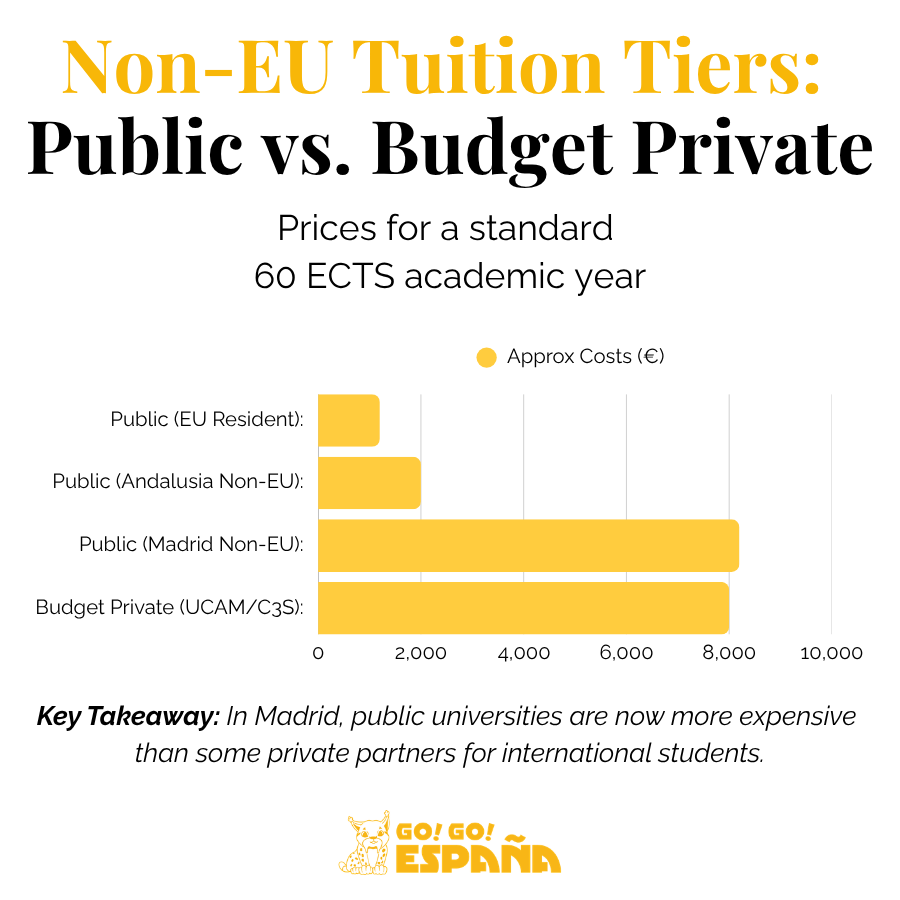
“Public is Cheaper” is a myth for many Non-EU students.
While public universities remain the budget-friendly option for EU residents (~€1,200/year), the tuition fees in Spain for non-EU students have shifted dramatically. Public institutions now use a “Tiered Pricing” system, where non-residents in key regions like Madrid and Catalonia can pay up to €8,200/year, a price point that rivals many private universities.
When you factor in the “hidden costs” of EBAU preparation academies (~€5,000), and the year-long delay to study for exams, the total cost of the “public” route often equals or exceeds the private option.
Learn more:
Look at first-year credit pricing tiers and non-EU fees in our comprehensive breakdown of the cost of university in Spain.
The Public “Tiered” System
Public universities charge by credit (ECTS). A standard year is 60 ECTS. However, the price per credit depends on your residency status.
| Student Type | Price Per Credit | Annual Tuition (Approx.) |
| EU Resident | €15 – €25 | €900 – €1,500 |
| Non-EU (Andalusia/Valencia) | €15 – €30 | €1,000 – €2,000 |
| Non-EU (Madrid/Catalonia) | €113 – €136 | €6,800 – €8,200 |
Note: Madrid often applies the “4th Enrollment” price to non-residents from day one.
The Private Sector Range
Private universities charge a flat annual fee regardless of your nationality. While elite schools are expensive, “Budget Private” schools have emerged as cost-effective alternatives for international students.
| Category | Annual Tuition (Approx.) | Examples of Schools |
| Budget Private | €5,000 – €8,000 | UCAM (Murcia), C3S Business School |
| Mid-Range | €9,000 – €14,000 | Nebrija University, Universidad Europea, ESIC Business & Marketing School, GBSB Global, EU Business School, U-tad, Animation and Video Games University |
| Elite | €18,000+ | IE University, ESADE, IESE |
The “Cost of Living” Hack
When comparing costs, remember that tuition is only half the equation; geography dictates your rent. A public university in Madrid may charge you €8,200/year in tuition, plus you will face Madrid’s high living costs (approx. €1,000–€1,200/month).
Conversely, choosing a “Budget Private” institution in a more affordable region, such as UCAM in Murcia, means paying a flat €6,000/year for tuition while enjoying living costs closer to €600–€800/month.
When factoring in the total cost of ownership, studying privately in a secondary city is often thousands of euros cheaper per year than studying publicly in Madrid or Barcelona.
What are the Main Differences in Curriculum Focus Between Private and Public Universities In Spain?
The academic philosophy in Spain is split between two distinct worlds: Theory vs. Practice.
Public universities are the engines of research and academia. Their curriculum is designed to produce scholars, civil servants, and technical experts who have mastered the theoretical foundations of their field.
In contrast, private universities operate as “Career Accelerators.” Their curriculum is often co-designed with corporate partners to produce graduates who are “job-ready” from day one, prioritizing soft skills, group projects, and practical application over pure theory.
| Feature | Public Universities (The “Research” Model) | Private Universities (The “Employability” Model) |
| Primary Focus | Theoretical Depth and Research | Practical Application and Soft Skills |
| Teaching Style | Magisterial Lectures (Professor speaks, you listen) | The “Case Method” (Problem-solving real business scenarios) |
| Faculty Profile | Tenured Academics and Researchers | Working Professionals and Industry Experts |
| Student Role | Independent Learner (High autonomy) | Active Participant (Mandatory attendance and teamwork) |
| Assessment | Final Exams (Often 100% of grade) | Continuous Assessment (Projects + Presentations + Exams) |
| Best For… | Academia, Science, Medicine, Law | Business, Marketing, Tech, Creative Arts |
How does the student-to-faculty ratio differ between public and private universities in Spain?
The classroom experience is one of the most noticeable differences, and choosing which one best suits you often comes down to a matter of personal preference.
In public universities you may find yourself in lecture halls with 100+ students. While this means less individual attention from professors, some students prefer this environment because it offers a livelier social atmosphere and the chance to meet a wider variety of people from different backgrounds.
Classes are typically capped at 15 to 30 students in private universities. This ensures a “high-touch” environment where professors know your name and participation is mandatory. This is ideal for students who need structure, but it can feel less like a “massive university experience” and more like a continuation of high school dynamics.
Do Private Universities In Spain Offer More English-Taught Degree Programs Than Public Ones?
Yes, but with a major caveat. Be careful not to assume that every private university is a safe bet for English. Many traditional private universities in Spain teach almost exclusively in Spanish.
However, International private universities (like our partner schools) are designed specifically for the global market.
A traditional private school might offer a “Bilingual” degree that is 50% Spanish. Our partners (ex: EU Business School, GBSB Global) guarantee 100% English curriculums for the full duration.
Always check the curriculum language carefully. If you do not speak Spanish, look specifically for “International” private schools rather than just any private institution.
How do Extracurricular Activities Differ Between Public and Private Universities?
Where will you have more fun? It depends on your style.
Private universities generally offer a more organized “menu” of extracurriculars. Because they compete for students, they invest heavily in clubs, sports teams, organized trips, and cultural activities (Art, Drama, Music) to build community.
Public universities offer a wider range of activities due to the sheer number of students, but they are often student-led rather than university-organized. If you are proactive, you can find a club for almost anything, from political debate to mountain climbing, but you have to go out and find it yourself.
How Do Private And Public Universities In Spain Differ In Their Application Processes?
The application journey is a study in contrasts: Bureaucracy vs. Efficiency.
Public universities operate on a rigid, state-controlled timeline that demands high autonomy from the applicant. You must navigate complex government platforms like UNEDasiss to convert your grades, often without direct support. In contrast, private universities function like modern service organizations.
They offer a “concierge” experience with rolling admissions, dedicated counselors, and streamlined internal assessments, allowing you to bypass the stress of national exams and secure your spot months in advance.
Learn more:
To follow the exact sequence of regional database windows and registration steps, read our manual on how to apply to university in Spain.
Public: The “DIY” Visa and Bureaucracy
- Process: Requires UNEDasiss accreditation (converting GPA) and Homologation (can take 6-12 months).
- Risk: If paperwork is delayed (common), you miss the September start date and lose a year.
Private: The “Concierge” Service
- Process: Direct admission via internal assessment (Interview + CV). No EBAU exam is required.
- Speed: Rolling admissions mean you can apply in July and start in September (or even January).
Learn More:
Review subject selection strategies and grade weighting multipliers in our Pruebas de Competencias Especificas PCE guide.
Learn more:
Review full financial proof baselines, health insurance rules, and apostille requirements by checking out our Spanish student visa guide.
How do the Reputations of Private Universities in Spain Compare Internationally Versus Public ones?
Reputation in Spain is split between history and industry.
Public universities like Complutense (UCM) and University of Barcelona (UB) hold the crown for academic prestige. With centuries of history and massive research output, they consistently rank in the QS Top 200 globally and are highly respected by traditional employers (law firms, hospitals, engineering giants).
Private universities, while younger, have carved out a reputation for “Niche Excellence.” Schools like ESIC (Marketing), or U-tad (Animation), may not rival UCM’s general ranking, but within their specific industries, they are often preferred by recruiters for producing graduates who are “job-ready” from day one.
Public Prestige
- Strength: Historical weight, Research Output, and Global Rankings.
- Best For: Traditional careers (Law, Medicine) and Academia.
Private Networking
- Strength: Corporate Partnerships and High Placement Rates.
- Stat: Private universities often boast 90%+ placement rates thanks to active Career Service departments that hunt for internships for you.
Summary of Pros and Cons: Public vs. Private Universities in Spain

If you are still weighing your options, this direct comparison breaks down the primary advantages and disadvantages of each system for an international student.
Table: Pros and Cons of Spanish Universities
| Feature | Public Universities | Private Universities |
| The “Pros” | ✅ Historic Prestige: Degrees from institutions like UCM or UB carry centuries of weight. ✅ Low Cost for EU: Unbeatable value (~€1,200/yr) if you hold an EU passport. ✅ Research Power: Access to massive libraries, laboratories, and theoretical depth. ✅ “Real World” Immersion: Total immersion in Spanish language and culture. | ✅ Speed: Direct admission means no “gap year” to study for entrance exams. ✅ Language: The only safe bet for 100% English-taught degrees (at partner schools). ✅ Service: “Concierge” support for visas, housing, and paperwork. ✅ Employability: Curriculums designed for immediate entry into the job market. |
| The “Cons” | ❌ Non-Resident Cost: Tuition can spike to €8,000+ for non-EU students in Madrid/Barcelona. ❌ Bureaucracy: You must navigate complex Homologation and visa processes alone. ❌ The “Language Trap”: “Bilingual” degrees often revert to Spanish after Year 1. ❌ Impersonal: Large class sizes (100+) require you to be highly independent. | ❌ Higher Tuition: Upfront costs are significantly higher (though gap narrowing). ❌ “Bubble” Risk: Studying in English with international peers can limit local integration. ❌ Variable Prestige: Newer private schools lack the centuries-old history of public ones. ❌ Smaller Scale: Fewer “massive” campus events or political societies. |
Go! Go! España’s Partner Schools Offer the Best Value for International Students

If you want the English environment of a private school but need to balance budget and quality, consider our partner schools.
These institutions strip away the administrative barriers of the public system while offering a Price-to-Value ratio that often supersedes the traditional public sector offering.
Business and Leadership Schools
For students who want an international corporate network and practical business skills.
- EU Business School: High-level networking and corporate connections.
- ESIC Business and Marketing School: Spain’s premier institution for marketing and digital business.
- GBSB Global Business School: Focuses on innovation and digital entrepreneurship.
- ESERP Business School: Known for flexible degrees in law, business, and criminology.
- C3S Business School: Budget-friendly English degrees in Barcelona (~€6k).
- EAE Business School: A leader in MBA and specialized master’s programs.
Creative and Tech Schools
For Portfolio-based careers in design, animation, and technology.
- U-tad (University of Technology, Arts and Design): The industry leader in Animation, Gaming, and Software Engineering.
- IED (Istituto Europeo di Design): A global powerhouse for Fashion and Design portfolios.
- LCI Barcelona School of Design: Part of a massive international network for design professionals.
- LABA Valencia: A boutique school of art and design with Italian heritage.
Hospitality and Tourism
For students seeking careers in hotel management and culinary arts.
- CETT School of Tourism, Hospitality and Gastronomy (UB): The only school affiliated with the University of Barcelona (Public-Private mix).
- StPOL University College: A hotel-school model where you live and work in a real hotel environment.
Comprehensive and Accessible
For students who want a full campus experience with diverse degree options.
- Universidad Europea: A massive private university with top-tier facilities for Health, Architecture, and Sports.
- Nebrija University: Renowned for its focus on Spanish language and small class sizes.
- UCAM (Universidad Católica San Antonio de Murcia): Known as the “University of Sport.” Low tuition (~€6k) and high quality.
- Camilo José Cela University (UCJC): Offers a holistic, personalized educational model.
- Universidad Carlos III de Madrid (UC3M) International School: The “Gateway” option—start in a private foundation year, then transfer to the prestigious public degree.
- Complutense University of Madrid: One of Spain’s oldest and top-ranked universities, offering a wide range of programs with strong global recognition (QS Top 200) in the heart of Madrid.
FAQ: Public vs. Private Universities in Spain
1. Is public university free for international students?
No, public university is not free for international students. While EU citizens pay very little, non-EU students in major hubs like Madrid are often charged “3rd or 4th enrolment” rates, making the cost significantly higher (up to €8,000/year).
2. How do tuition payment plans differ between public and private universities in Spain?
Private schools typically offer flexible monthly instalment plans (ex: 10 payments). Public universities usually require the full payment upfront, or in two to four instalments, which can be a financial burden.
3. Are there notable differences in graduation rates between public and private universities in Spain?
Yes, there are notable differences in graduation rates between public and private universities in Spain. Private schools generally have higher graduation rates. Because of the personalized tracking and mentorship, fewer students drop out compared to the “sink or swim” environment of public universities.
4. How do private universities in Spain compare to public ones in terms of class diversity?
Private schools are significantly more international. At a school like GBSB Global, 80-90% of students may be international. At a public university, the student body is typically 85-90% domestic Spanish students.
5. Is a degree from a private university in Spain recognized internationally?
Yes. Private universities usually offer degrees accredited by the Spanish Ministry of Education (Título Oficial), or prestigious proprietary degrees (Título Propio), highly valued by global employers.
6. Do private universities offer better internship opportunities than public ones?
Generally, yes. Private universities often have dedicated “Career Service” departments with guaranteed internship agreements. Public universities have job boards, but securing a placement is usually a proactive, competitive process you must manage yourself.
7. Are campus facilities better at private universities?
It depends. Public universities have massive, historic campuses with huge libraries. Private universities tend to have modern, tech-forward facilities, smaller but higher-tech classrooms, and “boutique” amenities.
In Summary: Which One is Better, Private or Public University in Spain?
There is no single “better” option, only the option that fits your specific profile and budget.
When comparing public vs. private universities in Spain, the choice comes down to your academic goals and your tolerance for bureaucracy.
- Choose Public if: You are fluent in Spanish (B2+), have a high GPA, want the prestige of a historic institution, and are willing to navigate the complex administrative process.
- Choose Private if: You need a 100% English-taught degree, want a “Career Coach” approach to education, or need to bypass the risks of the EBAU exam.
Still unsure if you can afford private universities? Or if you can pass the public exam? Don’t guess with your future. Contact us for a free strategy session. We will help you compare the public vs. private universities in Spain to find the exact costs and timeline that match your passport and grades.
Explore our University Directory to find English-taught programs that fit your budget today.