Home - Spanish Universities Guide - English Universities in Spain
English Universities in Spain for International Students
Finding the best English universities in Spain is the first critical step toward earning a world-class degree while living the Spanish lifestyle.

Did you know you can earn a fully accredited European degree in Spain without speaking a word of Spanish? Spain is no longer just a destination for language learners. With over 800 English-taught programs (ETPs) now available, it has become a top choice for international students seeking high-quality education at a fraction of the cost of the UK or US.
Whether you are looking for a Bachelor’s degree in Business or a Master’s in Data Science, you can find a program that fits your goals—and your language skills.
This guide will reveal the best public and private universities teaching in English, break down the tuition costs, and explain exactly how to apply to your dream school.
(Last Updated: March 2026)
Key Takeaways
- Over 800 English Options: You do not need to be fluent in Spanish to study here. Spain offers hundreds of fully accredited Bachelor’s and Master’s degrees taught 100% in English.
- Public vs. Private Strategy: For Bachelor’s programs, public universities can be budget-friendly (€1,000 – €8,000/year), while private universities are more of an investment (€8,000–€25,000/year), however they include smaller classes, English-speaking support, and career networking. The tuition costs vary for students who are EU residents versus non-EU residents. Master’s programs can cost around €9,000 – €20,000.
- Higher Acceptance Rates: Top Spanish universities are far more accessible than their US counterparts, with acceptance rates around 75% for qualified international students (vs. <10% for elite US schools).
- Direct Specialization: Unlike the US “General Ed” model, Spanish degrees allow you to focus on your major (Business, Tech, or Engineering) from Day 1.
- Flexible Admissions: Private partners like EU Business School and GBSB, and public partners like Universidad Carlos III de Madrid, often waive the complex PCE entrance exams, reviewing your application holistically based on grades and motivation.
- Dual Degree Advantage: Many private business schools offer “Dual Degrees,” allowing you to earn a UK or US diploma alongside your Spanish degree for maximum global recognition.
- Graduate Career Opportunities: Speaking English is a career asset in Spain, specifically in the booming Tech (Barcelona) and Multinational Business (Madrid) sectors, supported by the new Digital Nomad and Startup Laws.
- Recognised Educational Framework: Spain follows the European Higher Education Area (Bologna) framework, so Spanish degrees are recognised across Europe and beyond (European Union, 2025).
Studying in Spain
Can You Study at English Universities in Spain?

While traditionally a Spanish-speaking destination, the rise of English universities in Spain has made it possible to earn an accredited degree without a language barrier.
While Spain’s official language is Spanish, the country has aggressively adapted to the European Higher Education Area (EHEA). This means universities are offering more “English Tracks” every year to attract global talent. These degrees are fully accredited and recognized throughout the European Union and globally.
However, it is important to know where to look. While most universities offer some classes in English, only specific institutions offer full degree programs where 100% of the coursework, exams, and administration are conducted in English.
Did You Know?
The number of English-taught Master’s degrees in Spain has grown by over 80% in the last decade, with private universities capturing a large share of this international market.
Public vs. private universities
Public vs. Private Universities: Which is Better for English Speakers?

For English-only speakers, private universities generally offer a smoother experience with more program options and flexible admissions, while public universities offer lower costs but require higher entry grades.
Choosing between public and private is the first big decision you will make. Here is how they compare for an international student who wants to study in English.
Public Universities in Spain for English Speakers
| Category | Description |
| Cost | Affordable for EU residents (€800 – €2,000/year). For Non-EU Students, be aware that in regions like Madrid, public university fees for non-EU students can be significantly higher (approx. €6,000 – €8,000/year), which closes the price gap between public and private options. |
| English Availability | Limited. Usually found in Engineering, Business, and Economics tracks. |
| Admission | Highly competitive. You often need a very high “Nota de Corte” (cut-off grade) and may need to take PCE Exams (Specific Competency Tests). These tests are in Spanish, which means it is necessary to at least have an intermediate level in Spanish to gain admission even if a program is fully taught in English. |
| Bureaucracy | High. Administrative processes are often in Spanish. |
Private Universities in Spain for English Speakers
Category | Description |
Cost | Higher (€8,000 – €25,000 per year). |
English Availability | Extensive. Entire campuses, like EU Business School, where most of the programs (Business, Engineering, Design, and Computing) operate in English. |
Admission | Usually do not initially require students to take the PCE admission tests but better to prepare just in case. Can be flexible by looking at your profile, interview, and motivation, not just exam scores. |
Bureaucracy | Low. They have dedicated departments to help international students with visas and paperwork. |
Spanish University Official Degrees vs. "Private" Degrees
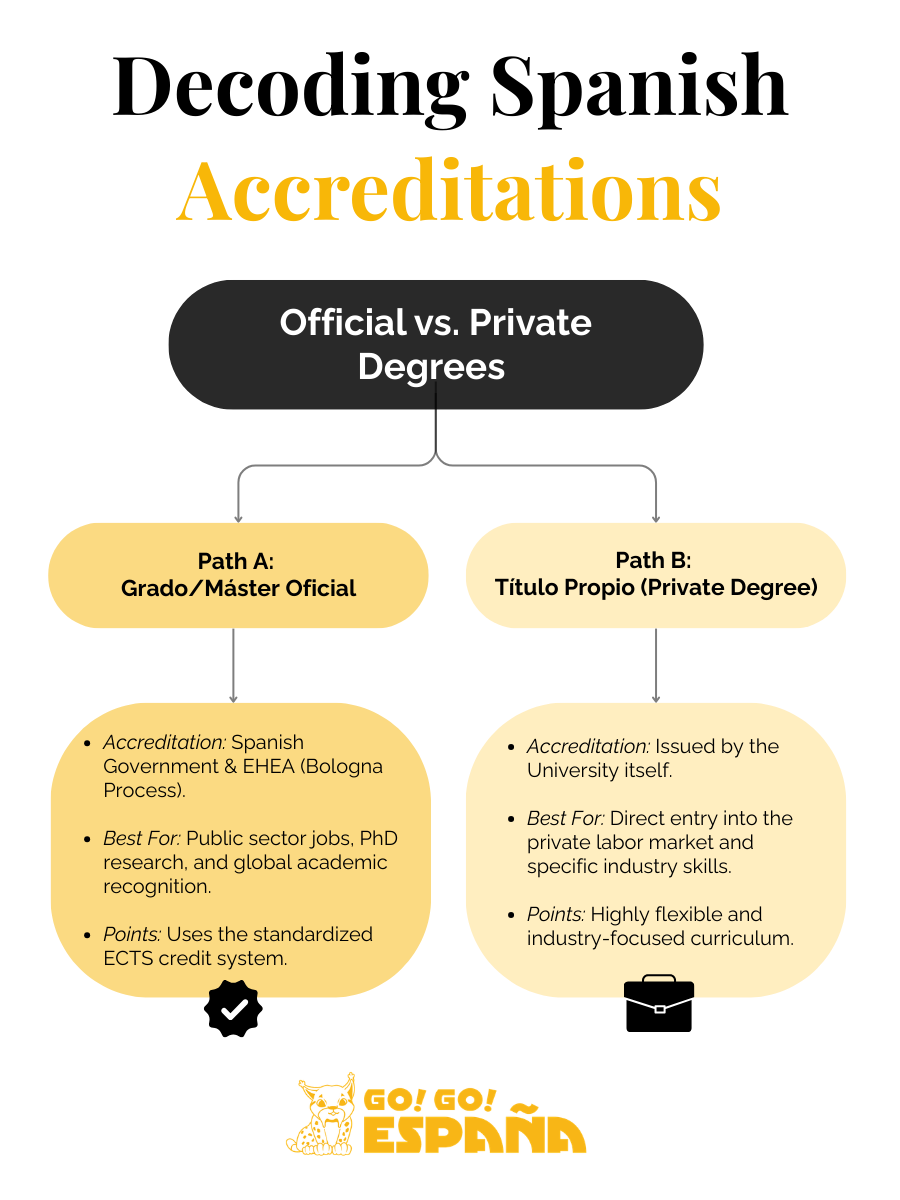
Before enrolling, you must understand the difference between the two types of accreditation in Spain:
Grado/Máster Oficial (Official Degree) | Título Propio (Private Degree) |
Accredited by the Spanish government and recognized across the entire EU (EHEA). | Designed by the university itself to be highly flexible and industry-focused. |
Required for those planning to work in the public sector or pursue a PhD later. | Highly respected by private employers but may not qualify you for government roles or further research abroad. |
Uses the standardized ECTS credit system. | Focuses on practical skills over traditional academic research. |
High-demand degrees in Spain
Popular English Courses in Spain (High-Demand Degrees)
If you are looking for specific “English Courses in Spain,” the most robust options are found in Business, Technology, and Design.
Before choosing a university, it helps to know which fields have the strongest English curriculums. These are the academic disciplines where Spanish universities are world-leaders in English education:
- Business Administration (BBA & MBA): This is the most popular track. Spain is home to some of the world’s top-ranked business schools.
- Digital Marketing & Communications: With Barcelona and Madrid being tech hubs, these degrees are highly practical and taught by industry pros.
- Computer Science & Video Game Design: English is the language of code. Specialized schools here offer cutting-edge tech degrees fully in English.
- Fashion & Graphic Design: Spain is a global fashion capital. You can study design in English while being inspired by the local culture.
- Health Sciences: While rarer, some private universities now offer degrees like Dentistry and Psychology in English to prepare students for global careers.
English-taught programs
Our Partner Universities with English-Taught Programs

We work directly with Spain’s most international universities to help you skip the confusion and apply with confidence to both Bachelor’s and Master’s programs.
At Go! Go! España, we have partnered with institutions that specialize in welcoming international students. These schools offer 100% English-taught programs and high employability rates.
Business and Management Focus
- EU Business School (Barcelona): A top-tier international business school offering Foundation, Bachelor’s, and Master’s degrees. The environment is extremely multicultural.
- GBSB Global Business School (Madrid/Barcelona): A Microsoft Showcase School known for its focus on digitalization, innovation, and tech-business degrees.
- ESIC Business & Marketing School (Madrid/Barcelona/Valencia): One of Spain’s leaders in Marketing and Business Management, with a huge alumni network.
- EAE Business School (Madrid/Barcelona): Corporate-focused with strong networking events and a “professional ready” methodology.
- C3S Business School (Barcelona): Specializes in UK-accredited dual degrees, allowing you to earn a British diploma in Spain.
- ESERP Business School (Madrid/Barcelona/Mallorca): Offers excellent executive education and business management tracks.
Design and Creative Arts Focus
- IED (Istituto Europeo di Design) (Madrid/Barcelona): A global powerhouse in Fashion, Visual Arts, and Design education.
- LCI Barcelona: Part of the global LCI Education network, excellent for fashion and product design.
- LABA Valencia: A hub for photography, multimedia, and creative industries in the sunny city of Valencia.
Technology and Digital Innovation Focus
- U-tad (Madrid): The premier university for Animation, Video Game Design, Software Engineering, and Mathematics.
Comprehensive Universities (Multi-disciplinary)
- Universidad Europea (Madrid/Valencia/Canaries): A massive private university offering English tracks in diverse fields like Health Sciences, Engineering, Sports Management (Real Madrid Graduate School), and Social Sciences.
Public universities with English Programs
Public Universities with Best English Programs

Spain’s top public universities, such as UC3M and UAB, offer prestigious English tracks, but you must be prepared for rigorous entrance requirements, whether you are looking into a Bachelor’s or Master’s degree.
If you are determined to attend a public university, these are the leaders in English-taught education:
- Universidad Carlos III de Madrid (UC3M): Widely considered the best public university for international students. They offer a specific “International Foundation Program” and have strong English tracks in Aerospace Engineering, Business, and Economics.
- Universitat Autònoma de Barcelona (UAB): A top-ranked research university offering excellent English degrees in Business Administration and Primary Education.
- Universitat Pompeu Fabra (UPF): Located in Barcelona, UPF is highly ranked globally and offers English-taught degrees in International Business and Economics.
Note:
Entry into these English tracks is competitive. You will likely need a high grade equivalent in your high school diploma.
English student support services
How to Choose a University in Spain?
One of the biggest anxieties for international students is bureaucracy. The good news is that many universities now have dedicated support teams that speak your language.
When choosing a university, look beyond the classroom. You want an institution that can help you navigate life in Spain.
- International Offices: Private universities like EU Business School and GBSB have dedicated “International Offices” where staff speak fluent English. They exist solely to help you with visas, housing, bank accounts, and getting your TIE (residency card).
- Public vs. Private Support: It is important to be realistic. Public university administration is often conducted entirely in Spanish. If you do not speak the language, simple tasks like registering for classes or signing paperwork can become major hurdles without outside help. Contact our team to help you with paperworks.
- The “Buddy System”: Many universities run programs pairing incoming international students with local students who speak English, helping you settle in and make friends from day one.
You can find more information about Spain’s settling support here.
Pro Tip:
If you choose a public university, get support for the basic bureaucratic needs. They can handle your empadronamiento and TIE residency card application among others, saving you hours of queuing and Spanish paperwork.
Diverse academic environment
The International Classroom Profile

Studying in English Universities in Spain doesn’t mean you will be isolated. You will be joining one of the most diverse academic environments in Europe.
Who will you be sitting next to in class?
- A Global Melting Pot: English-taught programs attract students from all over the world—Germany, the US, China, Latin America, and beyond. This diversity builds a global contact list, not just a local one.
- Erasmus Influence: Many English classes include Erasmus exchange students who are in Spain for a semester or year. This makes the social vibe dynamic, energetic, and incredibly social.
- Networking Opportunities: Because your classmates come from diverse backgrounds, you naturally build an international professional network that can open doors in multiple countries after graduation.
English university requirements
What Are the Requirements to Study in English Universities in Spain?
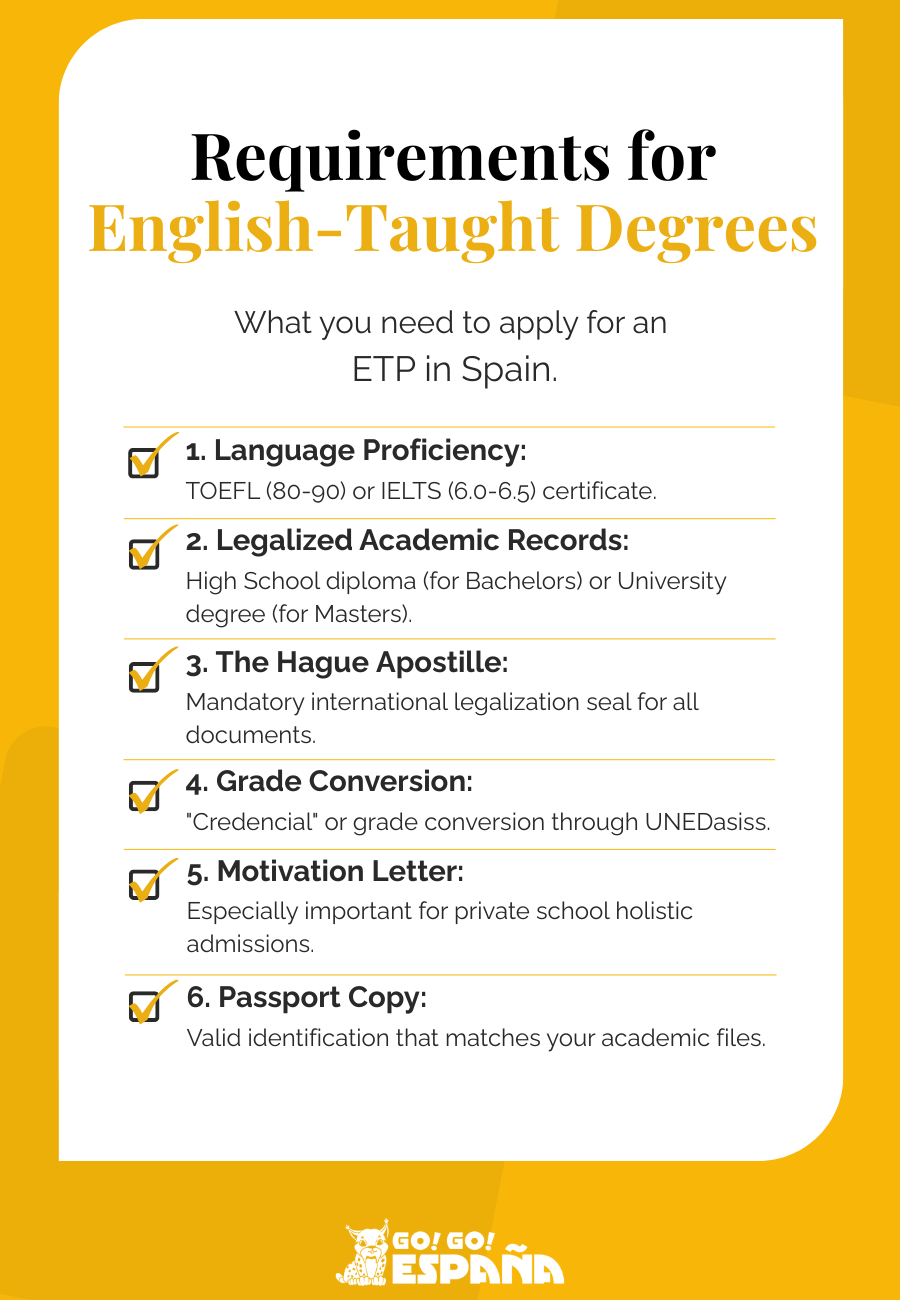
To study in English in Spain, you generally need proof of language proficiency and your legalized academic records.
The requirements vary slightly between public and private institutions, but the core documents remain the same.
- Language Proficiency: If you are not a native speaker, you will need an official certificate.
- TOEFL: Usually a minimum score of 80-90 (iBT).
- IELTS: Usually a minimum score of 6.0 – 6.5.
- Note: Some private universities have their own internal language tests.
- Academic Records:
- For Bachelor’s: Your High School Diploma and transcripts (legalized/apostilled).
- For Master’s: Your Bachelor’s Degree certificate and transcripts.
- Entrance Exams (Selectividad/PCE):
- Public Universities: For public universities, you cannot just apply directly. You must go through UNEDasiss, the centralized system that converts your high school grades into the Spanish scale (0–10).
- For EU/IB Students: You usually only need the “Credencial” (grade conversion).
- For Non-EU Students: You may need to take the PCE (Pruebas de Competencias Específicas). These are specific subject exams (like Math or History) that can boost your score from a maximum of 10 up to 14.
- Private Universities: Often do not require the PCE exams. They rely on their own admission tests and your high school GPA.
Career pathways for English speakers
Career Pathways for English Speakers Who Graduates from English-Taught Universities in Spain

Graduating from a Spanish university can be your launchpad into the European labor market, especially if you target the right industries.
Many international students worry that their degree will be useless if they don’t speak fluent Spanish by graduation. While speaking Spanish is a huge asset, it is not the only path to a career. Spain’s economy is modernizing rapidly, and specific sectors are hungry for English-speaking talent.
- Tech and Startups (The “Barcelona Hub”): Barcelona and Madrid are two of Europe’s top startup ecosystems. Tech companies here operate in English. Roles in Data Science, Digital Marketing, and Software Engineering often require English as the primary working language.
- Multinational Corporations: Large global companies with headquarters in Madrid (like Amazon, Google, or Deloitte) recruit heavily from top business schools. They value the “global mindset” of international graduates.
- Tourism and Hospitality: As one of the world’s most visited countries, Spain needs management-level professionals who can cater to international clientele.
- The “Startup Law” Advantage: Spain recently introduced the “Startup Law,” which makes it easier for international students to stay and work after graduation. It also offers specific visas for “Digital Nomads,” allowing you to work remotely for foreign companies while living in Spain.
- The “Job Search Visa” (Busqueda de Empleo): Upon graduating from an official Bachelor’s or Master’s program in Spain, you can apply for a residency permit specifically to look for a job or start a business. This allows you to stay in Spain for up to 12 months (and in some cases 24 months) after graduation to secure a work sponsorship, removing the pressure to find a job immediately upon finishing exams.
Did You Know?
Many of our partner schools, like EU Business School and ESIC, have dedicated Career Services departments that organize job fairs specifically for international students, connecting you with companies that hire in English.
English-only employment in Spain
Can I work in Spain if I only speak English?
It is harder, but possible. The student visa allows you to work up to 30 hours per week. Jobs for English speakers are most common in tech, teaching, tourism, and multinational customer support.
Recent immigration reforms and the Startups Law expand work opportunities for foreign graduates and introduce teleworking/digital-nomad options; student visas now permit part-time work (up to 30 hours/week) provided the activity is compatible with studies, see the official Spanish immigration guidance for details.
FAQ
FAQ About Studying in English in Spain
- Is university in Spain free for international students?
No, university is not free. Public universities are generally quite affordable, typically costing between €700 and €1,000 per year for EU citizens.. Private universities range from €8,000 to €25,000 per year. It is important to note that tuition fees for non-EU students typically cost more, usually ranging between €2,700 and €9,000+ for public universities and from €9,000 to €25,000+ for private universities (Study.eu, 2026). - Do I need to speak Spanish to live in Spain?
You can survive in major cities like Madrid and Barcelona with just English, but daily bureaucracy and social life are much easier if you speak basic Spanish. We highly recommend taking a Spanish course alongside your degree. - Are degrees from Spain recognized in the USA or UK?
Yes. “Official Degrees” (Grado Oficial) are recognized across the European Union and globally. Private degrees (Título Propio) are highly respected in the labor market but may not always qualify you for government jobs or PhD programs in other countries. - What is the best city to study in English-taught universities in Spain?
Madrid and Barcelona have the highest concentration of English-taught programs and international jobs. Valencia is a fantastic third option with a lower cost of living.
Summary
In Summary: English Universities in Spain for International Students
You can choose from over 800 English-taught degrees in Spain, ranging from Business and Tech to Design and Engineering.
Public universities offer low tuition but high entry barriers. Private universities offer higher tuition but easier access, smaller classes, and better English support.
Our partners like EU Business School and U-tad are designed to get you hired, often providing better networking opportunities for international students than traditional public schools.
Studying in English doesn’t mean ignoring Spanish. It’s the perfect safety net while you learn the local language through immersion.