 Skip to content
Home - Spanish Universities Guide - Spanish Public University Preparation
Spanish Public University Preparation: Guide for International Students
Prepare for Spanish public university. Learn about PCE, B2 Spanish, Homologation, and strategies to secure a public university spot.

Spanish public university preparation is a 360-degree strategic process that requires a delicate balance of linguistic mastery, academic rigor, and administrative precision. For international students, moving from a foreign secondary school to a Spanish public university is not a single step, but a “transitional” journey, usually over the course of a year.
This guide serves as your strategic master map, designed to be used alongside our Complete Guide to Spanish Universities to ensure a seamless entry into one of Europe’s most respected higher education systems.
(Last Updated: July 2026)
Key Takeaways
- The Three-Pillar Framework: Successful Spanish public university preparation is holistic: Language, Academic, and Administrative. Minor errors in areas like B2 Spanish certification or high school diploma homologation will completely block university registration.
- University Preparation Program Types: Select foundation years (university-based), private pathways, or intensive courses based on your aims. Private pathways are optimized for international students to maximize PCE scores and navigate the Homologación process.
- Essential Documentation: Secure your Hague Apostille and certified translations for high school transcripts before arriving in Spain. You must obtain the “Volante de Inscripción condicional” to apply for university spots while your final diploma recognition is being processed.
- The Strategy of 14: Boost your admission score toward the 14-point maximum by combining your 60% GPA with 40% PCE scores and 0.2 subject multipliers. Strategic elective choice is crucial for entry into competitive programs like Medicine or Engineering.
- Academy Success Rates: Specialized in-person academies offer up to a 40% higher success rate than independent study, by providing structured syllabi and administrative support. They are essential for navigating the recent shift towards analytical and problem-solving exam formats.
- Academic Language Mastery: Many Spanish-taught or bilingual programs require a B2 certificate (DELE/SIELE) , but the rule depends on the degree and university.
- Financial ROI and Rights: Preparation tuition is a high-return investment. Non-EU students can also use a 30-hour weekly work permit for financial support.
How to prepare for Spanish public universities?
What is the Best Way to Prepare for Public University in Spain?
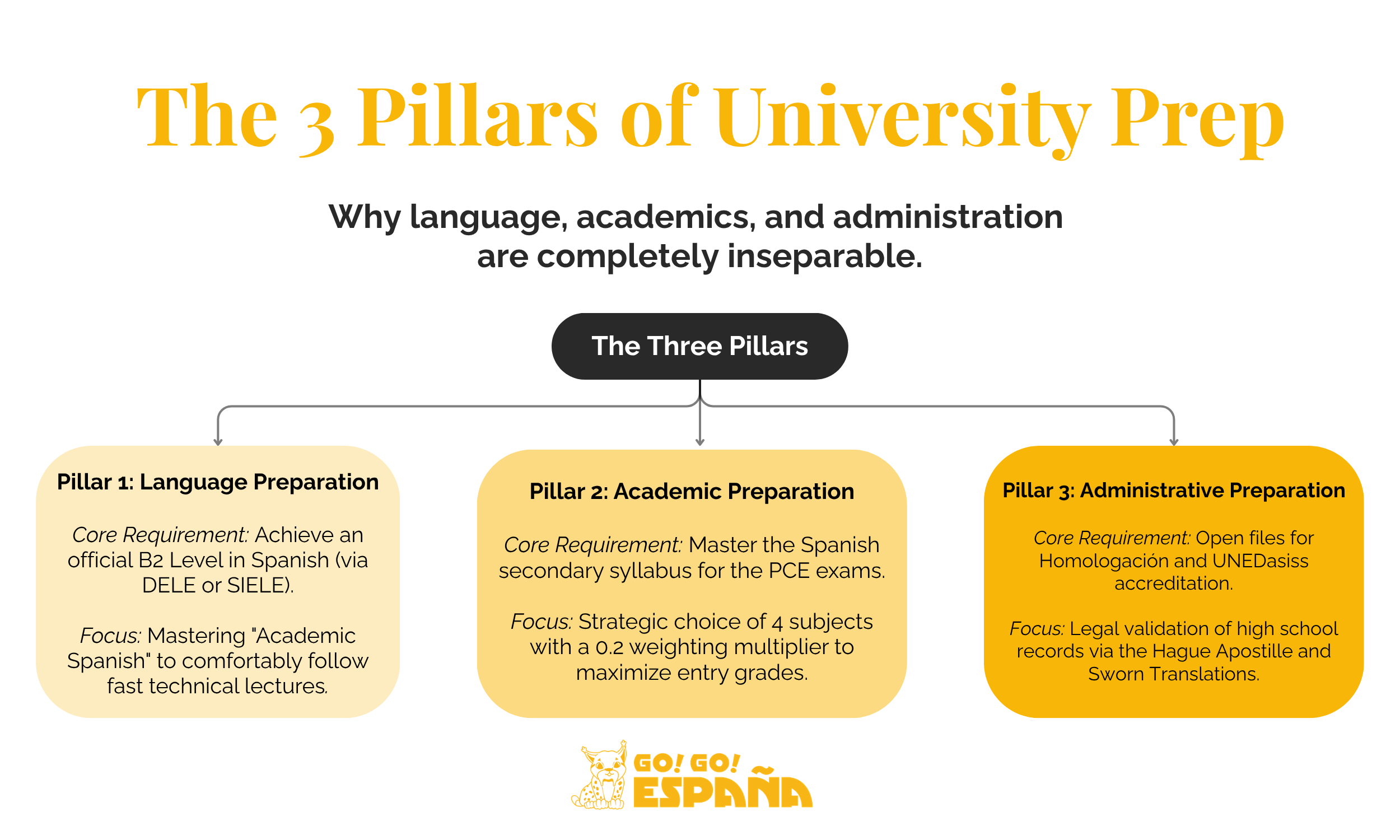
The most effective way to prepare for public university in Spain is to follow a holistic “Three Pillar” framework that integrates language proficiency, academic subject mastery, and administrative legal validation.
Relying on high school grades alone is rarely enough for competitive degrees; success depends on how well you manage these three core areas:
| Category | Requirement/Focus | Key Test/Process |
| Language Preparation | Achieving a B2 level in Spanish | DELE or SIELE |
| Academic Preparation | Mastering the specific Spanish syllabus for entrance exams | PCE (Pruebas de Competencias Específicas) |
| Administrative Preparation | Legal recognition of foreign high school diploma | Homologation and UNEDasiss application |
| Legal requirement for Non-EU students to study in Spain | Student Visa |
1. Language Preparation
The first and most critical step is achieving a B2 level of Spanish, as this serves as your official “license” to study in the country.
Most public universities will not consider your application without a certified B2 certificate from an official exam like the DELE or SIELE.
Beyond the certificate, language preparation is about gaining “Academic Spanish” skills, providing you with the ability to understand technical lectures and write analytical essays in a university setting. Without this foundation, you will struggle to pass the subject-specific entrance exams.
2. Academic Preparation
Academic preparation involves mastering the specific Spanish syllabus for the PCE (Pruebas de Competencias Específicas) to maximize your admission grade.
Unlike general high school tests, these exams are competency-based and require you to apply critical thinking to subjects like Mathematics, Biology, or Business Economics.
This is where you utilize regional weighting tables to strategically select subjects that offer a 0.2 multiplier, allowing you to raise your admission score from a base of 10 to a maximum of 14 points.
3. Administrative Preparation
Administrative preparation is the process of legally validating your foreign education and navigating the university application portals.
Legal recognition of foreign high school diploma
This involves two major hurdles: the Homologación (the official recognition of your high school diploma by the Spanish Ministry of Education), and the UNEDasiss accreditation (the access/accreditation route used for public university admission and score calculation).
During this stage, you must secure your Hague Apostille and obtain the Volante de Inscripción Condicional, which allows you to apply for university spots in the summer even while your final diploma recognition is still being processed.
Did You Know?
You cannot have a successful university preparation for Spain without all three pillars. If you skip the language part, you won’t understand the PCE exams; if you skip the PCE, you can’t get into a public university; and if you skip the administration, the university is legally prohibited from enrolling you.
Student Visa requirements for Non-EU students
For Non-EU students, obtaining a Student Visa is a key final step before beginning your studies in Spain. This process typically includes confirming your university acceptance, proving financial means, securing health insurance, and preparing the required legal documentation. As visa processing times can vary, early preparation is essential to ensure a smooth transition to studying and living in Spain. For an in-depth explanation on how to apply for a Spanish student visa, explore our full step-by-step guide for international students.
Spanish university preparation roadmap
Step-by-step Preparation Roadmap for Public University in Spain
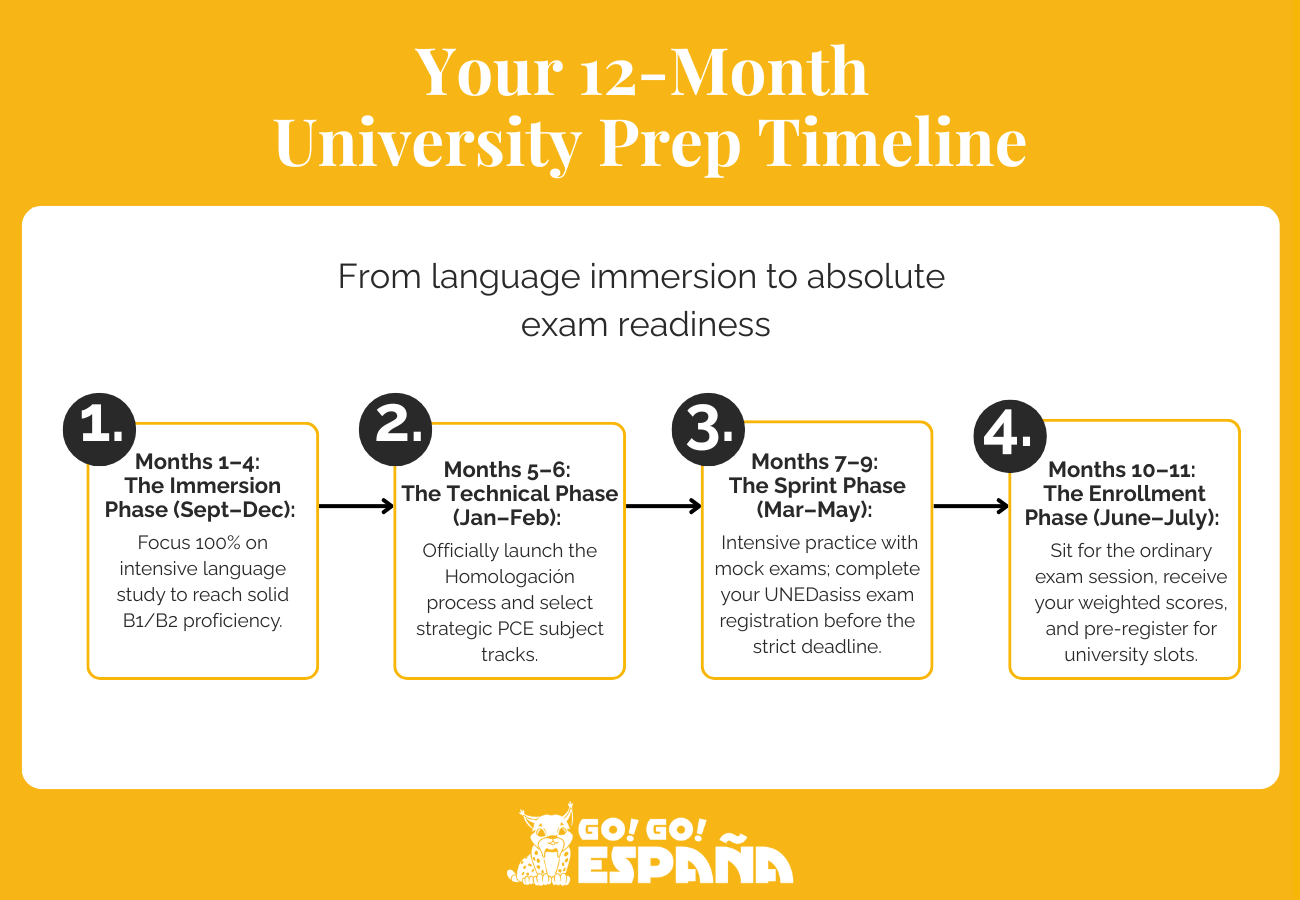
A successful university preparation timeline typically spans 10 to 12 months, allowing students to transition from language immersion to intensive subject-specific study.
Given the latest competency shift in exams, which now prioritize critical thinking and application over note memorization, having a structured roadmap is essential to manage deadlines and stress.
- Step 1: The Immersion Phase (September–December): Your primary goal is to reach a B1/B2 Spanish level. This is the time to plan your Spanish language study in Spain easily to ensure you are ready for academic subjects.
- Step 2: The Technical Phase (January–February): Start the Homologación process with the Ministry of Education and begin selecting your PCE subjects based on your target degree. The UNEDasiss application portal typically opens in late February.
- Step 3: The Sprint Phase (March–May): Transition into intensive PCE preparation. This is when you practice with mock exams and master the specific question formats used by UNEDasiss. Also, finalize your UNEDasiss exam registration before the strict early May cutoff.
- Step 4: The Enrollment Phase (June–July): Sit for the Convocatoria Ordinaria (Ordinary Exam Session) in late May or early June. Receive your final UNEDasiss accreditation by late June, just in time for the regional university pre-registration windows in July. Because missing these submission windows means waiting an entire year, consult our guide to Spanish university application deadlines to keep your schedule on track.
Required documents for public university preparations
What Documents do I Need for Spanish Public University Preparation?

To begin a public university preparation program and initiate the legal validation of your studies, you must prepare a specific dossier of academic and legalized documents.
These documents are the essential materials your preparation academy will use to manage your Homologación and UNEDasiss accreditation. To avoid delays in your pathway, you should secure the following:
- Official High School Transcripts: Original records covering the final three years of your secondary education.
- High School Diploma: Your official graduation certificate or proof of degree completion.
- The Hague Apostille: A mandatory international authentication stamp that must be applied to your original transcripts and diploma in your home country.
- Certified Spanish Translations: All academic documents must be translated by a Traductor Jurado (Sworn Translator) recognized by the Spanish Ministry of Foreign Affairs.
- Proof of Identity: A valid passport (for non-EU students), or a national ID card (for EU citizens).
- The Volante de Inscripción Condicional: This is the provisional receipt generated once you apply for degree recognition. It is the most critical document during your prep year, as it allows you to register for the PCE exams and pre-enroll in universities while your final Homologación is pending. To learn how to request and use this provisional document, see our Volante de Inscripción Condicional guide.
- Student Visa (For Non-EU Students): If your prep program is longer than 90 days, you must apply for a Student Visa. Once in Spain, you will have 30 days to apply for your TIE (Tarjeta de Identidad de Extranjero), which serves as your physical residency card.
Did You Know?
The Hague Apostille must be obtained in the country where your documents were issued. If you arrive in Spain without this stamp, you may be forced to mail your original transcripts back home to be legalized, which can take weeks and potentially cause you to miss the strict UNEDasiss exam registration deadlines.
The 14-point admission score in Spain
How to Maximize the 14-point Admission Score in Spain?
To reach the maximum 14-point admission grade required for competitive degrees like Medicine or Engineering, you must strategically take elective PCE exams that add bonus points to your 10-point base score.
In Spain, public university entrance is not calculated out of 10, but out of 14; understanding how to earn these extra 4 points is the most critical part of your academic preparation.
- The 10-Point Base: Your admission grade is calculated using a formula where your High School GPA counts for 60% and your compulsory PCE exams count for 40%.
- The 4-Point Bonus: You can earn up to 4 extra points by taking elective PCE subjects that have a 0.2 weighting (multiplier) for your specific degree.
- Weighting Tables: These regional tables are your most important research tool. Choosing the right “weighted” subjects can effectively inflate a modest GPA into a competitive entry score.
For a complete look at the mathematical formula and regional multipliers, check out our Spanish university grading system 14-point guide.
Official formula for computing the Admission Grade in Spain
Admission grade = 0.6 × NMB + 0.4 × compulsory phase grade + a × M1 + b × M2
where a and b are 0.1 or 0.2, depending on the degree’s weighting table.
UNEDasiss allows up to 6 PCE subjects; for the first application it recommends at least 4 subjects for non-EU students and at least 2 weighted subjects for EU/agreement students.
Example of the 14-Point Formula in Action
Let’s say you are applying for Medicine (which often requires a 13.0+ score) and your converted High School GPA + compulsory exams gives you an 8.5 out of 10.
- Subject 1 (Biology): You score a 9/10. Because Biology is heavily related to Medicine, the university applies a 0.2 multiplier (9 x 0.2 = 1.8 points).
- Subject 2 (Chemistry): You score an 8/10. It also has a 0.2 multiplier (8 x 0.2 = 1.6 points).
- Total Admission Score: 8.5 (Base) + 1.8 (Biology) + 1.6 (Chemistry) = 11.9 out of 14.
Did You Know?
Weighting multipliers are decentralized and vary by region. A subject that gives you a 0.2 bonus at a public university in Madrid might only give you a 0.1 bonus for the same degree in Valencia. Checking the specific weighting tables for your target region is essential before you register for your PCE exams.
Spanish public university programs
What are the Spanish Public University Preparation Programs?

Spanish university preparation programs, often called “Foundation Years” or “University Pathway Programs,” are structured academic courses designed to bridge the gap between your home country’s high school diploma and the Spanish university system.
These programs are not a one-size-fits-all; they are tailored based on your current Spanish level and your target degree. Most reputable programs in Spain fall into one of these three categories:
- University-Based Foundation Years: Often hosted by specific universities (mostly private or prestigious public ones like UC3M and UCM), these programs grant you “provisional student” status. They focus on academic Spanish and introductory subjects related to your future degree.
- University Pathway Programs: These are the most common for international students. They are hosted by specialized academies and focus intensely on the PCE (Pruebas de Competencias Específicas). They provide the most robust administrative support for Homologación and subject weighting strategy. Explore our partner College Preparatory Schools in Spain, that will help you pass the exams needed to enroll in a public university in Spain. Or review our guide to Spanish university pathway programs to select a course that fits your language level and study timeline.
- Subject-Specific Intensive Courses: These are shorter, 3-to-5 month programs for students who already have a B2 level of Spanish but need to master the Spanish Bachillerato syllabus for subjects like Business Economics, Biology, or Mathematics.
Did You Know?
A “Pathway” program is specifically designed to guarantee that you meet the minimum entry requirements for your chosen field. Most of our partner schools include full time Spanish courses first and then full time PCE exams prep.
Preparatory schools in Spain
Should I Use a Preparatory School in Spain or an Online Preparatory Course?

Specialized preparatory schools in Spain provide a significant competitive advantage, offering structured syllabi, the latest competency-based exams and administrative support that independent study cannot match.
When evaluating “value for money” in Spanish public university preparation programs, students generally choose between two paths:
- Preparatory Academies (In-Person): These schools offer the highest success rates. They provide face-to-face tutoring, help with the Homologación paperwork, and a focused environment that mitigates culture shock in Spain.
- Online Courses & Independent Study: While more affordable, online preparatory courses require extreme self-discipline. It is best suited for students who already have a high level of Spanish and a strong grasp of the Spanish secondary curriculum. This option is most common for students who prefer to take the PCE in their home country, and already have a high enough level of Spanish.
To compare top institutions across Madrid, Barcelona, and Valencia, view our preparatory schools in Spain guide.
Did You Know?
Professional admissions consulting can help you navigate the “Competency Shift.” The latest PCE exams move away from simple multiple-choice questions toward analytical essays and problem-solving, making expert coaching more valuable than ever.
Required academic skills
What Academic Spanish Skills Do I Need?
Developing “Academic Spanish” is a distinct skill set that involves mastering technical vocabulary and analytical writing beyond conversational fluency.
Even if you are comfortable speaking on the street, university-level success requires the ability to argue a thesis in History or solve complex problems in Physics using Spanish terminology.
- DELE vs. SIELE: Most universities require a B2 certificate. You should compare the DELE and SIELE exams to see which format suits your testing style and timeline better.
- Critical Writing: Start practicing essay structures early. The Spanish system values a specific style of formal academic presentation that differs from the US or UK systems.
Read our detailed breakdown of Spanish university language requirements for B2 proficiency to see which certifications your target school accepts.
Cost of public university preparation
How Much Does Public University Preparation Cost?
Spanish university preparation is a high-return investment that unlocks access to an affordable public university system where tuition is significantly lower than in many other global study hubs.
Here is a realistic breakdown of what to expect:
Expense Category | Estimated Cost (EUR) | Description |
Preparation Academy (In-Person) | €3,500 – €6,500 | Varies based on program length (5 to 9 months) and included administrative support. |
Administrative Fees | €150 – €300 | UNEDasiss exam registration, Homologación fees, and sworn translations. |
By spending a year in a prep program, you are effectively “buying” your way into a lower-cost degree later.
- Tuition and Costs: While the prep year has an upfront cost, the eventual cost of studying in Spain at a public institution is a fraction of private university fees.
- Legal Work Rights: International students in Spain have the right to a 30-hour student work permit. This allows you to integrate into the local economy and earn an income while you complete your studies. Learn more about how to find work as a student. Students who are only attending a preparatory school, are required to submit an additional application for a work permit, which requires the assistance of an employer.
We can help you prepare for universities in Spain
How can Go! Go! España Help with Your Public University Preparation?
Go! Go! España acts as your professional navigator through the Spanish educational system, providing free expert support to help you select the right preparation program and successfully secure a university spot.
Since 2016, we have helped thousands of international students move from the initial planning stages to their first day of university. Our partnership with over 100 accredited schools and universities allows us to offer a streamlined approach to your success:
- Strategic Academy Placement: We analyze your academic goals and current Spanish level to place you in the specialized preparatory academy that best fits your target degree, whether you need an intensive 5-month PCE course or a year-long foundation program.
- Expert Administrative Guidance: Our team provides clarity on the “Bureaucratic Gateway,” helping you to ensure no deadlines are missed.
- Access to Partner Universities: We connect you with top-tier partner institutions in Madrid, Barcelona, Valencia, and beyond, ensuring your preparatory credits and language levels are recognized by the best schools in the country.
- Holistic Life Support: Beyond the classroom, we assist with the logistical hurdles that cause the most anxiety, including finding student accommodation in Spain, securing health insurance, and navigating the student visa application process and all required paperwork that needs to be done once you are in Spain.
FAQ
FAQs About Spanish Public University Preparations
- What does “college preparation” mean in the Spanish context?
Spain’s college preparation is a strategic transition year for international students to align with the Spanish system. It’s a holistic process covering B2 Spanish proficiency, PCE (Selectividad) entrance exam preparation, and high school diploma validation (homologation). - Do I need to learn Spanish before I start my degree?
Most Spanish public universities require a certified B2 Spanish level for admission, though some private ones offer English degrees. Even for English programs, a preparatory year is highly recommended for cultural integration and navigating the complex Spanish administrative system, and ultimately the PCE tests will be in Spanish. - What is the difference between a language school and a university prep academy? Language schools prioritize conversational Spanish and DELE/SIELE exam preparation. University prep academies provide an academic setting, combining intensive Spanish with tutoring for PCE subjects (e.g.: Business Economics, Biology, Math) and specific UNEDasiss application support. Some language schools are associated with prep academies to offer pathway programs that combine language and PCE exam prep programs.
- How do I choose the right Spanish prep program for my goals?
Select your university prep course based on Spanish level and target degree. Beginners need a “Combined Pathway” (Spanish immersion then academics). B2-level students should choose an intensive, subject-focused course emphasizing the “Strategy of 14” and regional weighting tables. - What are the best online courses for university preparation in Spain?
The best online university preparation programs feature live virtual classes, latest competency-based PCE materials, and UNEDasiss portal administrative support. However, these flexible online options demand more self-discipline than a structured, immersive in-person academy. Check out our online option. - Can I study for the PCE entrance exams by myself?
Independent PCE study is risky due to the lack of an official textbook. Most successful students use specialized academies to master the specific 90-minute exam techniques and critical problem-solving skills needed for the 2026 format. - Will my Spanish university degree be recognized in my home country?
Spanish degrees are part of the EHEA, granting full recognition across 49 countries and high respect from global employers. For US, Japanese, or UK students, a top Spanish university degree offers a unique international profile and bilingual edge, boosting career prospects back home.
Summary
In Summary: Preparing for Public University Admission in Spain
Mastering the pathway to a degree in Spain requires a dedicated commitment to Spanish public university preparation that balances language mastery, academic rigor, and administrative precision.
By following the 12-month success roadmap and utilizing the “Strategy of 14,” you transform a complex bureaucratic process into a clear route toward your chosen field of study.
This preparatory year is not just a requirement; it is the essential foundation for academic excellence and long-term integration into the Spanish university environment.
Ready to start your journey? Contact our expert team today to find the perfect public university preparation program tailored to your goals.
Learn more about the first critical step of your administrative preparation in our next guide: The Volante de Inscripción.