 Skip to content



Master the 0–10 academic scale and the 14-point admission formula to maximize your Spanish university entrance score.
Mastering the Spanish university grading system is the most important tactical step for any international student. Unlike many systems that use a simple 4.0 GPA or percentage, Spain uses a dual-layered framework: a 0–10 scale for academic classes and a 0–14 scale for university entrance.
Understanding how these two scales interact, and how to “hack” the math to your advantage, is the key to securing a spot in Spain’s most competitive programs.
Key Takeaways
- Academic Grading Standards (0–10): Spanish grading is historically conservative, using a 0–10 scale where a 10.0 is an exceptional rarity. A 5.0 is the strict passing threshold, subsequently meaning that a 4.9 is considered a failure.
- ECTS and GPA Mechanics: One ECTS credit represents 25–30 hours of total work, with 60 credits constituting a full-time academic year. Your overall GPA (nota media) is a weighted average where core subjects with higher credit values have a larger impact.
- The 14-Point Admission Leap: For competitive undergraduate entry, Spain uses a 14-point scale that adds bonus points to a 10-point baseline. This score is mathematically calculated using your high school record and PCE exam performance.
- Weighting Multipliers (0.1 vs 0.2): Universities multiply PCE scores by 0.1 or 0.2 based on how relevant the subject is to the chosen degree. Choosing 0.2-weighted subjects is the “gold standard” for reaching high-demand programs like Medicine or Engineering.
- Knowledge Area Strategy: Weightings are organized into specific itineraries like Health Sciences or Engineering. A subject like Mathematics II may be weighted at 0.2 for Tech degrees but only 0.1 for Humanities.
- The “Double Counting” Advantage: This rule allows a 0.2-weighted PCE exam to count toward both the 10-point baseline and the 4-point bonus. A single perfect exam score can effectively contribute 3.0 total points to your final admission grade.
- Postgraduate Admission Criteria: Master’s and PhD admissions return to the 10-point scale and use a more holistic evaluation. International students must obtain an official “Declaration of Equivalence” to convert their foreign GPA for fair competition.
Table of Contents
Understanding the Spanish University Grading Scale (0–10)

The foundational 0–10 academic scale evaluates every exam, assignment, and thesis grade issued inside a Spanish classroom framework.
The Spanish university admission system is governed by national education laws and regulated through frameworks such as the EBAU (Evaluación de Bachillerato para el Acceso a la Universidad) and the accreditation process managed by UNEDasiss.
While universities have some regional autonomy, the core structure of the 0–10 grading scale and the 14-point admission formula is standardized across Spain under national higher education regulations.
This means that although weighting tables may vary slightly between regions, the mathematical structure of the admission system is consistent nationwide.
Further Reading: Read our UNEDassiss accreditation guide.
How the Spanish Grading Scale Compares to the US System?
The primary difference is academic “conservatism.” In the US, a 90% or higher is a common target for top students. In Spain, a 10.0 (Sobresaliente) is exceptionally rare and reserved for the absolute top tier of the class.
| Spanish Numerical Grade | Spanish Classification | US Letter Grade Equivalent | US GPA Value (4.0 Scale) |
| 10.00 | Matrícula de Honor | A+ | 4.00 |
| 9.00 – 9.90 | Sobresaliente | A | 3.70 – 4.00 |
| 7.00 – 8.90 | Notable | B+ / A- | 3.00 – 3.70 |
| 5.00 – 6.90 | Aprobado (High) | B | 2.50 – 2.99 |
| 0.0 – 4.9 | Suspenso (Fail) | F | 0.0 |
What is the Typical Passing Score in a Spanish University Course?
In the Spanish higher education system, the threshold for passing is strictly set at 5.0 out of 10.0. This grade is officially termed an Aprobado, signifying that the student has met the minimum learning objectives required for the course.
Key Rules of the Spanish Passing Grade:
- Strict Decimals: Grades are calculated with high precision. Because of this, a score of 4.9 is a failure; there is no “rounding up” to a 5.0.
- Consequences of Failure: If you score below the 5.0 threshold, you must retake the examination or the entire module in a subsequent call (convocatoria).
- Discipline Variance: In STEM (Science, Technology, Engineering, and Mathematics) fields, grades frequently cluster between 5.0 and 6.5. Achieving a 9.0+ is mathematically difficult and often reserved for only a tiny fraction of the class.
In Spanish academic culture, a 5.0 is considered a respectable achievement. In many rigorous degrees with high failure rates, it is common for only 20% to 30% of the class to pass in a given semester, making any passing grade a sign of academic sufficiency.
Warning: In Spain, a 4.9 is not a 5.0. Prepare for a system where every decimal point counts toward your academic standing.
What is the Meaning of “Matrícula de Honor” in the Spanish University Grading System?
The most prestigious grade in Spain is the Matrícula de Honor. This is awarded to students who achieve a 10.0, but it is legally capped at 5% of the students in a class.
The reward is significant: if you earn one, the corresponding credits are free of charge in the following academic year.
How do ECTS Credits Integrate with the Spanish University Grading Scale?
While the 0–10 scale measures the quality of your work, the ECTS (European Credit Transfer and Accumulation System) measures the quantity. It is the standard used across Spain to track the total workload required to pass a subject.
Understanding the ECTS Workload
Unlike systems that count only classroom hours, ECTS encompasses lectures, seminars, independent study, and examinations.
- Credit Value: One ECTS credit corresponds to approximately 25 to 30 hours of total work.
- Full-Time Study: A standard academic year in Spain consists of 60 ECTS credits.
- Degree Requirements: * Grado (Bachelor): 240 ECTS (typically 4 years).
- Máster (Master): 60 to 120 ECTS (1 to 2 years).
Calculating Your “Nota Media” (GPA)
The integration of ECTS credits and the 0–10 grading scale determines your overall academic standing, known as the nota media.
The nota media is a weighted average: each numerical grade is multiplied by the number of credits for that subject, and the total sum is divided by the total number of credits earned.
This ensures that a 12-credit core subject has a significantly higher impact on your record than a 3-credit elective.
The ECTS Statistical Distribution (A–F Scale)
To facilitate international mobility and help foreign institutions understand a student’s standing, Spain uses the ECTS statistical scale. This scale shows how your grade compares to other students who passed the same course.
| ECTS Grade | Classification | Statistical Distribution |
| A | Excellent | Top 10% of passing students |
| B | Very Good | Next 25% of passing students |
| C | Good | Next 30% of passing students |
| D | Satisfactory | Next 25% of passing students |
| E | Sufficient | Final 10% of passing students |
| F | Fail | Students who did not meet the 5.0 threshold |
What is the Grade Weighting in Spain’s Grading System (0–14 Scale)
When you apply for university, your 10-point GPA isn’t enough for degrees like Medicine or Law. You need the 14-point Admission Grade as part of your overall public Spanish university preparation. However, it is important to distinguish between the two separate components of your final score.
What Is The Difference Between The “Access Grade” And The “Admission Grade”?
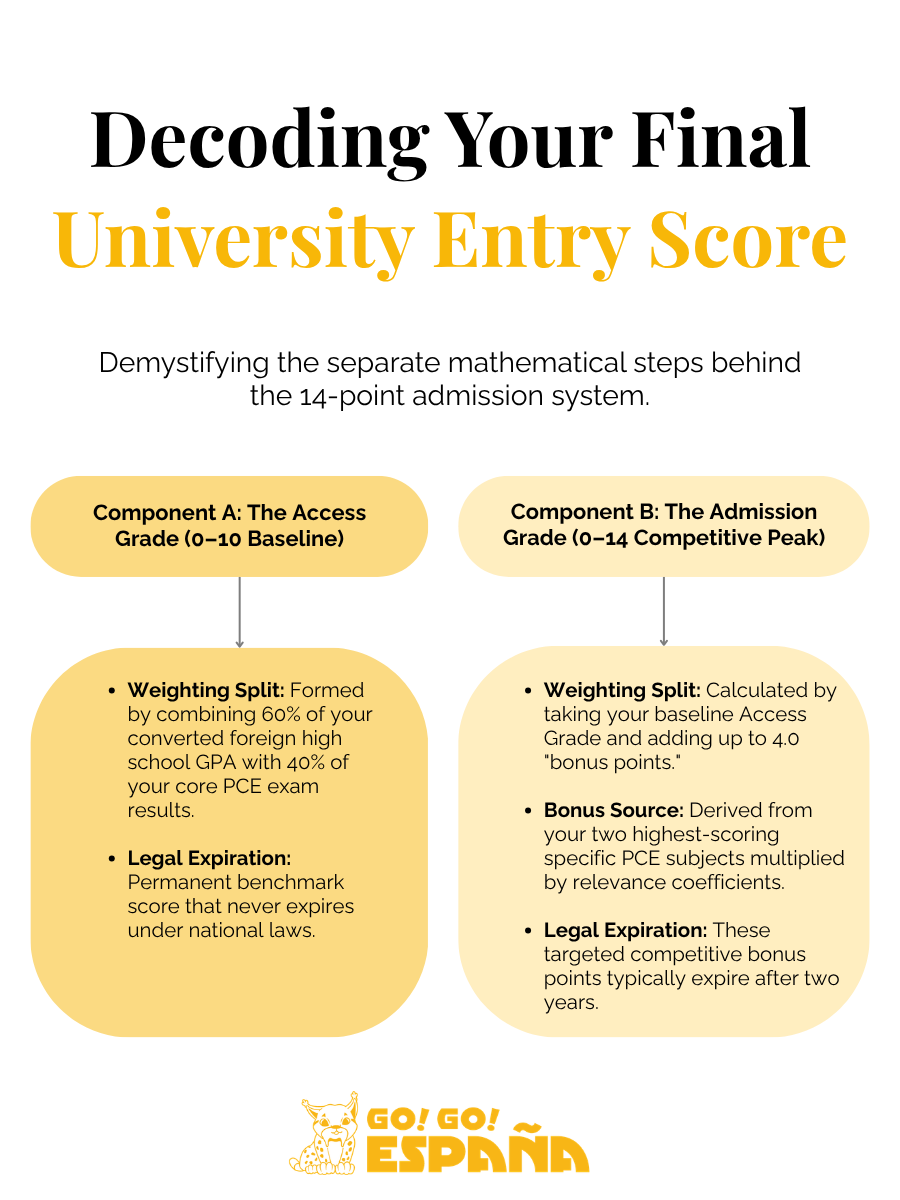
Before looking at the math, you must distinguish between the two separate components of your final entry score:
- Access Grade (0–10): This is your permanent baseline score. It is calculated by combining your converted high school GPA (60%) and your core PCE exam results (40%). Importantly, this score never expires. Read our guide on the Pruebas de Competencias Especificas (PCE).
- Admission Grade (0–14): This is your final competitive score for a specific degree. It is calculated by taking your baseline Access Grade and adding “bonus points” (up to 4.0) from your two best-performing specific PCE subjects. Unlike the Access Grade, the bonus points usually expire after two years.
Weighting Coefficients: The 0.1 vs. 0.2 Multiplier Effect
The most critical technical component of the 14-point system is the “weighting coefficient.” These multipliers (0.1 or 0.2) determine exactly how much a specific PCE subject boosts your final admission score for a particular degree.
| Weighting Coefficient | Degree Relevance | Points Earned (Score of 8.0) | Strategic Value |
| 0.2 | High (e.g., Biology for Medicine) | 1.6 Points | Essential for reaching high cut-off marks. |
| 0.1 | Moderate (e.g., Physics for Psychology) | 0.8 Points | Only use if a 0.2 subject is not available. |
| 0.0 | None (e.g., Art History for Engineering) | 0.0 Points | Does not contribute to the 4-point bonus. |
What is a 0.2 Weighting? (Highly Relevant)
These subjects are considered “highly relevant” to your chosen career path. A 0.2 weighting is the “gold standard” for reaching competitive cut-off marks because it doubles the subject’s impact on your score.
- Example: For a degree in Medicine, Biology and Chemistry are traditionally weighted at 0.2.
- The Math: If you score an 8.0 in Biology, you gain 1.6 points (8.0 x 0.2) toward your final grade. Since you can use two such subjects, this is the most efficient way to reach the 14-point maximum.
What is a 0.1 Weighting? (Moderate Relationship)
A 0.1 weighting is assigned to subjects that have only a “moderate” relationship with the degree.
- Example: Physics might be weighted at 0.1 for a Psychology degree.
- The Math: In this case, an 8.0 in Physics would only add 0.8 points (8.0 x 0.1). Choosing a 0.1 subject over a 0.2 subject effectively halves the potential points you can earn, making it a less efficient strategy for high-demand programs.
What is a 0.0 Weighting? (No Relevance)
If a subject is listed with a 0.0 weighting (or not listed at all), it means it has no relevance to that specific degree. While you can take the exam for your own interest or to help reach the initial 10-point “Access Grade,” that subject will contribute zero points to the bonus 4-point “Admission Grade.”
Pro Tip: By focusing on subjects with a 0.2 weighting, you ensure that every hour of study delivers the maximum possible return for your university admission grade.
How Do Weightings Vary by Field of Study?

Weighting differences are not random; they reflect how well your preparation matches the demands of your degree.
Universities organize these into “Knowledge Areas” or itineraries to ensure students have the right foundational skills.
| Knowledge Area | Typical 0.2 Weighted Subjects | Targeted Degrees |
| Health Sciences | Biology, Chemistry, Physics, Mathematics II | Medicine, Nursing, Pharmacy |
| Engineering & Tech | Mathematics II, Physics, Technical Drawing | Software, Civil, Mechanical Engineering |
| Social Sciences | Applied Math, Economics, Geography | Law, Business, Sociology |
| Humanities | Latin II, Art History, Philosophy, Greek | History, Languages, Translation |
The Role of Core Subjects
A subject’s value changes depending on your destination. For example:
- Mathematics II (Pure Math): This is a universal 0.2 “must” for Engineering and Science, but it may drop to a 0.1 for Humanities.
- Latin II: This is essential (0.2) for a Classics or Philosophy degree, but usually carries zero weight (0.0) for Engineering.
Pro Tip: It is important to check the specific “Weighting Tables” for the region where you plan to study. Because Spanish universities have regional autonomy, the University of Valencia might weigh a specific language or elective differently than the University of Seville, even for the exact same degree. For example, universities in regions like Catalonia and Andalusia may assign slightly different weightings to subjects such as Mathematics Applied to Social Sciences or foreign languages.
What Is The “Double Counting” Rule And How Does It Work?
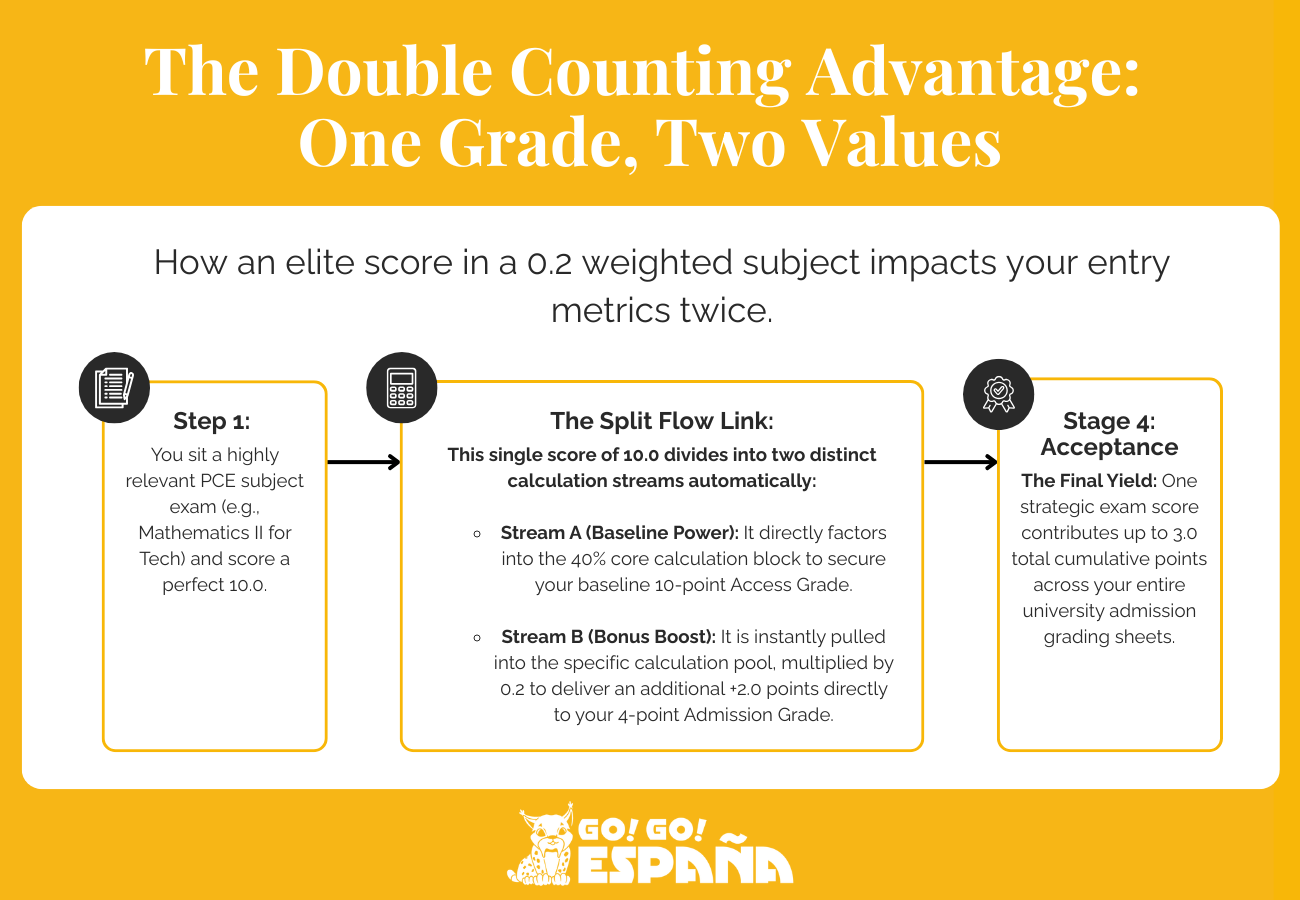
This is not a loophole, but a structural feature of the system that rewards strategic subject selection in the Spanish university grading system.
If you take a PCE subject that is weighted at 0.2 for your degree, that single grade is used twice:
- It counts toward your baseline 10-point Access Grade.
- It is used again as a bonus subject for the 4-point Admission Grade.
The Result: A perfect 10.0 in a 0.2 subject can contribute up to 3.0 points when combined across baseline and bonus components.
The Official Formula of the University Grading System in Spain
Once you have selected your subjects and received your grades, UNEDasiss applies the following university grading system to calculate your final competitive score:
Admission Grade = (0.2 x NMB + 4) + 0.1 ∑Mcore + (a x M1) + (b x M2)
Where:
- NMB: Your high school GPA.
- Mcore: Your core PCE exam scores.
- a / b: Weighting coefficients (0.1 or 0.2).
- M1 / M2: Your two highest-scoring specific subjects.
Pro Tip: Rather than trying to master every possible subject independently, you can work with specialized tutors from our preparatory schools in Spain guide to focus intensely on the subjects most relevant to your chosen field and make sure you maximize these high-value points.
Real Cut-Off Scores (Notas de Corte) in Spain
Admission into Spanish universities is ultimately determined by the notas de corte (cut-off scores), which vary each year based on demand. Consult our guide to Spanish university application deadlines to make sure your target grades are submitted on time.
Typical ranges:
- Medicine: 12.5 – 13.5
- Dentistry: 12.0 – 12.8
- Engineering: 10.5 – 12.5
- Business & Law: 9.0 – 11.5
These scores are not fixed, they reflect the lowest admitted student in the previous intake, meaning they fluctuate annually depending on applicant performance.
How do grades affect Master’s and PhD applications?

While undergraduate entry is a mathematical race for 14 points, admission to Master’s and PhD programs returns to the 10-point scale.
At this level, the criteria become more holistic, shifting from pure exam results to a combination of academic history, work experience, and research potential.
What Are Common Grade Requirements For Postgraduate Programs?
In Spain, the requirements for a Master’s degree depends heavily on the type of program and the demand for the faculty:
- General Master’s Programs: Most universities require a minimum undergraduate average (nota media) of 6.5 to 7.0.
- Professional Master’s Degrees: For degrees required to practice a profession,such as Law (Abogacía) or Secondary Teaching (Profesorado),the cutoff often rises to 8.0 or higher.
- PhD Programs: Entry into a doctorate is highly competitive. While a 7.0 might get you admitted, securing a funded research contract (like an FPU grant), usually requires a 9.0 or higher.
The “Relevance” Factor
Postgraduate programs don’t just look at your GPA; they weigh the relevance of your undergraduate degree. For example, a student with a 7.5 average in a closely related field (e.g., Economics) will often be prioritized over a student with an 8.0 in an unrelated field (e.g., Art History), when applying for an MBA.
Converting Your Foreign GPA to the Spanish University Grading System
If you graduated from a university outside of Spain, you cannot simply show your original transcript. You must obtain an official “Declaration of Equivalence” from the Ministry of Universities.
Key Distinction: Homologación vs. Equivalence
- Undergraduate Applicants: Need Homologación of their high school diploma, complete the legal recognition process outlined in our high school diploma homologación guide and sit for PCE exams.
- Postgraduate Applicants: Usually do not need PCE exams. They need a Declaration of Equivalence to officially convert their foreign GPA into the Spanish 0–10 scale so graduate schools can rank them fairly against domestic applicants.
Further Reading:
Learn how to request and submit this provisional document in our guide to obtaining and using the Volante de Inscripción Condicional.
FAQ About Spanish College Grading System
1. Is a 7.0 on the Spanish 0-10 scale considered a good grade for undergraduate school?
A Spanish 7.0 (Notable) is a strong graduate program entry grade, generally translating to a UK 2:1 (Upper Second Class Honours), or a US 3.0 GPA. However, in highly competitive fields (e.g., Medicine, Advanced Data Science), the cutoff may be 8.0 or 8.5. Moreover, a 7.0 is usually insufficient for state-funded research grants or doctoral fellowships, which typically require a Sobresaliente (9.0+) average.
2. Is a 7.0 on the Spanish 0-10 scale considered a good grade for graduate school?
A 7.0 (Notable) is a strong grade in Spain. While a 9.0 is required for elite scholarships and doctoral funding (like the FPU grants), a 7.0 is typically the standard requirement for entry into most Master’s and graduate programs.
3. How do Spanish universities assess transfer credits from US institutions based on grading?
Spanish universities assess transfer credits from US institutions through Homologación (full degree recognition), or Convalidación (individual subject recognition). The faculty’s Comisión de Convalidación reviews the US transcript and syllabi, requiring at least a 75% content match. Grades are typically converted from the US 4.0 scale to the Spanish 10.0 scale (e.g., A=9.0-10.0, B=7.0-8.0). Alternatively, universities may apply “Pass/Fail” credit recognition, where the numerical grade is not transferred and does not affect the final nota media.
4. Why does Spain use a 14-point scale instead of a standard 10-point scale for admission?
The 14-point scale was introduced to create a “competitive leap” for high-demand degrees. Because the 0–10 academic scale is very conservative, many top students would end up with similar scores. The extra 4 points, earned through specific PCE exams, allow universities to differentiate between candidates and rank them more accurately for programs with limited spots, like Medicine or Engineering.
5. Does the “Matrícula de Honor” tuition discount apply to international students?
Yes. If you achieve a Matrícula de Honor (a 10.0 grade within the top 5% of your class), you are legally entitled to a tuition waiver for the equivalent number of credits in the following academic year. For international students, this can represent a significant financial saving, although the honor is academically very difficult to achieve due to the strict percentage caps.
6. What is a “Declaration of Equivalence” and do I need it for undergraduate admission?
No, the Declaration of Equivalence is specifically for postgraduate students (Master’s and PhD). While undergraduate applicants use the UNEDasiss accreditation to enter university, graduate applicants must apply to the Ministry of Universities for this declaration. It officially converts your foreign university GPA into the Spanish 0–10 scale so that graduate schools can evaluate your application fairly against domestic students.
Summary: Spanish University Grading System
The Spanish university grading system is a highly meritocratic architecture that requires a blend of academic excellence and tactical planning.
For international students, the path begins with a firm understanding of the 0–10 academic scale and its rigorous 5.0 passing threshold.
However, ultimate success in university entry depends on mastering the 14-point admission logic to bridge the gap between a standard GPA and competitive cutoff scores.
By identifying subjects with 0.2 weighting coefficients and utilizing the “Double Counting” rule, you can ensure that every hour of study delivers the maximum possible return for your university admission grade.
Need further assistance? Contact our team at Go! Go! España for further consultation on the Spanish University Grading System.


