 Skip to content



A strategic guide to the critical windows, “fases,” and regional deadlines that determine your admission to Spanish higher education.
For international students applying to a Spanish university, the challenge extends beyond grades; it requires precise coordination with the state-mandated academic-calendar (calendario académico).
Public universities offer two application windows, or fases, that determine your eligibility for specific programs. Private universities, however, operate on a rolling basis, offering much more flexibility.
This guide will cover everything you need to know about Spanish university application deadlines, including the difference between public and private university timelines, the two phases of public university applications, and common mistakes that could jeopardize your application.
Key Takeaways
- Public vs. Private Timelines: Public universities adhere to rigid regional calendars and offer two application windows, with the first typically closing in early July. Private institutions offer more flexibility through rolling admissions and early-bird rounds that start as early as December.
- Public Admission Phases: Public universities offer two application windows or phases: fase ordinaria (Ordinary Phase) and fase extraordinaria (Extraordinary Phase). The Ordinary Phase in June is the primary window and grants applicants Preferential Right to degree spots. The Extraordinary Phase in September, however, is a high-risk secondary option only for remaining vacancies.
- Common Application Failures: Administrative delays, such as slow Apostille processing or using non-sworn translators, frequently lead to missed deadlines. Students also risk losing their spots through “waitlist passivity” by failing to manually confirm their interest in regional portals.
- Critical Technical Requirements: Many public university portals close strictly at 14:00h CET, making early submission essential to avoid technical lockouts. Non-EU applicants must start visa preparation early; official processing times vary by consulate.
- Strategic Intake Planning: Success in Spanish admissions requires mastering the UNEDasiss portal and coordinating with regional Distrito Único systems. Prioritizing the June intake is the only way to guarantee access to the full catalog of Spanish degrees.
Table of Contents
Public University Admission Timelines: Fase Ordinaria vs. Fase Extraordinaria

Public universities offer two application windows or phases: fase ordinaria (Ordinary Phase) and fase extraordinaria (Extraordinary Phase). Together, they form the structural timeline of our public Spanish university preparation guide.
The Ordinary Phase in June is the primary window and grants applicants Preferential Right to degree spots. The Extraordinary Phase in September, however, is a high-risk secondary option only for remaining vacancies.
Comparison of University Admission Phases
| Feature | Fase Ordinaria (Ordinary Phase) | Fase Extraordinaria (Extraordinary Phase) |
| Primary Occurrence | June – July 1 | July – September 1 |
| *Key Deadlines (Examples) | Madrid: June 5 – July 6, 2026 | Madrid: July 20 – July 24, 2026 Catalonia: September 17 – September 18, 2026 (only 48 hours) |
| Degree Availability | 100% of programs offered | Only programs with remaining vacancies |
| Admissions Priority | Preferential right | Secondary priority; seats offered only after Fase Ordinaria is closed |
| Intake Type | Primary Fall Intake (Sept/Oct) | Late Fall Intake (Oct) |
| Strategic Importance | Highly recommended, as it allocates the vast majority of spots and grants an “Absolute preferential right”. High-demand programs often fill up completely during this phase. | Secondary priority; seats are only offered if vacancies remain after the Ordinary Phase. This phase carries a high risk for non-EU students due to visa timing. |
Important note: The dates in this table are only examples, not fixed national deadlines. Public university calendars change by region, and some portals close at 14:00 while others remain open later in the day or until 23:59. Always verify the official admission calendar for your target university.
What is Preferential Right and Why is it Important?
The reason it is so important to apply during the fase ordinaria is that it grants you Derecho de Preferencia (Preferential Right).
Derecho de Preferencia means that under Spanish law, universities must process and place every eligible student from the Ordinary Phase before offering a single spot to those in the Extraordinary Phase.
What is the Nota de Corte and Why is it Important?
The Nota de Corte is the minimum grade required for admission to a university program.
This grade is not pre-set by the university; it is determined by the grade of the last student admitted before the program reaches capacity during the Ordinary Phase. This means that by the time the Extraordinary Phase opens, high-demand programs like Medicine, Engineering, or Business rarely have a Nota de Corte at all—their status simply reads “closed.”
The Pre-Requisite: UNEDasiss and PCE Exam Timelines

Before you can even apply during the Ordinary Phase, international students must secure their UNEDasiss accreditation.
Depending on your educational background, this often requires passing the PCE exams (Pruebas de Competencias Específicas) to boost your university admission grade.
You must track these deadlines just as closely as the university portals:
- PCE Exam Registration: Typically opens in late February and strictly closes in early May.
- PCE Exam Dates (Ordinary Call): Conducted in late May to early June, ensuring your grades are processed just in time for the July public university deadlines.
- PCE Exam Dates (Extraordinary Call): Conducted in early September. Note: Relying on September exams means you can only apply during the high-risk Extraordinary Phase.
Check out Go! Go! España’s guides on UNEDasiss accreditation and PCE Exams today!
Private University Admissions
The admission deadlines for Spanish universities differ significantly between the public and private sectors. Private institutions like Universidad Europea, IE University, and ESADE typically use rolling admissions, reviewing applications continuously.
Most private institutions operate on an independent calendar with early admission rounds starting as early as December or January. Despite private university admission timelines offering more flexibility, it is still important to consider capacity. These universities often reach capacity by March or April, so applying during the “early bird” window is essential to secure both your spot and any available scholarships.
- The Strategic Goal: Competitive programs often reach capacity by March, making early spring applications essential.
- Scholarship Advantage: “Early Bird” rounds in January or February provide the best odds for institutional funding.
Common Spanish University Application Deadline Mistakes

- Delayed Apostille Processing: Obtaining a state-level Apostille can take several weeks; waiting until after graduation often makes it impossible to meet the July portal deadlines. If your diploma validation is delayed, use our guide to the Volante de Inscripción Condicional to submit a provisional application before the June cutoff.
- Incorrect Translation Authority: Only “Sworn Translations” (Traducción Jurada) from Spanish-registered translators are accepted; using local agencies causes processing halts. Go! Go! España provides a list of trusted sworn translators here.
- Waitlist Passivity: In regions like Valencia, students must actively log in to confirm they want to stay on a waitlist, or they are automatically withdrawn.
- The “September Fallacy:” Assuming a September application is viable for high-demand programs, which are almost always full by July.
- Ignoring Regional Fragmentation: Assuming Spain has a single national application portal. Spain consists of 17 Autonomous Communities, each managing its own Distrito Único portal (e.g., Madrid, Andalusia, Catalonia). You must register and track deadlines individually for every region where you wish to apply.
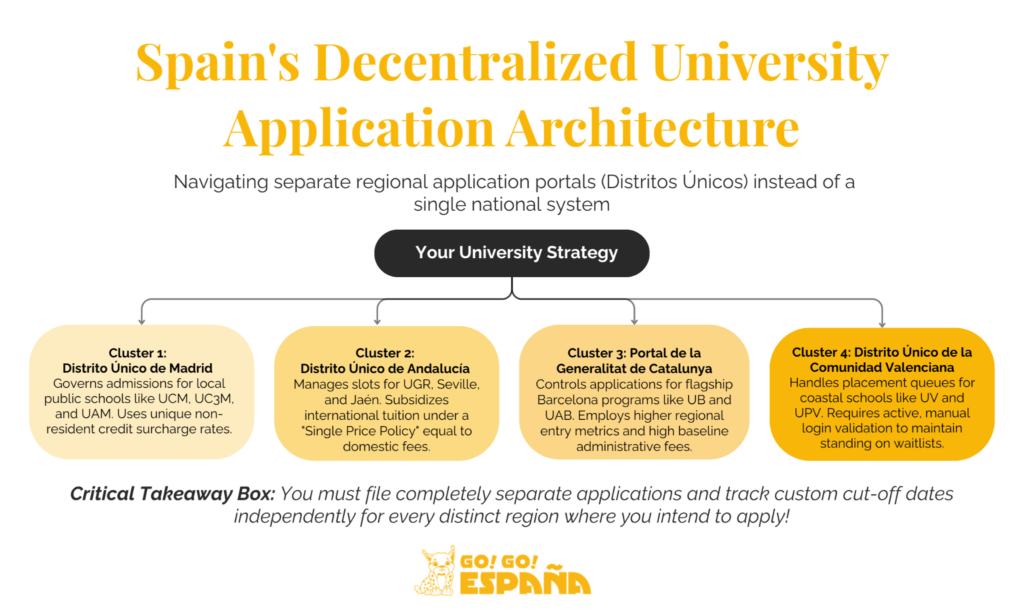
- Assuming Every University Accepts the Same Access Route: Not all universities treat UNEDasiss the same way, so applicants should confirm whether their target institution requires UNEDasiss accreditation, additional subject exams, or a different access procedure.
- Ignoring PCE Planning: UNEDasiss states that Specific Competency Tests can be taken in up to six subjects, and the subject choice depends on the student’s educational background and the university’s admission requirements. This should be planned early, not after the degree deadlines open.
FAQ About Spanish University Application Deadlines
1. What is the application deadline for international students in Spain?
Public university portals for the primary Ordinary Phase typically close between late June and early July, often with a strict 14:00h (CET) cutoff. It is vital to submit your pre-registration during this window to ensure you are considered for the full catalog of degrees before competitive spots are filled.
2. Do private universities have different deadlines?
Yes, most private institutions operate on an independent calendar with early admission rounds starting as early as December or January. These universities often reach capacity by March or April, so applying during the “early bird” window is essential to secure both your spot and any available scholarships.
3. Is there a difference for EU and non-EU applicants?
While both groups participate in the same application phases, non-EU students must account for the two-month lead time required for Type D visa processing. Non-EU applicants should complete their UNEDasiss accreditation as early as possible to avoid administrative delays that could prevent them from arriving for the start of classes.
4. What happens if I miss the final deadline?
Missing the Ordinary Phase deadline results in the loss of your “Preferential Right,” meaning you can only apply for remaining vacancies in the Extraordinary Phase, where competitive programs are usually already full. In many cases, this results in losing an entire academic year, since high-demand degrees like Medicine or Engineering rarely open a second application window.
5. Are there rolling admissions in Spain?
Rolling admissions are primarily offered by private institutions such as IE, ESADE, and Nebrija, where applications are reviewed and seats are filled as they are received. Public universities do not use this system and strictly follow the centralized regional windows managed by their respective Distrito Único.
6. Do English-taught programs have different dates?
English-taught degrees at public universities generally follow the same regional Distrito Único calendar and June/July deadlines as Spanish-taught programs. In the private sector, these programs may have priority early-bird deadlines, but they typically align with the institution’s broader rolling admission cycle.
7. Does every university accept UNEDasiss?
No. UNEDasiss is widely used for undergraduate admission, but the platform itself notes that some universities do not consider UNEDasiss accreditations for all applicants or all programmes. Before applying, confirm the admission route directly with the university.
8. Do foreign academic documents need translation or legalization?
Yes, in many cases they do. Spanish administrative guidance states that foreign-issued documents must be accompanied by a Hague Apostille and a sworn translation. Applicants should verify the exact format required by the university and the relevant consulate or regional admissions body.
Summary: Spanish University Intakes
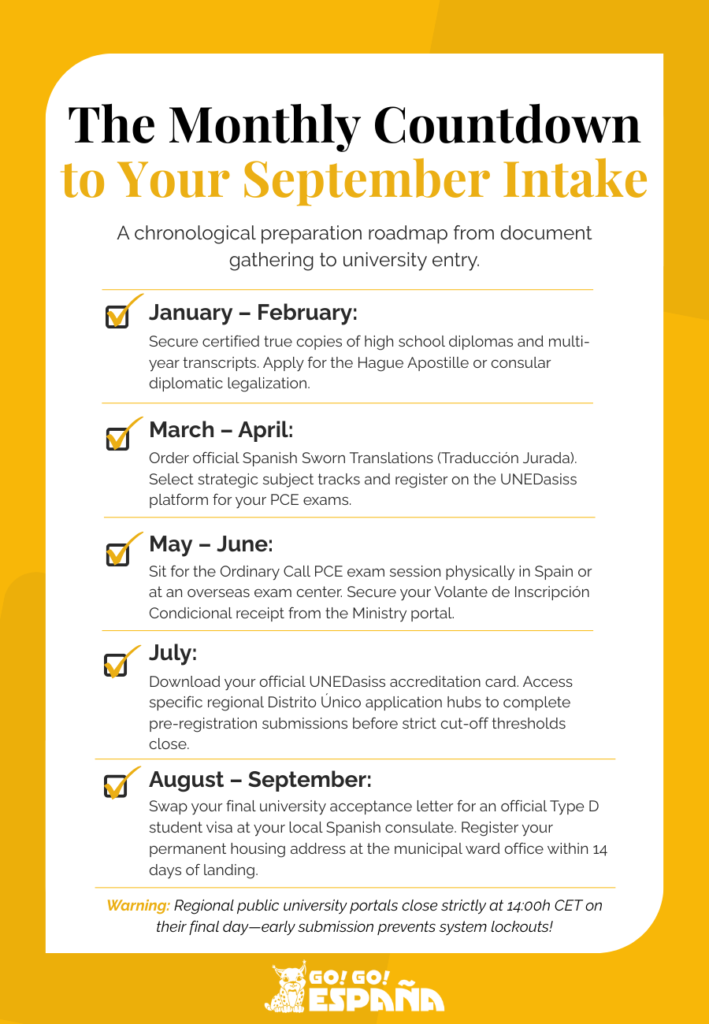
Managing Spanish university application deadlines is the most critical strategic hurdle for international students seeking a spot in a Spanish classroom.
Success requires synchronization of your UNEDasiss accreditation, regional portal registrations, and document legalization to meet the strict Ordinary Phase windows in June. Missing these narrow primary intakes often means losing your preferential right to high-demand degrees, potentially delaying your education by an entire year.
By planning your roadmap from January and avoiding the common “September Trap,” you ensure your application is positioned for maximum success in both public and private institutions.
Don’t let a missed deadline cost you a year. Contact Go! Go! España to stay ahead of the clock.
Once your timeline is set, the next logical step is mastering your documentation, read our guide on How to Get Your Homologation in Spain.


