 Skip to content
Home - Learning Spanish in Spain - Spanish Courses in Spain
A Guide to Spanish Courses in Spain: Your Roadmap to Fluency
Follow this guide to ensure you’re choosing the right language course for your goals, understand how to track your progress, and have the most helpful tips on how to achieve fluency faster.

Your journey to fluency is a strategic path. It combines total immersion with choosing the right Spanish courses in Spain, understanding how to track your progress, and adopting effective study habits to accelerate your learning.
Becoming fluent takes more than just living in a Spanish-speaking country. It’s about selecting the right course for your goals, knowing how to measure your progress, and using effective study strategies to accelerate your learning.
This guide is your step-by-step roadmap to mastering Spanish during your time in Spain. From understanding the different types of language programs to adopting daily habits that boost your fluency, you’ll find everything you need to make your language-learning journey structured, rewarding, and fun.
For a broader overview of the entire study abroad experience, check out our Complete Guide to Learning Spanish in Spain.
(Last Updated: January 2026)
Key Takeaways
- The right course for you depends on your goals. Intensive courses are best for rapid progress, while DELE preparation courses are essential for students seeking official certification.
- Earning a DELE or SIELE certificate provides official, internationally recognized proof of your proficiency, which is a powerful asset for your professional resume.
- Always choose a language school that is officially accredited by the Instituto Cervantes to ensure you receive a high-quality education.
- While classroom learning is essential, the key to learning Spanish fluently is practicing in your daily life through immersion.
Choosing Spanish courses
How to Choose the Right Type of Spanish Courses in Spain
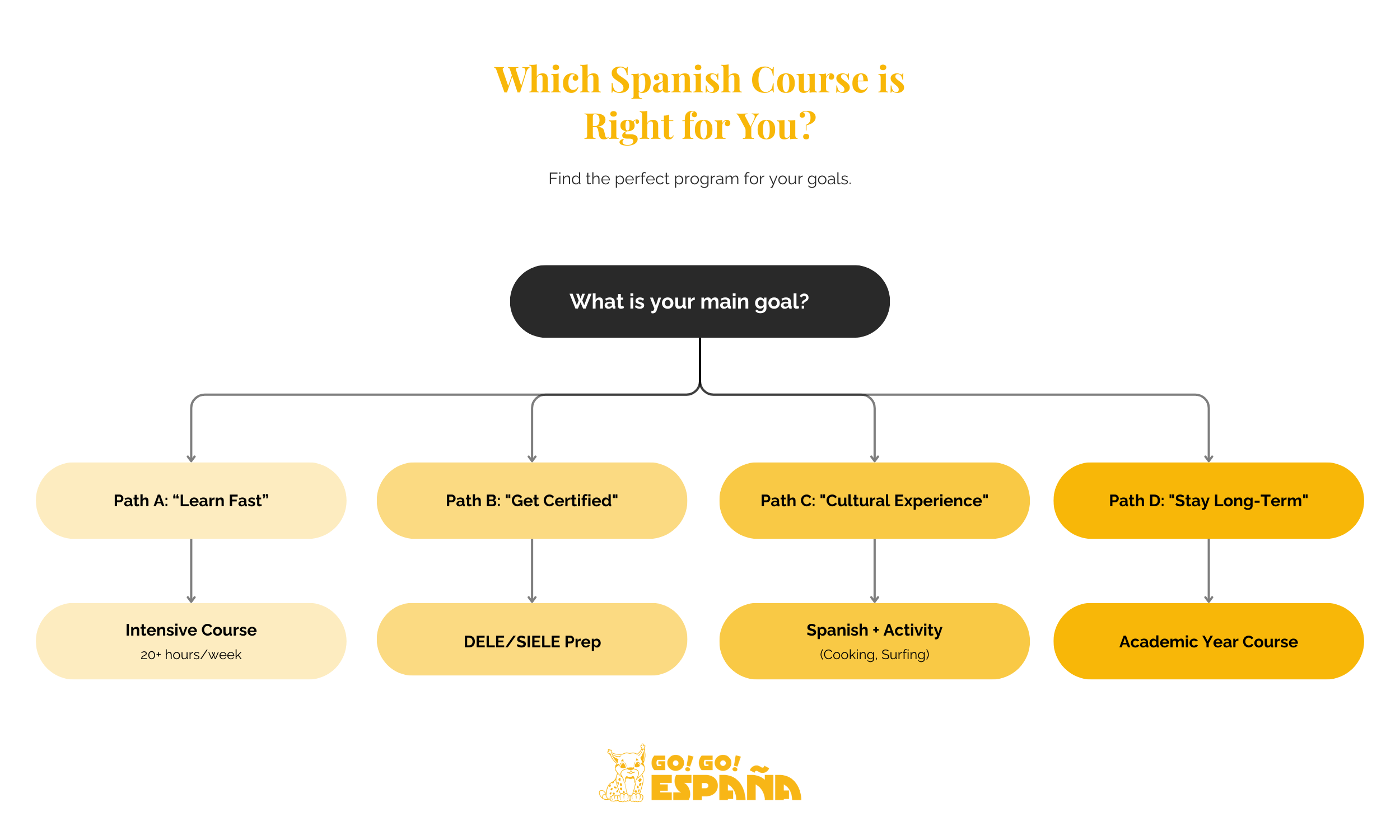
The first step in your Spanish learning journey is choosing a language program that aligns with your goals, schedule, and learning style.
Spain offers a wide variety of Spanish courses for international students, each designed to meet different needs, from intensive study to flexible evening classes. Understanding the options available will help you select the best Spanish course for your lifestyle and language goals.
1. Intensive Courses (20+ hours/week)
Based on our experience helping thousands of students, we find that Intensive Spanish courses in Spain are the most effective choice for rapid progress. They also meet the 20-hour minimum requirement for a Spanish student visa.
2. Long-Term Academic Year Courses
If you plan to study Spanish in Spain for several months or longer, long-term academic courses offer steady progress and cultural immersion. These programs usually include 20 or more classroom hours per week and follow a structured academic calendar.
Studying long-term offers students greater flexibility in their schedules. By staying longer, you’ll naturally get to enjoy some of Spain’s many holidays, such as Semana Santa, and you’ll also have the freedom to take time off for travel when you’d like.
3. DELE/SIELE Preparation Courses
If your goal is to earn an official Spanish language certificate, DELE and SIELE preparation courses are ideal. These specialized classes focus on exam-specific strategies, formats, and skills needed to pass internationally recognized proficiency tests.
Many Spanish schools in Spain, including Go! Go! España partner institutions offer DELE and SIELE courses in addition to their intensive programs. This allows students to prepare for certification while improving their communication.
Unsure which exam is right for your goals? Read our detailed breakdown of the DELE vs SIELE exam differences to choose the best path for your resume.
4. Spanish + Activity Courses
These programs combine language learning with cultural experiences such as cooking, flamenco dancing, art, or surfing. These courses are perfect for students who want to learn Spanish while engaging in hands-on cultural immersion.
They provide a fun and dynamic way to practice your language skills outside the classroom and connect with local traditions.
5. Evening/Weekend Courses
If you are already living, studying, or working in Spain and want to improve your Spanish without committing to a full-time schedule, evening or weekend courses are a great option.
These part-time programs usually meet once or twice a week for a total of three to four hours, making them ideal for those balancing other responsibilities. They are often held in the evenings or on weekends to fit busy schedules.
It’s important to note that these courses do not qualify for a student visa, as they don’t meet the required number of class hours.
Choosing a long-term course means you will need a visa; make sure to read our guide for applying for a Spanish Student Visa to understand the application steps.
Choosing the right Spanish school
How to Choose the Right Spanish Language School
No matter which type of Spanish course you choose, selecting a reputable institution is key. Always make sure your chosen school is accredited by the Instituto Cervantes, the official organization that certifies the quality of Spanish language education worldwide.
Accreditation not only ensures you receive high-quality instruction, but is also required when applying for a student visa.
The school you choose is just as important as the course type. Explore our expert advice in the Guide to Choosing the Best Spanish Language School in Spain.
CEFR language levels
How to Understand Your Progress: The CEFR Language Levels
Before you can measure your progress in learning Spanish, it’s important to know your starting point. Take our Free Spanish Level Test to discover your current Spanish level and get a clear idea of where to begin.
Once you know your baseline, the next step is understanding how to track your improvement. The best way to do this is by using an internationally recognized system called the Common European Framework of Reference for Languages (CEFR).
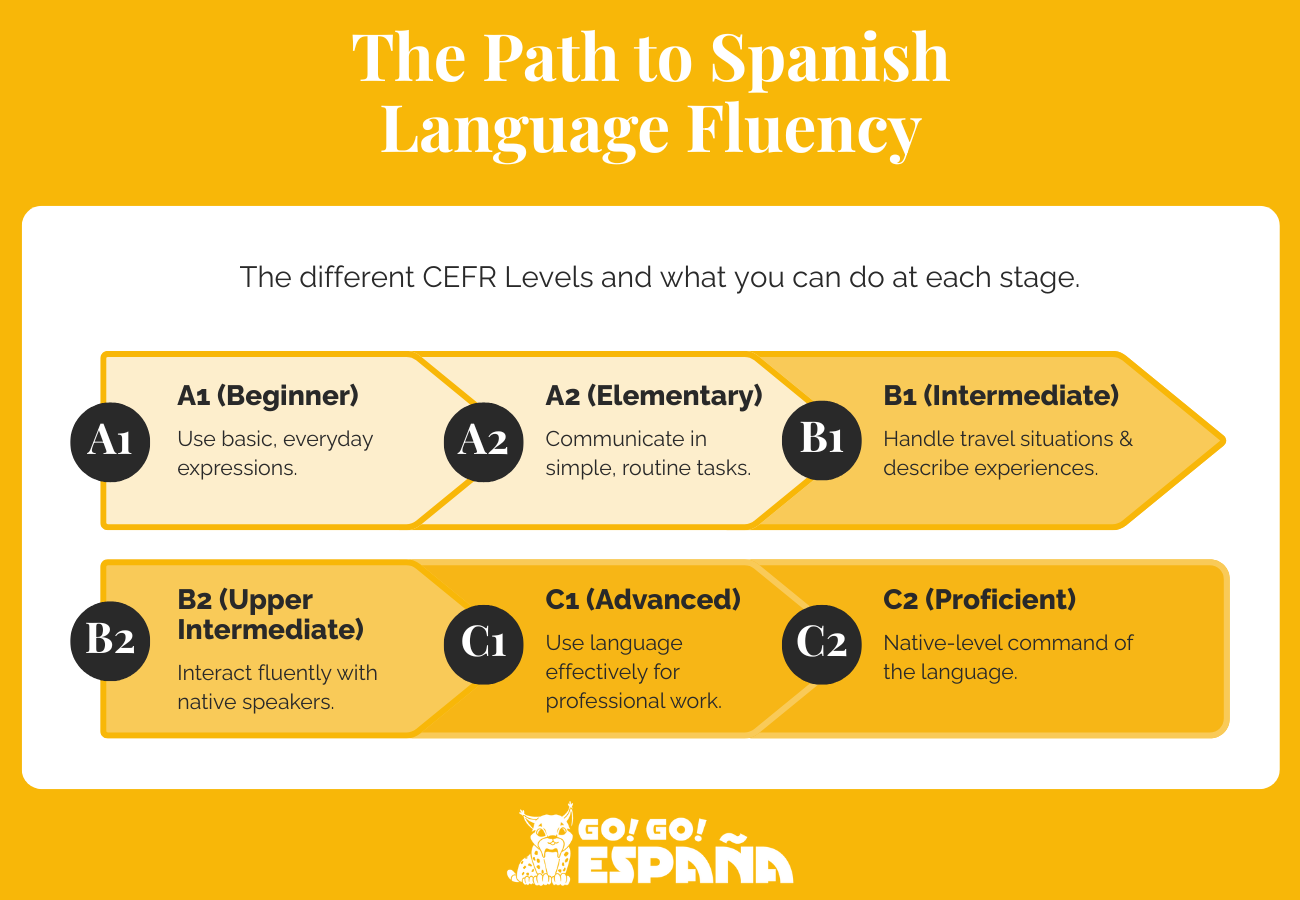
The CEFR Spanish levels provide a standardized way to describe language proficiency on a six-level scale, from A1 (beginner) to C2 (mastery). This framework is widely used across Spain and the rest of Europe by language schools, universities, and employers to measure fluency.
Using the CEFR to track your Spanish learning progress helps you set realistic goals, choose the right course level, and stay motivated as you move from basic to advanced fluency.
Here’s a simple overview of the CEFR Spanish levels:
| Level | What you can do? |
| A1 (Beginner) | You can understand and use basic, everyday expressions. If this is where you are starting, you can sign up for our Free Online Spanish Beginner Course to start advancing today! |
| A2 (Elementary) | You can communicate in simple, routine tasks. |
| B1 (Intermediate) | You can handle most situations that arise while traveling and can describe experiences and events. This is often considered a “conversational” level. |
| B2 (Upper Intermediate) | You can interact with a degree of fluency and spontaneity with native speakers. This is the level often required for university or professional work. |
| C1 (Advanced) | You can use the language flexibly and effectively for social, academic, and professional purposes. This is what most would consider “fluent.” |
| C2 (Proficient) | You have a mastery of the language, with a command similar to that of a native speaker. |
Spanish fluency timeline
How Long Does It Take to Become Fluent in Spanish?
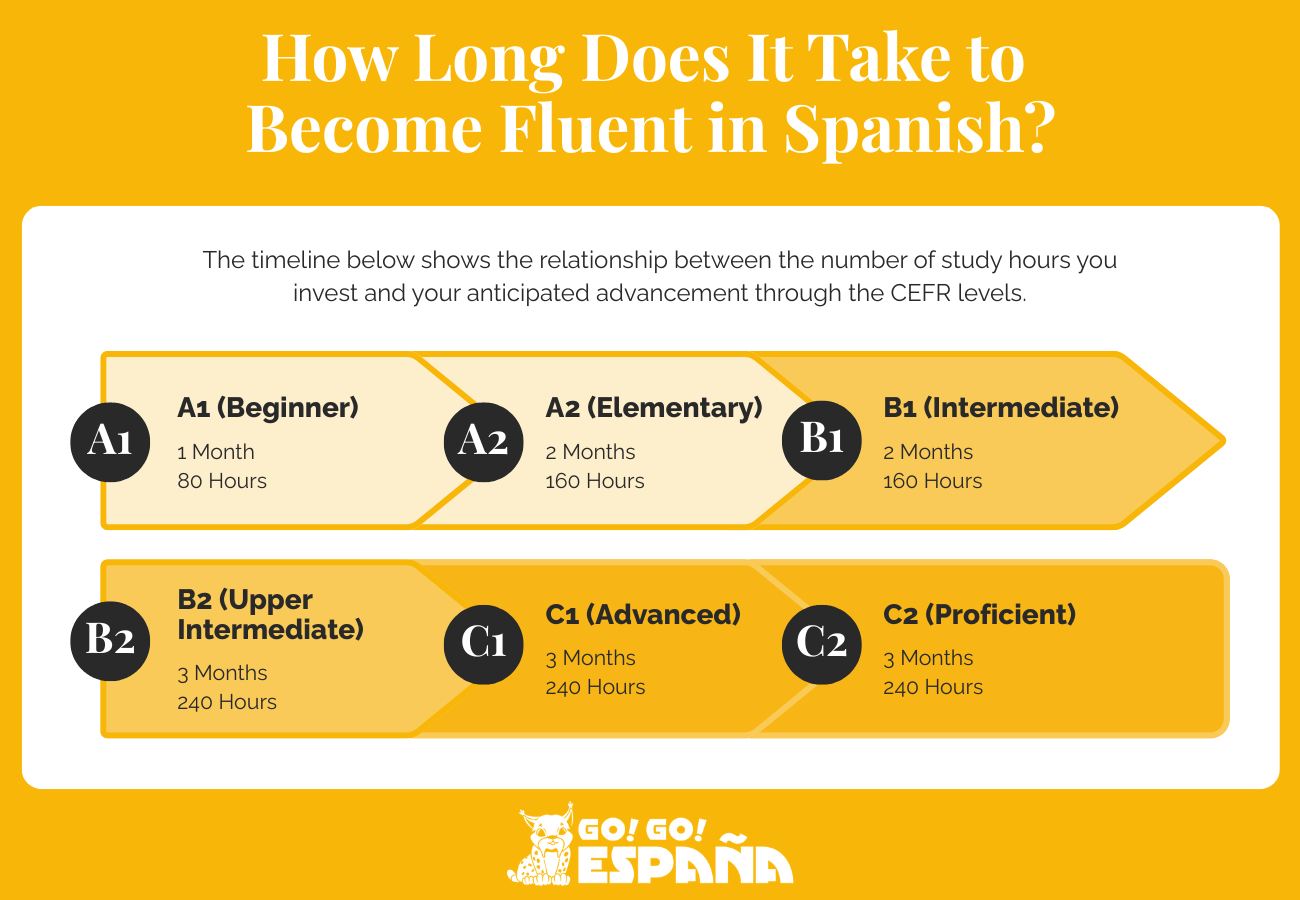
The time it takes to achieve Spanish fluency varies from person to person, depending on factors such as study habits, consistency, and language exposure. Your native language also plays a major role. If it’s similar to Spanish, like Italian or French, you’ll likely progress more quickly. Use the guide below to estimate how long it may take to reach each level of proficiency.
The timeline below connects the number of study hours invested with your expected progress through the CEFR levels. It also shows approximately how long it takes to advance from one level to the next.
For example, students typically move from A1 to A2 after about 160 hours of focused study. With continued practice and immersion, you can progress steadily toward fluency in Spanish.
Key to Spanish progress
What is the Key to Making Progress in Your Spanish Language Learning Journey?
The most important factor in becoming fluent in Spanish is combining active participation in the classroom with consistent daily practice in real-life situations.
Your language school will provide the foundation, but your progress depends on how much you use Spanish outside the classroom. The students who improve the fastest are those who take every opportunity to practice.
Living in Spain gives you countless chances to practice your Spanish, from ordering tapas to checking out at the grocery store. While many people in Spain may speak some English, it’s important to make the effort to communicate in Spanish first. Early on, these moments may feel uncomfortable, but they are the fastest way to advance your language skills.
Language exchanges, or intercambios, are excellent for improving speaking and comprehension. The Go! Go! España team strongly encourages attending them as often as possible.
To understand why your daily life in Spain is your best classroom, see our practical guide on how to learn Spanish fluently.
For detailed strategies, techniques, and habits to improve your Spanish quickly, check out our guide on immersion learning in Spain.
Study toolkits and habits
Your Study Toolkit: Essential Resources & Good Habits
Supplementing your formal Spanish classes with modern tools and media, while avoiding common mistakes, can significantly accelerate your learning.
Your language school provides the foundation, but you can boost your progress by creating a personal study toolkit:
- Fill your toolkit with our curated list of the best apps, media, and resources to learn Spanish.
- Make sure your library includes the best books for learning Spanish.
- Learn what not to do by reading our guide to the 8 common habits to avoid when learning Spanish.
Using these resources and building smart study habits will help you make faster, more consistent progress.
FAQ
FAQ About Spanish Courses in Spain, Study Techniques, and Reaching Fluency
- How many hours a week should I study to learn fast?
Most intensive Spanish courses include around 20 hours of classroom time per week. When you add homework and daily immersion practice, you create a highly effective learning environment that accelerates your progress. - What is the Instituto Cervantes?
The Instituto Cervantes is a public institution founded by the Spanish government to promote the Spanish language and culture. Its accreditation is considered the “gold standard” for Spanish language schools, ensuring high-quality teaching.
Your language school must also be accredited by the Instituto Cervantes to be eligible for obtaining a student visa in Spain. For more on these requirements, consult our Spanish student visa guide. - Is it better to choose a school with small or large classes?
Smaller classes, typically 8–10 students, provide more personalized attention from the teacher and more opportunities to speak. This often leads to faster progress. Most of the Go! Go! España partner schools offer small class sizes to maximize learning. - How do I know what my Spanish level is?
Most language schools require a placement test before you start your course to ensure you are in the correct group for your ability level. You can also check your level now by taking our Free Spanish Level Test.
Summary
Summary: Ready to Start Your Language Journey?
A successful journey to Spanish fluency is about more than just moving to Spain. It requires choosing the right program, tracking your progress, and immersing yourself in the language outside the classroom.
While learning a new language takes effort, the rewards are well worth it! You will gain confidence, independence, and the ability to connect with people and culture in a whole new way.
Ready to take the next step? Go! Go! España can help you find the perfect accredited language school that matches your goals and learning style. Contact us today for free guidance and start your journey to fluency!