


We provide a full breakdown of the exam structure, plus proven strategies and tips for every section of the DELE exam.
Congratulations on deciding to take the DELE exam!
This official diploma is the most widely recognized Spanish language qualification in the world and a powerful addition to your resume. But passing the DELE exam takes more than general Spanish skills; it requires focused, strategic DELE exam preparation.
This guide is your complete roadmap to success. We will break down the exam structure, help you create an effective study plan, and share proven strategies for mastering each of the four sections.
Preparing for the DELE is one of the most rewarding challenges of your academic career. To see how this fits into your broader timeline, check out our guide to Spanish Courses in Spain.
(Last Updated: February 2026)
Main Key Takeaways
- You must pass both “groups” of tests (Reading/Writing and Listening/Speaking) to receive your diploma for a specific level (ex: B2).
- The most effective way to prepare is by enrolling in a specialized DELE preparation course, as it teaches you the specific strategies and formats of the exam.
- Your study plan should revolve around using official sample exams from the Instituto Cervantes to get used to the timing and question types.
- Each section of the exam is strictly timed. Practicing under exam conditions is essential for success.
- While mistakes are a part of learning, there are specific habits to avoid during your DELE exam preparation that can hinder your progress.
Table of Contents
What is the Structure of the DELE Exam?
The DELE exam is divided into four tests (pruebas) that are grouped into two main blocks. To pass, you must receive a passing score on both blocks.
Before you start your DELE exam preparation, it’s essential to understand what you’ll be facing. The exam tests the four core language skills. For most levels (like B2), these are grouped as follows:
| Group | Test Section (Prueba) | Passing Score |
| Group 1: Reading & Writing Skills | Prueba 1: Reading Comprehension (Comprensión de Lectura) | Minimum 30 / 50 points(Combined score for Group 1) |
| Prueba 2: Written Expression and Interaction (Expresión e Interacción Escritas) | ||
| Group 2: Listening & Speaking Skills | Prueba 3: Listening Comprehension (Comprensión Auditiva) | Minimum 30 / 50 points(Combined score for Group 2) |
| Prueba 4: Oral Expression and Interaction (Expresión e Interacción Orales) |
If you need a more flexible or faster digital option, compare it with the DELE vs. SIELE exam differences before you begin your intensive study plan.
How Should You Create Your DELE Study Plan?
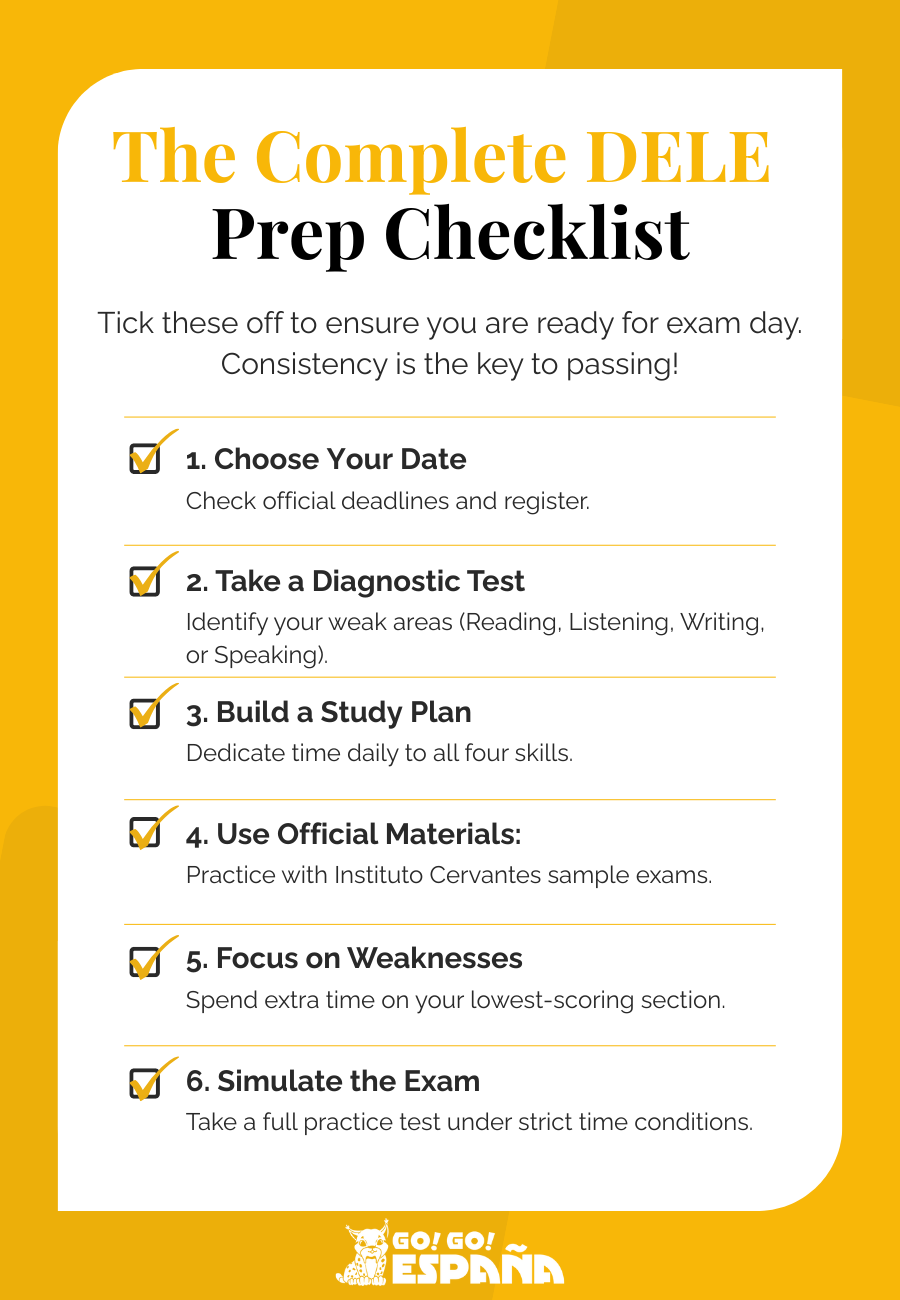
A good study plan starts with choosing your exam date, taking a practice test to identify your weaknesses, and building a consistent study routine.
- Choose Your Date: The first step in any plan is setting a deadline. You can find all the official deadlines in our guide to the DELE exam dates.
- Take a Diagnostic Test: Before you begin your DELE preparation, take a full, timed practice exam. The Instituto Cervantes provides a full practice exam for each level (A1-C2), along with instructions on how much time you are allotted for each section. Doing this will show you which sections are your weakest and where you need to focus your energy.
- Consider a Prep Course: The single most effective way to prepare is to enrol in a dedicated DELE exam preparation course at a Spanish language school. The teachers are experts in the exam format and can give you personalized feedback on your writing and speaking that is impossible to get when studying alone.
Use the Go! Go! España search filter to find schools that offer specialized DELE exam preparation courses.
Pro Tip:
Efficiency is key when preparing for a technical exam. Ensure you aren’t slowing your progress by reading about the habits to avoid when learning Spanish in Spain.
How to Master the Reading Section? (Comprensión de Lectura)
- Skim the Questions First: Before you read the long text, read the questions. This tells you what specific information to look for and saves you time. For example, you might be given a letter written to a friend and then asked a question like:
En el texto se dice que Luisa (In the text, Luisa says):
- Tiene un restaurante (She has a restaurant)
- Es una profesora de idiomas (She is a language teacher)
- Va a estudiar por la tarde (She is going to study this afternoon)
By reading the question first, you will have key words like restaurante or profesora de idiomas to look for as you read the full letter.
- Learn to Identify Keywords: You don’t need to understand every single word. Focus on scanning the text for keywords and synonyms that relate to the questions. Continuing with the example above, the text might say, “Luisa enseña francés y italiano en la universidad” (Luisa teaches French and Italian at the university). From this, you can infer that she is a language professor (profesora de idiomas) based on your understanding of the words enseñar and universidad.
- Manage Your Time: The reading section is a race against the clock. During your practice, be very strict with your timing for each task.
Tips to stay on track include:
- Don’t get stuck on a word or phrase you don’t understand; focus on the overall meaning.
- Keep an eye on the clock and pace yourself for each passage.
- Answer the questions you know first, then return to harder ones if time allows.

How Can You Master the Listening Section? (Comprensión Auditiva)
- Practice with Different Accents: The listening section can include speakers from various regions of Spain and Latin America, so it’s important to expose yourself to a range of accents during your DELE exam preparation.
One way to do this is by watching movies and TV shows in Spanish. Reality shows with Spanish-speaking contestants are especially useful because they feature contestants from many different Spanish-speaking countries, giving you exposure to multiple accents. - Listen for Keywords: Just like in the reading section, pay attention to specific words and phrases that can guide you to the correct answer. When practicing, whether by watching TV or listening to music in Spanish, it’s helpful to keep a notebook of new vocabulary you hear that you can later review.
- Don’t Panic if You Miss a Word: It’s easy to lose valuable time by getting stuck on a word or phrase you don’t understand. Try to avoid this and focus instead on the next question and what you do understand.
The best way to practice your listening is simply to listen to more Spanish! You can find great recommendations in our essential toolkit of Spanish podcasts and TV shows.
How Can You Master the Writing Section? (Expresión e Interacción Escritas)

- Learn the Formats: The DELE exam writing section requires you to use specific formats, such as a formal letter, email, or opinion article. It’s important to learn the structure and key phrases for each.
- For example, study common ways to formally address someone in Spanish, such as Querido or Estimado (Dear), as well as formal sign-offs like Atentamente (Sincerely).
- Memorize Useful Connecting Phrases (Conectores): Words like sin embargo (however), además (furthermore), and por lo tanto (therefore) will make your writing more sophisticated. You can start by creating a flashcard deck or using an app like Anki to memorize these phrases. Once you know them, practice writing short paragraphs and then revise them by adding transition words.
- Always Proofread: Leave at least 5–10 minutes at the end to read through your writing and check for common grammar and spelling mistakes. Ask yourself questions like:
- Is this verb in the correct tense?
- Am I missing any accent marks?
- Could I improve this by adding a connecting phrase?
How Can You Master the Speaking Section? (Expresión e Interacción Orales)
- Structure Your Monologue: For the part where you have to speak on a topic, practice structuring your answer with a clear introduction, two or three main points, and a conclusion.
- Use Conversational Fillers: If you take a moment to think about how you naturally speak, you may be surprised by how often you use filler words like “um,” “like,” or “whatever.” The same applies when speaking Spanish!
- To sound more natural, use small phrases such as pues, a ver, or o sea. Using these phrases not only gives you more time to think, but also makes you sound less robotic.
- Interact with the Examiner: Remember that this is an “interaction” test. Ask the examiner questions and listen to their responses. Some good questions to practice are:
- ¿Y usted, qué opina? – What is your opinion?
- ¿Qué piensa usted sobre esto? – What do you think about this?
- ¿Está usted de acuerdo? – Do you agree?
Pro Tip:
The examiners aren’t just looking for correct grammar; they want to see natural, fluid communication. Incorporate our techniques on how to learn Spanish fluently to help you sound more like a native speaker during the interview.
What are the Best Resources for Your DELE Preparation?
Your preparation should be a mix of official materials from the Cervantes Institute, well-known preparation books, and, ideally, a specialized course with an expert teacher.
While consistent study is key, using the right resources will make your DELE exam preparation much more effective. Here are the top three resources every student should use:
- Official Materials from the Cervantes Institute: This is non-negotiable. The Instituto Cervantes is the body that creates the exam, and they provide official sample exams and guides on their website. Practicing with these is the best way to get used to the real format, timing, and question style.
- DELE Preparation Books: There are many excellent, well-known prep books that provide detailed strategies, practice exercises, and mock exams. Look for popular series like Preparación al DELE from the publisher Edelsa, or Las Claves del DELE.
- Dedicated DELE Preparation Courses: A specialized course at a Spanish language school is the single most valuable resource. An expert teacher can provide personalized feedback on your writing and speaking that is impossible to get when studying alone. They know the common mistakes students make and can teach you the specific strategies needed to pass.
Pro Tip:
You can easily find a Spanish school that offers these specialized courses by using Go! Go! España’s search tool with the filter “DELE exam preparation course.”

FAQ on How to Prepare and Pass a DELE Exam
-
How long should I study for the DELE?
This depends on your current level, but most students enroll in a dedicated DELE preparation course for 4–8 weeks before the exam.
-
Which DELE level should I take?
You should take a practice test to see what level you are currently at. It’s best to aim for the level you are confidently at or slightly above, rather than trying to jump two levels at once.
You can find out your baseline now by taking Go! Go! España’s free Spanish language test!
-
Where can I find official practice exams?
The Instituto Cervantes, the official body that runs the DELE, provides sample exam papers and materials on their website. You will practice materials for every level (A1-C2) and each group. Official materials are a great start, but you should also build a comprehensive study stack. Explore our curated list of resources to learn Spanish for the best apps and textbooks for exam prep.
-
Is the DELE exam very difficult?
The DELE is a challenging exam that requires serious preparation. It tests academic language skills, not just conversational ability, making a specific DELE exam preparation strategy essential. It’s as much about knowing how to take the exam, as it is knowing Spanish.
-
What happens if I fail one part of a group but do really well on the other?
You must score a minimum of 30 out of 50 points in each section, meaning a very high score in reading cannot compensate for a very low score in writing. You need to demonstrate competence in all skills.
Conclusion:
Passing the DELE is a challenging but very achievable goal. With a clear understanding of the exam format, a consistent study plan, and the right strategies for each section, you can approach the exam with confidence and earn a diploma that will benefit you for the rest of your life.
The best way to ensure you pass is with an expert teacher.
Go! Go! España connects you with accredited schools offering specialized DELE exam preparation courses. Find your course today!
Don’t forget to check the official DELE Exam Dates to register on time!


