 Skip to content



University pathway programs are bridge years that prepare international students for the Spanish higher education system through intensive language training, academic exam preparation, and administrative support.
Spain has become one of the most popular destinations for international students, offering high-quality education and a gateway into the European Union. But for non-native speakers, jumping straight into university-level subjects like Calculus or Physics without a solid foundation in the language is a recipe for frustration.
The Spanish University Pathway Programs exist to solve exactly that problem. It gives students the linguistic and administrative preparation they need to genuinely succeed once they arrive, serving as the critical first step toward building an academic career in Europe.
Keep reading to find out how it works, what it costs, and how to choose the right program for your goals.
Key Takeaways
- Admission Foundation: Pathway programs manage the 14-point admission scale, balancing your 60% high school GPA with the 40% earned through PCE scores.
- The Dual-Phase Model: Students transition from 20–25 hours of intensive weekly Spanish to focused PCE academic review. This structure ensures you reach the mandatory B2 level before tackling technical subjects in a native-speed environment.
- Subject Specialization: Preparation is divided into four tracks, such as Health Sciences or Engineering, to maximize your specific “Nota de Corte”. Schools like Academia Guiu lead the field by providing the high-level Mathematics and Science required for elite technical degrees.
- Visa & Legal Assistance: While a pathway program itself does not meet Type D visa requirements, the full-time Spanish language component included in most programs does. Pathway programs will also provide support to complete the mandatory Homologación process, and many schools help manage your UNEDasiss registration to ensure no critical application deadlines are missed.
- Integrated Efficiency: Learning Spanish alongside PCE subjects saves you 12 months of extra rent and living expenses compared to sequential study. This synchronized approach results in a 90% success rate for students entering competitive Spanish degrees.
- Flexible Study Formats: Students can choose between full in-person immersion for beginners or online programs for those already at a B2 level.
- Cost-Benefit Advantage: A €4,000–€6,000 pathway investment unlocks low-cost public university tuition of €700–€8,000 per year. This strategy often pays for itself by preventing the need for private universities that charge up to €30,000 annually.
Table of Contents
What is a Spanish University Pathway Program?
A Spanish University Pathway Program is a comprehensive academic and administrative package designed to transition international students into the Spanish public university system.
It is not just a language course; it combines language acquisition, exam preparation, and support with visas, diploma recognition, and university applications into a single, structured program.
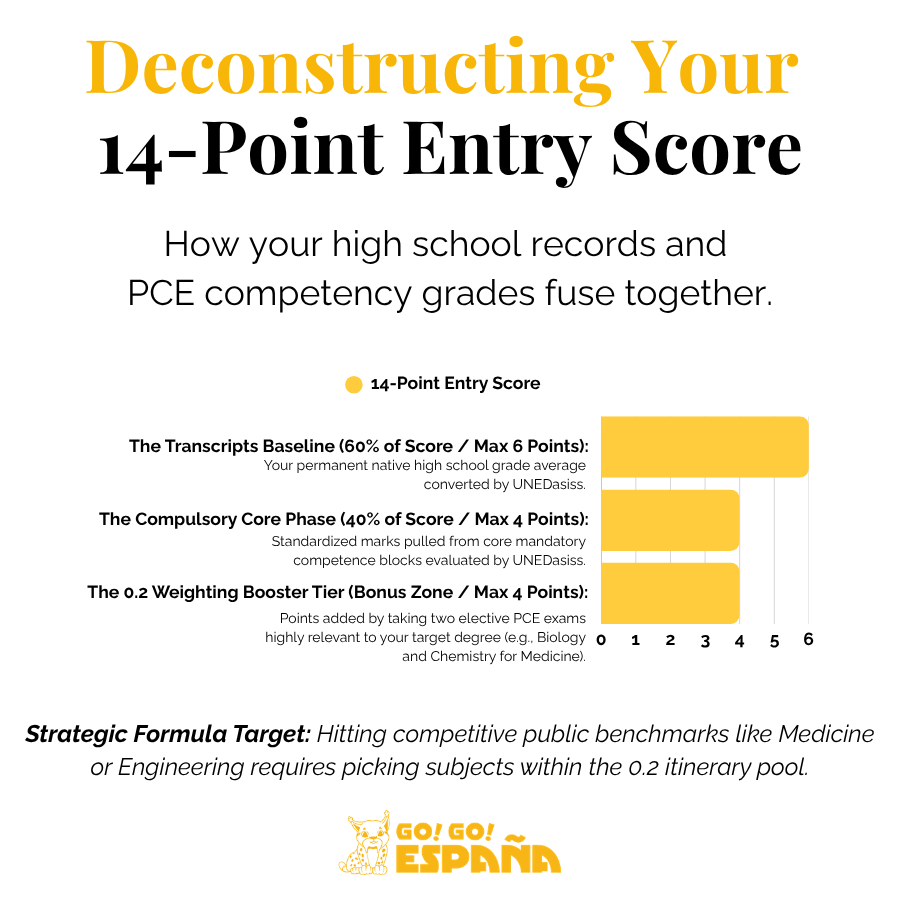
The program is built around the strategic need to optimize your university admission score, which is calculated on a 14-point Spanish university grading system:
- High School Average (60%): Contributes up to 6 points based on your homologated high school GPA.
- PCE Results (40%): Contributes up to 4 points based on standardized entrance exams.
- Specific Subject Weighting: Students can take two additional subjects to add up to 4 extra “bonus” points, bringing the maximum possible score to 14.
Further Reading:
What Is The Difference Between University Foundation in Spain and a Pathway Program?

In Spain, these terms are often used interchangeably, but there is a subtle distinction.
A “University Foundation Program” typically refers to a program organized directly by universities that facilitates access to the university upon successful completion, such as the International Foundation Program at University Carlos III of Madrid or the International Foundation Program at Complutense University of Madrid.
A “Pathway Program,” on the other hand, refers to the strategic route, combining language study, PCE preparation, and administrative steps that international students follow to gain admission to a Spanish university.
Unlike the UK, where a “Foundation Degree” is a standalone qualification, a Spanish Foundation Program is purely preparatory and does not grant a university degree; it grants the eligibility to apply for one.
How Are These Preparatory Programs Regulated in the Spanish Education System?
University-run Foundation Programs are organized and accredited directly by the universities themselves, offering a structured and officially recognized path into their undergraduate programs.
Spanish private preparatory schools work differently. These independent schools provide intensive Selectividad training for international students, specifically coaching them for PCE competency blocks evaluated through the UNEDasiss official portal.
Important: It is important to note that private preparatory schools have no formal connection to UNEDasiss. Their role is simply to equip students with the knowledge needed to pass the exam. Ultimately, it is the PCE result itself that determines a student’s eligibility for university admission in Spain.
How is the Spanish University Pathway Program Structured?
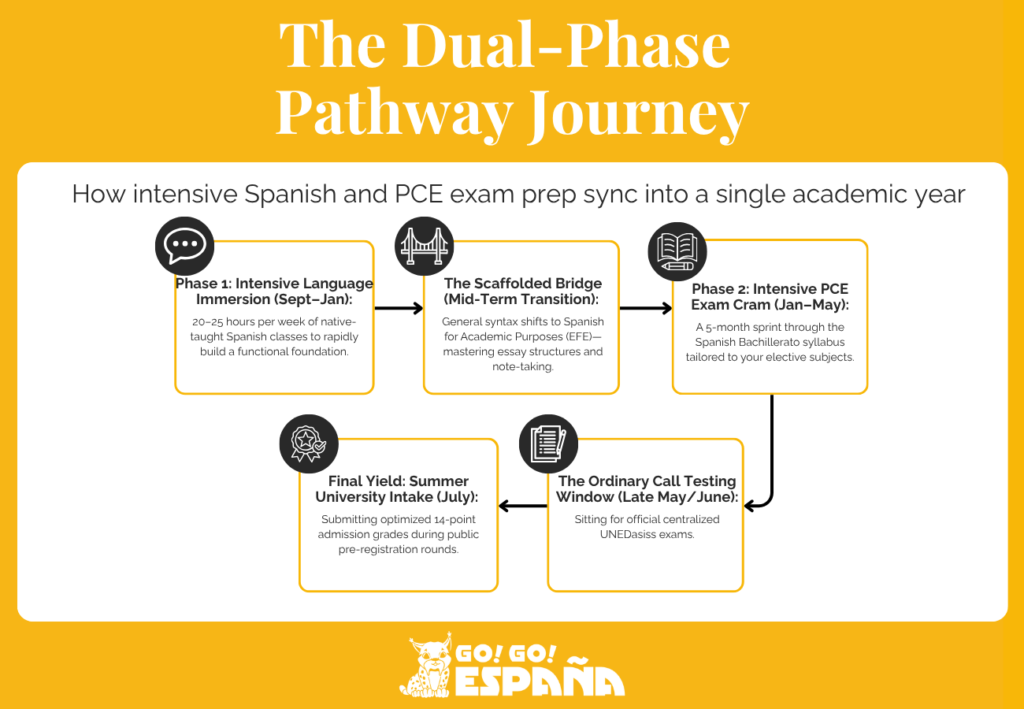
A successful pathway program combines Spanish language preparation with academic exam training, ensuring students are ready before they are tested.
The exact structure and timing will vary depending on the school you choose (for example, Academia Guiu and Costa de Valencia each publish their own intake calendars with different available start dates), but most programs follow a similar two-phase approach.
Phase 1: Intensive Spanish Language Preparation
The objective of this initial phase is to bring students from a beginner or intermediate level up to the B2 proficiency required for university coursework. This involves intensive immersion with 20 to 25 hours of Spanish instruction per week in small, interactive groups.
Phase 2: PCE Academic Exam Preparation
Once students have achieved sufficient Spanish proficiency, the focus shifts to preparing for the PCE exam. This is an intensive review of the Spanish Bachillerato curriculum, focused on mastering the specific subjects required for the student’s chosen field, such as Health Sciences, Engineering, or Social Sciences. The duration of this phase depends on the program.
How are intensive Spanish language courses integrated into the academic curriculum?
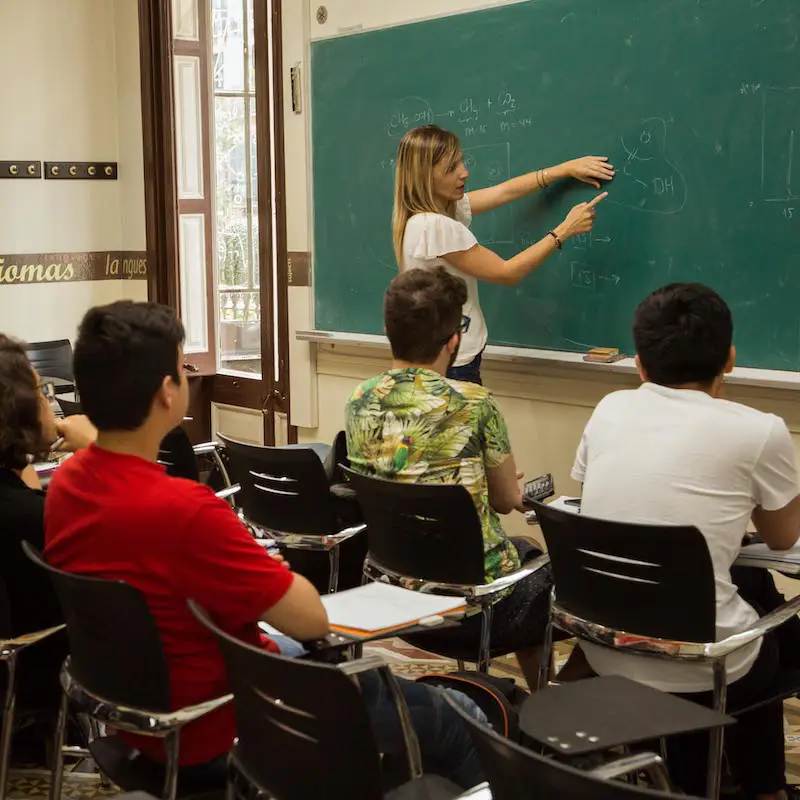
The integration is gradual and intentional. In the first phase, the focus is entirely on general language acquisition. As students progress, the curriculum shifts from general Spanish toward Spanish for Academic Purposes (EFE), where the language skills learned are applied directly to university-level contexts. Rather than everyday conversational topics, students practice:
- Technical Listening: Taking notes from mock lectures in Physics or History.
- Academic Writing: Learning how to structure the essays required in the Spanish Language and Literature PCE exam.
- Field-Specific Vocabulary: Building command of the terminology relevant to their chosen subject area, so that technical language does not slow them down during the exam.
What Specific Qualifications Do Pathway Programs Provide?
It is important to clarify that a pathway program does not itself award credentials. Rather, it prepares you to obtain the qualifications you need for Spanish university admission. If you complete the program and pass the relevant exams, you can earn the following:
- An Official Spanish Language Certificate: Pathway programs include intensive Spanish language instruction that prepares you for the DELE or SIELE exams. If you take and pass one of these exams, you will receive an official certificate proving your B2 proficiency.
- A UNEDasiss Accreditation: Pathway schools typically support students through the UNEDasiss accreditation and homologation process, helping you convert your high school GPA and submit your official PCE exam scores. However, this accreditation is issued by UNEDasiss directly, not by the school itself.
- A Certificate of Completion: Issued by the preparatory school, this document confirms your attendance and is often required by consulates and the Extranjería to prove you have maintained your student visa status throughout the program.
Are There Specific Pathway Tracks for STEM, Business, or Healthcare Studies?
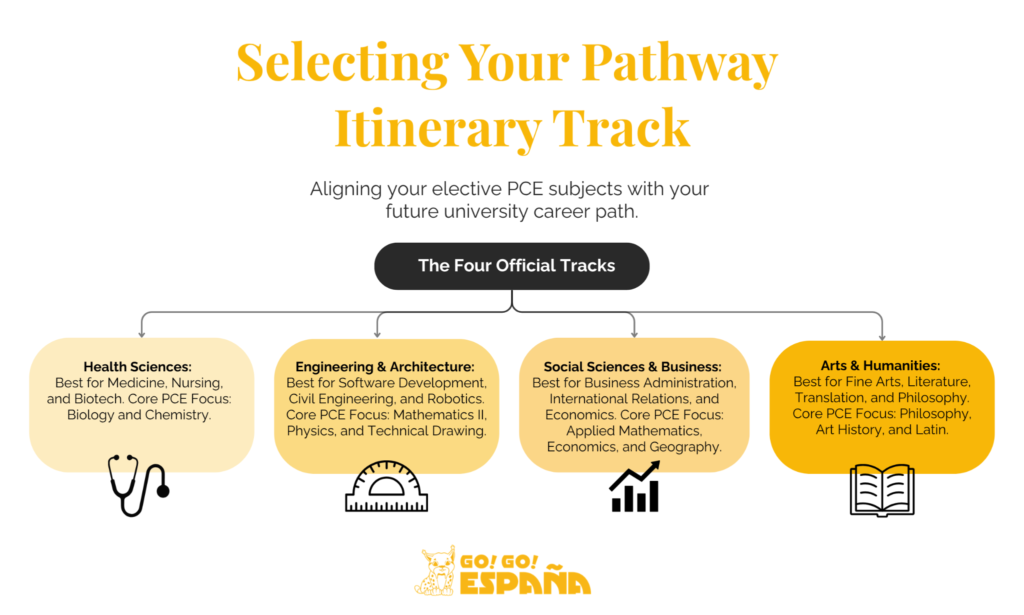
Yes. In the Spanish system, you do not just “prepare for university”, you prepare for a specific itinerary. To maximize your 14-point score, pathway programs divide students into four specialized tracks based on their target degree:
- Health Sciences: Focused on Biology and Chemistry (essential for Medicine or Nursing).
- Engineering & Architecture: Focused on Physics, Chemistry, and Technical Drawing.
- Social Sciences & Business: Focused on Mathematics for Social Sciences, Economics, and Geography.
- Arts & Humanities: Focused on Philosophy, Literature, and History of Art.
Choosing the right track ensures you are spending your preparation time on the subjects that directly contribute points to your specific Nota de Corte, rather than covering material that does not affect your admission score.
How do Pathway Programs Handle your Visa and Paperwork?
Beyond academics, pathway programs typically offer administrative support to help you navigate the complex bureaucratic hurdles of the Spanish system. The level of support available will vary depending on the school you choose.
- Student Visa Management (Type D): Pathway programs themselves are not currently eligible for student visa applications. However, preparatory schools can support your visa process because their programs include a full-time Spanish language component, which is eligible for the student visa. Schools provide the official enrollment letters and documentation that consulates require, based on this language course enrollment.
- Homologation of Diplomas: This is the mandatory process of having your foreign high school degree legally recognized as equivalent to the Spanish Bachillerato. Many schools support or manage this process on your behalf, often providing a “volante” (conditional voucher) so you can apply to universities while your final credential is still being processed.
- UNEDasiss Registration Support: Many schools offer guidance through the UNEDasiss registration process, helping you open your account, select the right exam subjects for your degree weighting, and keep track of key deadlines.
How an Integrated Spanish University Pathway Saves you Time and Increases Your Success Rate?

Choosing an integrated pathway over taking separate language and academic courses offers distinct advantages that directly impact your final admission grade:
- Mastering “Technical Spanish”: Instead of just learning how to travel or socialize, you learn the specific vocabulary of your subjects (e.g., derivadas for Math or síntesis de proteínas for Biology) in parallel with general grammar. This ensures you can “speak the subject” by the time you sit for the exam.
- Time and Cost Efficiency: A combined program condenses your preparation into a single academic year. This prevents you from taking a “gap year” to learn the language and then another year to prepare for exams, significantly reducing your living expenses and tuition costs.
- Score Optimization through Mock Exams: These programs include continuous assessment under official UNEDasiss conditions. By practicing with real exam formats and timing, you learn to avoid common pitfalls—like the score penalties for incorrect multiple-choice answers—that often catch independent students off guard.
- A Clearer Path to Public Universities: By maximizing your PCE scores through this synchronized approach, you are more likely to reach the “Nota de Corte” for low-cost public universities (approx. €700–€8,000/year), avoiding the high tuition of private institutions.
Which Program Format is Right For Your Budget and Language Level?
Not every student needs the same level of support. Depending on your current Spanish skills and your visa status, you can choose from two main study modes:
In-Person Immersion
This is considered the gold standard for beginners at an A1 or A2 level. It provides the full 9 to 14 month experience in Spain, which is typically required to secure a long-term Student Visa, and offers the highest level of social support and cultural integration.
100% Online Preparation
For students who already have a strong B2 level of Spanish and only need targeted academic coaching for the PCE subjects, online preparation is the most cost-effective and flexible alternative.
Go! Go! España University Pathway Program Partners
- Academia Guiu (Barcelona): A national pioneer with a 90% success rate. Guiu is the premier choice for students targeting competitive, high-demand degrees like Medicine or Engineering.
- Costa de Valencia (Valencia): Known for its supportive, “family” environment and small group sizes. This is an excellent option for students who want deep immersion in a more affordable, student-centric city.
Cost Comparison: University Pathway Programs vs. Private University Tuition Fees
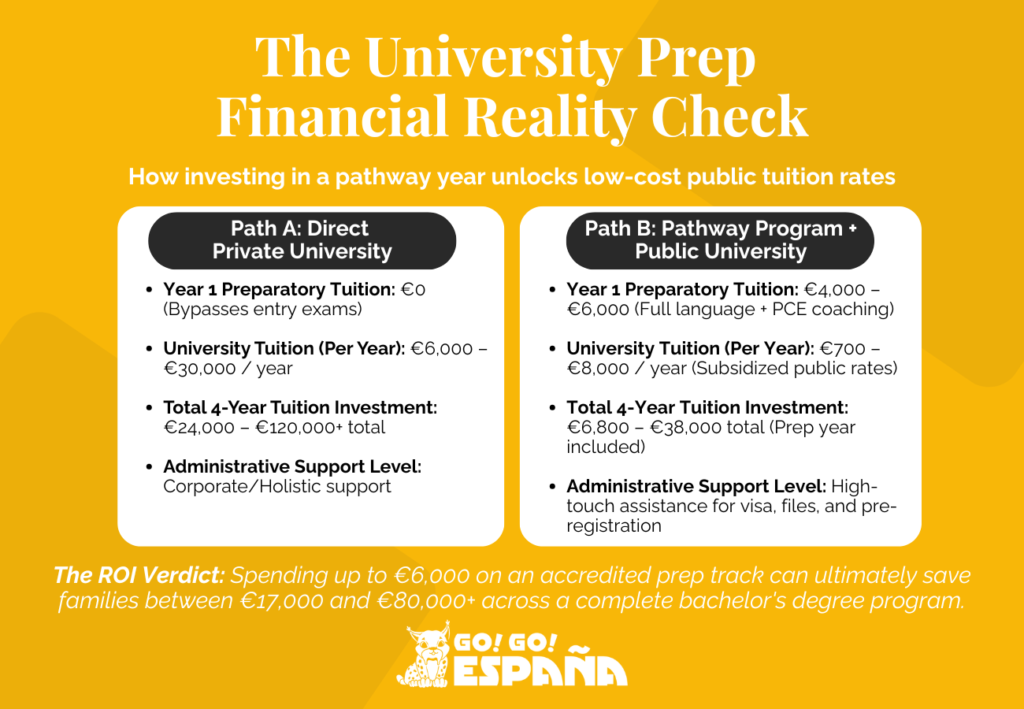
The total cost for a comprehensive, year-long pathway program typically ranges between €4,000 and €6,000. While this is a significant upfront expense, it is a highly efficient investment when you look at the total cost of your degree.
Table: Is a university pathway program worth the investment?
| Feature | Public University Tuition (per year) | Private University Tuition (per year) | Benefit of Pathway Program |
| Cost | €700 – €8,000 | €6,000 – €30,000 | Saves tens of thousands of euros by aiming for public university entry scores. |
| Entry Requirements | Higher | Lower | Helps achieve the higher scores needed for public universities. |
| Risk | High for independent applicants (visa/exam failure) | Lower, but higher cost | Acts as an insurance policy, significantly increasing success rate and mitigating loss. |
| Timeframe | Independent often takes 2 years (language + exams) | Varies | Condenses language and exam prep into a single academic year, saving 12 months. |
Spain Public vs. Private University Tuition
In Spain, public university tuition is heavily subsidized, costing between €700 and €8,000 per year. Private universities, which often have lower entry requirements, charge between €6,000 and €30,000 per year.
For students who qualify for a public university place, the savings over a four-year degree can be substantial. Investing in a pathway program to achieve the higher entry scores that public universities require can therefore pay for itself many times over.
Risk Mitigation
Navigating the Spanish university admissions process without guidance often leads to costly mistakes. Common failure points include errors in the visa application, exam registration, and the homologation process.
These mistakes can result in delays, rejections, and lost time without any academic progress to show for it. A pathway program significantly reduces these risks by providing expert support at every stage, increasing your chances of gaining university admission on the first attempt.
Avoiding the “Lost Year”
Without a structured program, many students find themselves spending one year on language learning and another on exam preparation. This stretches what could be a single academic year into two, adding an extra year of rent, food, and insurance costs on top of tuition.
A well-designed pathway program consolidates both phases into one continuous academic year, keeping you on track and minimizing unnecessary expenses.
FAQ About Spanish University Pathway Programs
1. What is a university pathway program in Spain?
A university pathway program is a comprehensive “bridge year” that combines intensive Spanish language training with academic preparation for the PCE entrance exams. It is designed to help international students meet the linguistic and academic requirements for admission into the Spanish university system.
2. How long is a university pathway course?
Most standard pathway programs last between 9 and 12 months. Start dates and durations vary by school; for example, Academia Guiu’s Annual Pathway runs from October through June, while shorter intensive tracks of 5 to 7 months are also available for students who already possess a functional level of Spanish.
3. Do pathway programs help with Spanish student visas?
Pathway programs themselves are not currently eligible for student visa applications. However, preparatory schools can support your visa process because their programs include a full-time Spanish language component, which is eligible for the student visa.
Schools provide the official enrollment letters and documentation that consulates require based on this language course enrollment. Many schools also offer guidance for the residency card (TIE) application once you arrive in Spain, though the level of support available will vary depending on the school you choose.
4. Is a pathway program worth it for public universities in Spain?
It is a highly cost-effective investment, as it prepares you to access public universities where tuition is only €700–€8,000 per year, compared to €30,000 at private institutions. Additionally, the program significantly increases your chances of success by maximizing your PCE scores and supporting the complex homologation process.
5. Can I do a Spanish foundation year/pathway online?
Yes, many leading academies offer online or hybrid formats where you can complete the initial language phase from your home country. Some schools also provide 100% digital PCE preparation, though a student visa usually requires an in-person component in Spain.
6. What is included in a combined Language + PCE program?
A combined program typically includes intensive Spanish lessons, specialized coaching in four to six PCE subjects, and full administrative support for visas and diploma recognition. Most schools also include mock exams, all study materials, and access to a virtual classroom with recorded sessions.
Summary: Spanish University Pathway Programs for International Students
Spanish University Pathway Programs are the essential bridge year for international students. They combine intensive language training and targeted PCE exam preparation to maximize scores on Spain’s 14-point university admission scale and achieve the mandatory B2 Spanish proficiency.
Beyond academics, the programs support critical administrative needs like student visas and diploma homologation, ensuring a smoother entry into the public university system. A pathway program is a strategic investment that reduces the risk of costly mistakes and opens the door to affordable, world-class Spanish education.
Ready to get started? Explore our college preparatory partner schools and find the pathway program that fits your goals.
Our expert advisors can help you build a personalized roadmap for your Spanish university journey. Get in touch today.


