


Our guide covers the complete process for the Spanish student visa, with instructions for applying from your home country or from within Spain.
Getting your Spanish student visa is the most important step in your study abroad journey. While the process requires careful preparation, it is a well-established procedure that hundreds of Go! Go! España students successfully complete every year.
This guide provides a deep dive into the student visa application. If you are just starting your research and want a broad overview of the entire journey, read our complete guide to learning Spanish in Spain.
(Last Updated: January 2026)
Key Takeaways:
- The most important first step is to determine your application path. You will either apply from your home country at a Spanish Consulate, or from within Spain if you are already there legally through a different kind of visa (such as tourist/schengen visa or digital nomad visa)
- Any non-EU citizen planning to study in Spain for longer than 90 days must obtain a student visa.
- Both application paths require the same key documents, including a school acceptance letter, proof of financial means, and comprehensive health insurance.
- Official documents from your home country, such as a criminal record check, will need to beofficially legalized with an Apostille to be valid in Spain. This is often much easier to do from your home country.
- Official documents from your home country also must be translated to Spanish or the co-official language of the territory in which you are submitting the documents (for example, Catalan or Galician) by a certified translator.
- If you are studying for more than 180 days, you must apply for a residency card (TIE) after you arrive in Spain.

What Determines Where and How to Apply for Your Spanish Student Visa?
When it comes to applying for your Spanish student visa, your path depends on two things: where you are located when you apply and what type of studies you will pursue.
Each comes with its own steps and considerations and taking a little time to understand them now will help you feel more confident and prepared.
Applying from Your Home Country
If you apply from home, you will fill out the National Visa Application Form and submit it through your local Spanish Consulate or Embassy. This route can often feel a bit more straightforward since you will have easier access to documents and familiar systems.
Applying from Within Spain
If you are already legally in Spain, perhaps on a tourist or digital nomad visa, you may be able to apply without leaving the country. In this case, you will complete a different form (EX-00) and submit your application at an Immigration Office (Oficina de Extranjería).
There is also an online option for students already in Spain. Because this process can be tricky, it is recommended to work with a lawyer to make sure everything is done correctly.
Is Your Program Eligible for Application in Spain?
Even if you are legally in Spain, not every program qualifies for the in-country application process. It also depends on the type of studies you are pursuing.
- Eligible: Enrolling in a bachelor’s or master’s program, or taking Spanish courses at an accredited Spanish university.
- Not eligible: Spanish courses at a language institute, even if the school is accredited by the Instituto Cervantes.
Things to Keep in Mind if Applying from Spain
If your program qualifies and you decide to apply from within Spain, just be prepared for a few extra challenges when gathering documents.
- Apostille requirements: Certain documents, like your criminal background check, must be apostilled (a form of international legalization). This is often much easier to take care of before leaving home. You can read our detailed guide on how to legalize and apostille a document for Spain.
- Medical certificates: Consulates usually provide specific templates for medical certificates. Tracking these down and getting the right form completed can sometimes be more complicated once you are already abroad.
We share these potential challenges not to discourage you, but to help you plan ahead. With the right preparation, you will have no troubles attaining a student study visa.
What are the Two Types of Spanish Student Visas?
There are two categories of Spanish student visas, determined by the length of your course. Both use the same application form, but the main differences are the documents required and whether you need to apply for a residency card (Tarjeta de Identidad de Extranjero or TIE) upon arrival.
Short-Term Student Visa (91–180 days)
If your course lasts 3 to 6 months, you’ll receive a visa that covers your entire stay. You do not need to apply for a residency card (TIE).
Long-Term Student Visa (Over 180 days)
If your course lasts more than 6 months, you’ll receive an initial 90-day visa. After arriving in Spain, you must apply for a residency card (TIE) within 30 days to validate your stay for the full duration.
Important: The 180-day countdown starts when you enter Spain, not when your course begins. Arriving early could push your stay over 180 days, meaning you’d need a long-term visa, even if your course is under 6 months.
For a practical plan that covers all your logistics, from budgeting to housing, use our If you are staying for more than 180 days, use our walkthrough on how to get your TIE card to complete your residency registration once you arrive..
How Do You Apply for a Spanish Student Visa from Your Home Country?
Applying for a student visa from your home country is the standard, most common, and often most recommended path for all international students.
Below you will find the steps on how to apply.
Application Steps to Follow When Applying From Your Home Country
- Get Accepted: First, you must be accepted into an accredited school in Spain and receive your official acceptance letter.
- Gather Your Documents: Use the detailed checklist in the next section to gather all required documents.
- Book Your Consulate Appointment: Schedule an appointment at the Spanish Embassy or Consulate that has jurisdiction over your place of residence. You can find the location closest to you here.
- Submit Your Application: Attend your appointment, submit all your documents, and pay the visa application fee. The deadline to submit your application is at least two months before the start date of your studies. There is no limit on how early you can apply, as applications can be accepted and processed at any time. However, the resolution granting the Student Visa will explicitly state that it becomes effective exactly one month before the studies begin. For example, if your studies officially start on October 1, 2025, the effective date of the long-term stay authorization will be September 1, 2025.
- Wait for the Decision: The Spain visa processing time is typically around one month, but it can be longer.
- Receive Your Visa: Once approved, you will receive your passport back with the visa sticker inside.
How Do You Apply for a Spanish Student Visa from Within Spain?
This path is an option for students who are already in Spain legally, and decide to enroll in a long-term course.
How to Know You Are Eligible to Apply from Within Spain
- You must already be in Spain legally. This could be on a 90-day tourist stay, a digital nomad visa, or another form of valid status.
- You must be enrolled in a degree seeking program, such as a bachelors or masters program, or Spanish language course at an accredited university. Language schools, even when accredited by the Instituto Cervantes, are not eligible. Explore your options in our comprehensive guide to Spanish courses in Spain.
- You must apply in time. Your application needs to be submitted at least 60 days before your current legal stay ends, as outlined by the Spanish Ministry of Immigration. There is also no limit on how early you can apply. As with applications submitted from your home country, the resolution granting the Student Visa will explicitly state that it becomes effective exactly one month before your studies begin.
Application Steps to Follow When Applying From Within Spain
- Get accepted into a school and prepare your paperwork. Secure your place at a university program and start gathering your documents. Many of them take over 30 days to be issued back home, so it’s a good idea to prepare as much as you can before traveling to Spain. (See the note below about online applications).
- Submit your application. You’ll present everything either at your local Immigration Office (Oficina de Extranjería) or through the online system.
- Consider getting legal support. The online process can be especially useful if you don’t yet have all the required documents ready. Our partner lawyers can file your application online with the documents you already have and then add the missing ones later. This flexibility can save you from running out of time on your legal stay.
- Wait for your decision. Once submitted, you’ll receive an official resolution (resolución) from the Immigration Office.
- Apply for your TIE. If your visa is approved, your final step will be applying for your Tarjeta de Identidad de Extranjero (TIE), the ID card that makes your stay in Spain official.
Your Master Checklist for Spanish Student Visa Application
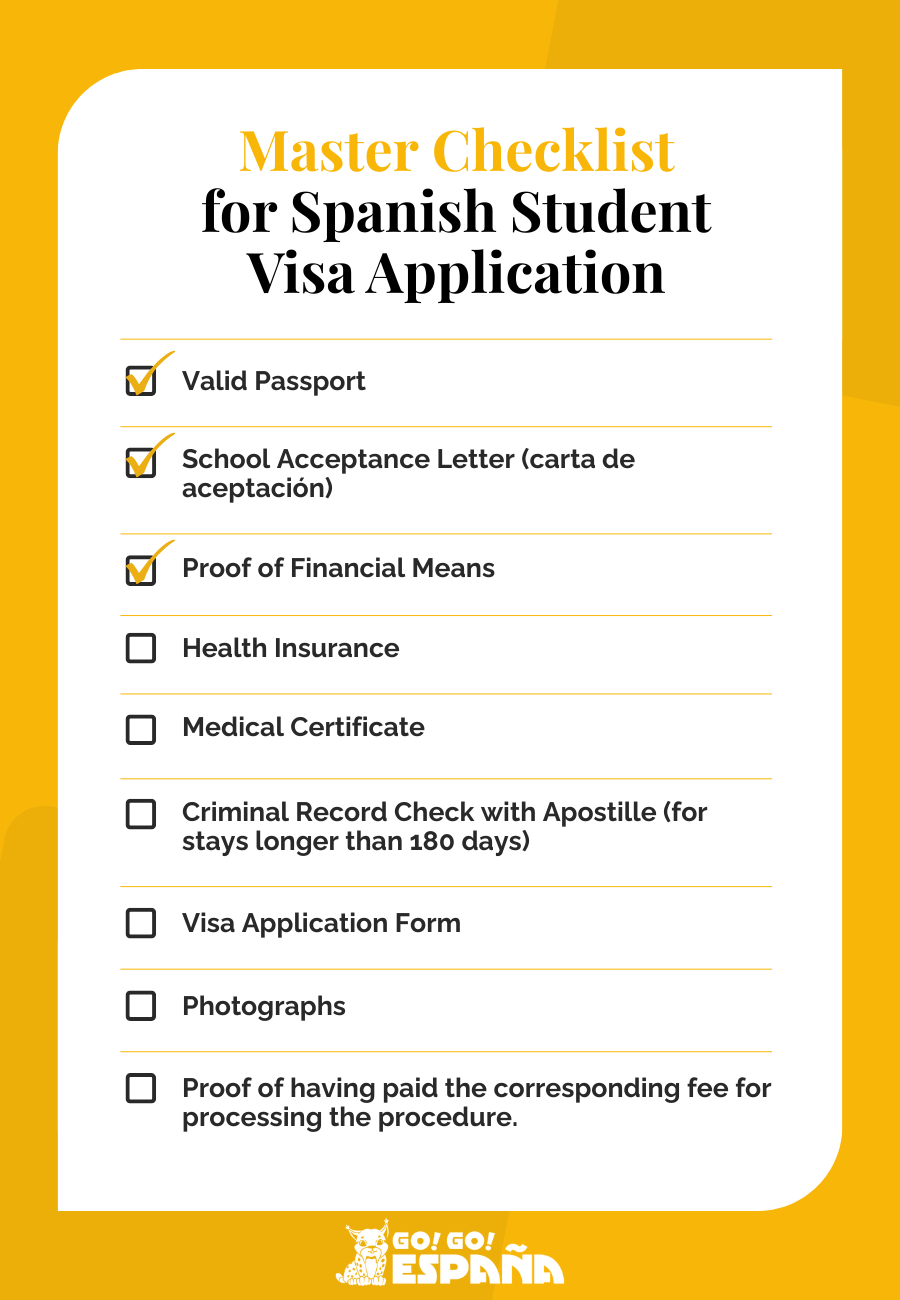
- Valid Passport
- School Acceptance Letter
- Proof of Financial Means
- Health Insurance
- Medical Certificate
- Criminal Record Check with Apostille (only if your stay is longer than 180 days)
- Visa Application Form
- Photographs
- Proof of having paid the corresponding fee for processing the procedure.
Important: Any documents issued outside of Spain must be translated into Spanish or into the co-official language of the region where you are applying (such as Catalan or Galician) by a certified sworn translator. If you require official translations of your documents, you can request a quote here.
Detailed Explanation of the Documents You Need for Your Spanish Student Visa Application
Regardless of where you apply, the core Spanish student visa requirements are the same. You will need proof of your identity, your studies, your financial stability, and your health.
Proof of Admission Into an Accredited Program
This is the one document that varies for every student. It must clearly show that you have been accepted into a full-time, accredited program in Spain. Find your student type below to see the specific proof you will need to provide.
A. For Spanish Language Students
You must submit an official acceptance letter (carta de aceptación) from an accredited Spanish language school. The letter should confirm that you are enrolled in a full-time, in-person program. Remote or hybrid courses are not eligible.
Eligible programs include:
- Language schools accredited by the Instituto Cervantes. Explore your options in our comprehensive guide to Spanish courses in Spain.
- Officially recognized universities that offer intensive Spanish courses
The letter must state:
- The name of your course
- The official start and end dates
- The number of study hours per week (typically 20 hours or more)
In addition to the acceptance letter, you will almost always need to provide a separate receipt showing that the course fees have been paid in full.
B. For University Degree Students
You must provide the official acceptance letter (carta de admisión) from a recognized Spanish university for a full-time degree program.
This letter must confirm your enrollment in a Bachelor’s (Grado), Master’s (Máster), or PhD (Doctorado) program. These programs may be hybrid, as long as at least 50% of the classes are held in person.
It is also common to be asked for proof of your first tuition payment to the university.
C. For College Entrance Exam Takers
You must provide an official enrollment certificate for a full-time university preparation course designed for the PCE or EBAU exams. This certificate must come from a recognized academic center and confirm that you are enrolled in a full-time program that is held in-person. Remote formats are not accepted.
Important: Enrollment in PCE and EBAU exam preparation courses alone is no longer sufficient to obtain a student visa. To qualify, you must combine these preparatory courses with Spanish language classes. This combination is currently accepted by Spanish Consulates and Embassies for student visa purposes.
It is very important that your acceptance letter clearly states that you are enrolled in Spanish courses in addition to your exam preparation courses.
Other Universal Documents for Spanish Student Visa Application

A Valid Passport
You must have a valid, unexpired passport with at least two blank pages, and it must remain valid for the entire duration of your planned stay in Spain. Your passport is your most important form of identification, so double-check its validity before applying. Note that passports issued more than 10 years ago are not accepted, even if they are still technically valid.
A Completed Student Visa Application Form
This is the official government form required to request your student visa.
You can download the National Visa Application Form directly from the website of the Spanish Embassy or Consulate where you will submit your application. Always use the version provided by your local consulate, as requirements can vary.
See our tips on how to fill out the National Visa Application Form here.
If applying from within Spain, you will instead complete the modelo oficial (EX-00).
Passport-Sized Photos
You will need one or two recent, passport-sized color photographs. These must be taken against a plain white or light background, show you facing forward with a neutral expression, and be free of glasses or anything that obscures your face.
Proof of Financial Means
You must demonstrate that you have sufficient funds to support yourself throughout your stay without needing to work.
As a general rule, this means proving access to 100% of Spain’s monthly IPREM (around €600 per month). For a one-year stay, this totals at least €7,200. At Go! Go! España, we recommend showing a minimum of €10,000 to strengthen your application.
Acceptable proof includes recent bank statements, a scholarship award letter, or a notarized letter of financial support from your parents.
To calculate your total expected expenses and ensure your savings meet the threshold, see our guide on the cost of studying in Spain.
A Compliant Private Health Insurance Policy
You must hold comprehensive private health insurance from a company authorized to operate in Spain. The policy must:
- Have no co-payments (sin copagos)
- Cover your entire stay
- Provide coverage equivalent to Spain’s public health system
This requirement is one of the most common causes of visa rejection, so pay close attention to compliance. Standard travel insurance does not qualify.
At Go! Go! España, we recommend Universitas Mundi Asisa’s policy, as it meets all official requirements.
To ensure your coverage meets the strict criteria for a student visa, read our specialized guide on student health insurance in Spain.
A Medical Certificate
This certificate must be signed by a licensed doctor and confirm that you do not have any diseases that could pose a public health risk in Spain.
Many consulates provide the required wording (often in both English and Spanish), and it must appear on the document, usually on official letterhead.
A standard example is a statement verifying that you do not suffer from any disease with serious repercussions for public health, in line with the 2005 International Health Regulations.
A Criminal Record Check with Apostille (for stays over 180 days)
Applicants staying longer than 180 days must submit a criminal background check issued by the police authority of their home country (for example, the FBI in the U.S.). This certificate must be:
- Issued within the last 3–6 months
- Legalized with an Apostille (an internationally recognized certification)
- Translated into Spanish, if not already
Because this process can take significant time, both to obtain the record and to secure the Apostille, we strongly recommend starting this step as early as possible.
How to Legalize and Apostille a Document
Need to get your documents legalized? See our country-specific guides on how to legalize and apostille a document:
- How to Apostille a Document in the US
- How to Apostille a Document in Australia
- How to Apostille a Document in Canada
- How to Apostille a Document in the UK
Remember, this document must be translated into Spanish or the co-official language in the territory for which the application is being submitted by a sworn translator.
What are the Most Common Mistakes to Make When Applying for a Spanish Student Visa?
The Spanish student visa process is very meticulous, and even small mistakes can lead to delays or rejection. The most common reasons include incomplete applications, incorrect documentation (especially for health insurance), and missed deadlines.
The good news is that, unlike many other countries, Spanish immigration authorities often give applicants a second chance when the error is minor. For example, if you forget to attach a required document, you’ll usually receive a rejection notice explaining the issue and be given around 10 days from the date of notification to correct it.
Still, the best approach is to avoid these issues from the start. By carefully reviewing your documents, meeting deadlines, and double-checking requirements, you can strengthen your student visa application for Spain.
The 5 Most Common Mistakes to Make When Applying for a Spanish Student Visa
- Incorrect Health Insurance
This is one of the most frequent reasons for rejection. Submitting standard travel insurance or a policy with co-payments (copagos) will result in automatic denial/correction request. Your policy must meet the strict requirements set by the Spanish consulate. - Insufficient Financial Proof
You must clearly demonstrate that you meet the minimum financial requirement of 100% of Spain’s monthly IPREM. Having the exact amount in your account may not be enough. Consulates want to see stable, consistent funds. - Missing an Apostille
Official documents, such as your criminal record check, must be legalized with an Apostille. Forgetting this step makes the documents invalid. - Forgetting to Translate Documents
All official documents must be translated into Spanish or the co-official language in the territory for which the application is being submitted by a sworn translator. - Applying Too Late
From gathering documents to consulate processing times, the entire process can take several months. Starting just one or two months before your program begins puts your visa approval at serious risk.
What Happens After Your Student Visa is Approved?
Congratulations, your Spanish student visa application was successful! Here is what to expect next.
Receiving Your Visa
Once approved, you will receive your passport back with a visa sticker affixed to one of its pages. This sticker is your official authorization to travel to Spain for your studies. When you arrive, immigration officers will stamp your visa, which marks the official start of your legal stay.
If You Are Staying 91–180 Days
Your visa sticker is typically valid for the entire duration of your stay. No additional administrative steps are required.
If You Are Staying More Than 180 Days
Your visa sticker is valid only for the first 90 days. Within 30 days of your arrival in Spain, you must complete two important steps:
- Register for your Certificado de Empadronamiento. This is the local registration that confirms your residence in Spain.
- Apply for your TIE card (Tarjeta de Identidad de Extranjero). This is your official residency permit for the length of your studies.
Both steps are mandatory for long-term students.
If you are staying for more than 180 days, use our walkthrough on how to get your TIE card to complete your residency registration once you arrive.
FAQ About Applying for a Spanish Student Visa
Can I apply for a student visa if I am already in Spain as a tourist?
Yes, but you must meet strict requirements. You need to be in Spain legally, submit your application at least 60 days before your legal stay ends, and be enrolled in an accredited university (Spanish courses or degree-seeking studies are both valid).
Keep in mind that obtaining required documents, such as an apostilled background check from your home country, can be difficult while in Spain.
We recommend applying online with the help of an immigration lawyer for a smoother process and higher chances of visa approval.
What is the most common reason for a visa rejection?
One of the most frequent reasons for rejection is submitting an incorrect health insurance policy. The policy must be from a company authorized in Spain and have no co-payments (sin copagos). Incorrect or insufficient proof of financial means is another common reason.
At Go! Go! España, the most common reason for rejection among our students is the failure to clearly demonstrate a genuine intent to study in Spain.
This requirement is especially important for applicants from countries with historically higher visa rejection rates. Students from countries that do not require a visa to enter Europe do not usually get their visa rejected.
How much money do I need to show for my student visa?
You must prove you have access to 100% of Spain’s monthly IPREM, which is roughly €600 per month. For a one-year stay, this totals at least €7,200. We recommend 10,000 € at Go! Go! España to be on the safe side.
How long does the visa application process take?
If you apply from your home country, the Spain visa processing time is typically around one month, but it can be longer.
If you apply for a student visa from within Spain, the process can take several months. Don’t worry, once your application is submitted you can stay in Spain even if your tourist visa expires while you wait for a decision.
Do I need a visa if my language course is only two months long?
No. For courses lasting 90 days or less, you do not need a student visa. However, depending on your nationality, you may need a Schengen Visa to enter Spain. For a broader look at how this fits into your overall timeline, refer to our step-by-step planner for studying in Spain.
Conclusion: Ready to Start Your Student Visa Application?
The Spanish student visa process may seem complex, but with careful preparation and the right guidance it is completely achievable. This is your first step toward an exciting academic adventure and a life-changing experience abroad.
As a specialized study abroad company in Spain, we provide technical reviews of your documents to maximize your chances of success.
You don’t have to navigate it alone. At Go! Go! España, our Visa Support Service will guide you through every step. With our help, you can focus on what truly matters, embracing your studies and the experience of living in Spain. Contact us today!


