Skip to content


Compare costs, languages, and degrees to find your perfect match for the Spanish higher education system.
Spain has reached a pivotal inflection point as a premier destination for global talent as we approach the 2026 academic year. While often overshadowed by the United States and United Kingdom, Spain now offers a unique synthesis of high-quality business education and a rapidly modernizing legislative environment for foreign workers, hence becoming an even more appealing study destination.
The academic drawcard for international students goes beyond the lifestyle. It is about the “Iberian Discount”, accessing world-class education at Triple Crown schools for a fraction of the cost of Northern European or American alternatives. However, navigating this landscape requires an in-depth understanding of complex situations, specifically the difference between Título Oficial (Official) and Título Propio (Private) degrees. To view a complete directory of public and private university tracks that do not require full Spanish fluency, check out our guide to English universities in Spain.
This guide provides a definitive breakdown of the Spanish graduate education landscape. We will compare the ROI of MBAs versus specialized MScs, clarify the legal implications of your degree choice, and explain the new visa regulations that allow students to work while they study.
Key Takeaways
- Official vs. Private: The most critical distinction is between Título Oficial (Official Degree), which grants access to PhD programs and public jobs, and Título Propio (Private Degree), which is agile and career-focused.
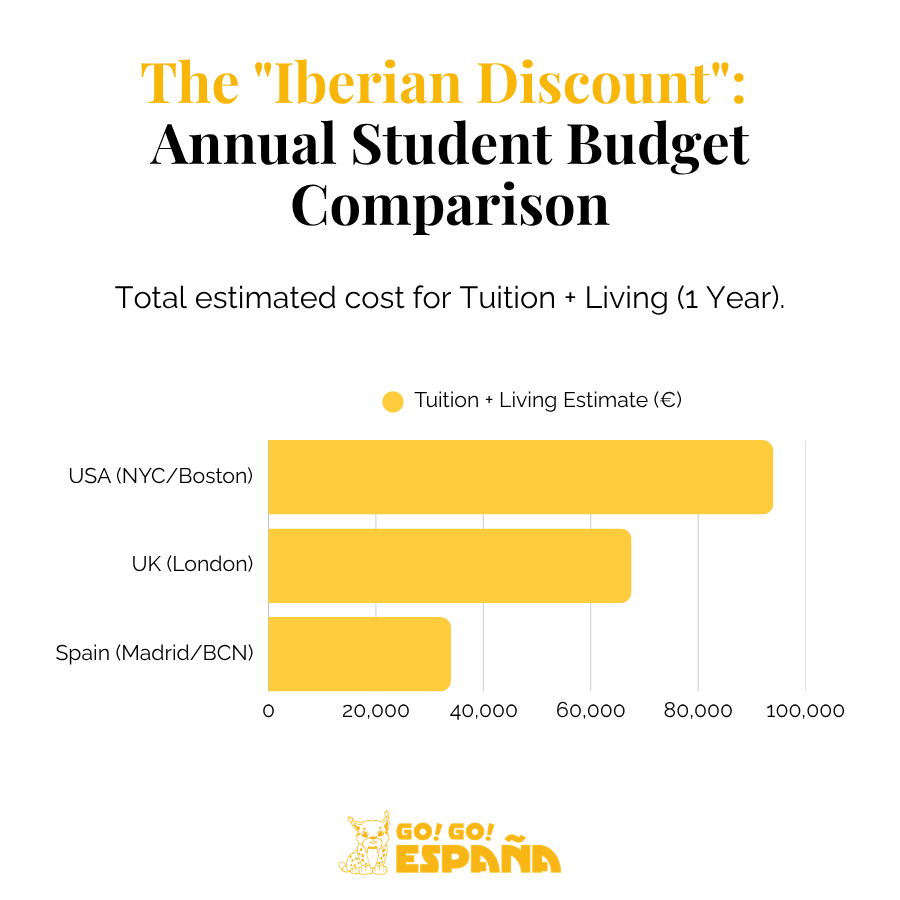
- The “Iberian Discount”: A student can fully fund a degree and living expenses in Spain for nearly one-third the cost of a US degree (~€34,400 vs. ~€94,000).
- Working Rights: Under new 2026 regulations, the Student Visa automatically applies the right to work for up to 30 hours per week, removing the need for separate employer sponsorship.
- Language Strategy: While English is sufficient for tech roles in hubs like Barcelona, attaining a B2 level in Spanish doubles your opportunities in the job market across traditional corporate sectors.
- MBA ROI: Graduates from top Spanish business schools like IESE or IE often see salary increases of 100% to 150% within three years of graduation.
- Post-Study Residency: Graduating from a Spanish institution allows you to apply for the Job Search Visa (Búsqueda de Empleo), granting you 12 months to find employment or start a business without needing a job offer first.
- Fast-Track for Talent: Graduates securing a job with a salary over ~€40,000 (or ~€30,000 for specific tech roles) can access the Highly Qualified Professional (HQP) Permit, which bypasses the standard “labor market test” and processes in just 20 days.
Table of Contents
What is the Spanish Equivalent of a Master’s Degree? (Official vs. Private)

To successfully navigate the Spanish higher education system, students must distinguish between the state-regulated Título Oficial and the market-driven Título Propio.
The structure of Spanish higher education operates on a two-part model where the legal status of the degree dictates your future academic mobility.
1. Official Master (Máster Universitario / Título Oficial)
This is a degree regulated by the ANECA (National Agency for Quality Assessment) and issued by the King of Spain and the Ministry of Education.
- Legal Status: It is recognized across all 49 countries of the European Higher Education Area (EHEA).
- Best For: Students who plan to pursue a PhD (Doctorate) or work in regulated professions (ex: Lawyer, Architect, Engineer, Psychologist). It is also required for government jobs (Oposiciones).
- Academic Focus: These programs often have a stronger emphasis on research and academic theory.
2. Private Degree (Título Propio / Máster Propio)
These are “University-specific” degrees designed by the institution itself to bypass slow bureaucratic approval processes.
- Flexibility: Because they don’t require government validation, universities can update the curriculum annually to match the speed of the market (ex: Fintech, Digital Marketing, AI).
- Best For: Students seeking immediate entry into the private sector. These degrees are highly valued by multinational companies for their practical, “hands-on” approach.
- Limitations: A Título Propio does not grant access to PhD programs.
Did You Know?
A Título Propio is not “unrecognized.” In the private sector, especially among startups and multinationals, a private degree from a top-tier business school often commands higher prestige than an official degree from a lesser-known public university due to its practical focus.
Learn more:
Structural funding differs between state-subsidized and independent universities, impacting your costs and European career mobility. Understand these frameworks and admission rules in our guide to private and public universities in Spain.
Is Spain a good place to study for a master’s degree?

Yes, it is a good place to study for a Master’s Degree. It combines elite academic institutions with an unmatched quality of life, offering a strategic launchpad for global careers at a fraction of the cost of US or UK competitors.
Beyond the obvious appeal of the climate and culture, Spain has cemented itself as a powerhouse in global higher education. Here is why thousands of international students choose Spain for their postgraduate studies every year.
1. Global Prestige and “Triple Crown” Schools
Spain is home to some of the world’s most respected business schools. Institutions like IESE Business School, IE Business School, and ESADE consistently rank in the top tiers of global lists by Financial Times, QS, and Bloomberg.
- The “Holy Trinity”: These schools hold the coveted “Triple Crown” accreditation (AACSB, AMBA, EQUIS), a distinction held by less than 1% of business schools worldwide.
- Employer Reputation: A degree from these institutions is recognized globally, opening doors to top-tier multinational corporations not just in Spain, but in London, New York, and Singapore.
2. An Unbeatable Lifestyle
Quality of life is often cited as the number one reason students choose Spain. It offers a safe, vibrant environment that balances academic rigor with personal well-being.
- Safety: Spain consistently ranks as one of the safest countries in Europe for international students.
- Culture & Gastronomy: From world-class museums in Madrid to the architectural wonders of Barcelona, students are immersed in a culture that values history, art, and social connection.
- Cost of Living: Compared to other major educational hubs like London or Paris, Spanish cities offer a significantly lower cost of living without sacrificing infrastructure or entertainment.
Pro tip: While daily living costs (food, transport) are low, rent in Madrid, Barcelona, and Valencia has risen sharply. Competition for apartments in September is fierce. Do not wait until you arrive to look for housing. Book a temporary stay (1–2 months) or use a trusted student housing platform at least 4 months in advance.
Additionally, utilise Go! Go! España’s cost of living calculator for a more detailed estimation of what you can expect to spend as a student in Spain.
3. A Strategic Global Bridge
Spain’s geographical and cultural position makes it a unique hub for international business.
- Gateway to Europe: As a key member of the European Union, a Spanish degree grants you access to the entire European labor market.
- Bridge to Latin America: Spain serves as the primary European entry point for Latin American markets. For students interested in international relations or global trade, this dual connection between the Eurozone and the Spanish-speaking world provides a competitive edge that no other European country can offer.
Master’s (MSc) vs. MBA: Which Path Fits Your Profile?
The choice between an MBA and a specialized MSc depends largely on your years of work experience and your desire for generalist leadership training versus technical specialization.
The decision matrix for choosing between these two paths is driven by your experience level and expected salary.
Learn more: Look at our curated profiles of elite business campuses in our directory of MBA schools universities Spain.
The MBA (Master of Business Administration)
This path is designed for professionals with significant work experience (typically 3 – 8 years). The curriculum focuses on leadership, strategy, and networking. Top Spanish schools like IESE, IE, and ESADE hold “Triple Crown” accreditation and offer substantial ROI, with graduates often seeing salary increases of over 100% within three years.
The MSc (Master of Science)
These programs cater to recent graduates (“pre-experience”) or early-career professionals. They are significantly more affordable, with tuition at public universities often ranging between €5,750 and €13,500 for non-EU students. While starting salaries are lower than MBAs (€30k – €45k), the lower initial investment means a shorter time for ROI.
Comparison of Degree Types
| Feature | MBA (Top Tier) | Specialized MSc (Public/Private) |
| Ideal For | Experienced Professionals (Age 29+) | Recent Grads / Specialists (Age 23+) |
| Focus | Leadership & Strategy | Technical Skills (ex: Big Data, Finance) |
| Tuition (Est.) | €30,000 – €82,000 | €4,000 – €29,000 |
| Avg. Salary | €70,000+ (Post-Graduation) | €30,000 – €45,000 |
Learn more:
Early-career students weighing immediate employment against specialized certificates can find essential context on business curriculums and entry options in our Bachelor of Business Administration in Spain full guide.
Are there Master’s Degrees in English in Spain?

Yes, there are Master’s Degrees in English in Spain. While thousands of international students flock to English-taught programs, success in the local labor market often requires bilingual skills.
Spain has strongly adapted to the global market, with universities offering over 800 degrees fully or partially in English.
- The “English-Only” Bubble: In tech hubs like Barcelona’s 22@ district and Madrid’s fintech sector, English is often the working language. Companies like Glovo and TravelPerk recruit aggressively for English speakers in engineering and product roles.
- The Corporate Ceiling: For traditional sectors like banking and consulting, fluency in Spanish (C1 level) is mandatory for client-facing roles. Without it, graduates may hit a bit of a bump in the road with job applications.
- Strategic Advice: Treat your Master’s year as a language immersion opportunity. Reaching even a B2 level of Spanish can double your potential positions in the job market.
Top Master’s Degrees by Field in Spain
Spain offers a vast array of specialized Master’s Degrees tailored to the demands of the modern labor market. Below is a breakdown of the most popular fields, starting with business and management.
We have curated a list of top Master’s Degree programs from our partner network in Spain, categorized by industry.
Master in Business
Spain is globally renowned for its business education, hosting some of the top-ranked business schools in Europe. Students can choose from a wide variety of specializations, many of which are taught entirely in English or offer online flexibility.
Available Business Master Degrees
- Business Administration (MBA)
- Business and Finance
- International Business Management
- Big Data and Business Analytics
- Digital Business
- Entrepreneurship and Business Venturing
- Innovation & Entrepreneurship
- Corporate Finance
- International Trade & Business
- Business Legal Advice
- Political and Business Communication
- Strategic Business Planning, Analysis, and Decision Making
Where to Study for a Master in Business?
| Location | Institutions |
| Madrid | Universidad Carlos III de Madrid (UC3M)Camilo José Cela UniversityNebrija UniversityComplutense University of Madrid (UCM) |
| Barcelona | EU Business SchoolC3S Business SchoolPompeu Fabra University (UPF) |
| Multiple Campuses(Madrid, Barcelona, Valencia) | ESIC Business & Marketing SchoolUniversidad Europea (Valencia, Madrid)ESERP Business SchoolGBSB Global Business School |
| Murcia | UCAM (Universidad Católica San Antonio de Murcia) |
Quick Facts:
- Typical Duration: 9 to 12 months.
- Estimated Cost: Between €4,000 and €15,000 (total program cost), depending on the institution and format (online vs. in-person).
Master’s in Advertising and Marketing
Spain is a creative powerhouse, home to award-winning agencies and a rapidly growing digital ecosystem. Studying marketing here allows students to blend traditional strategic frameworks with cutting-edge digital trends in a vibrant, international environment.
Advertising and Marketing Master’s Degrees on offer include:
- Marketing Management
- Digital Marketing
- Marketing
- Advertising Communication
- Marketing and Commercial Management
- Advertising and Public Relations
- Marketing & Commercial Innovation
- Digital Marketing and Social Media Management
- Marketing and Luxury Business Management
- Marketing and Communication
Where to Study Master’s in Advertising and Marketing?
| Location | Institutions |
| Madrid | Universidad Carlos III de Madrid (UC3M)ESIC Business & Marketing SchoolESERP Business SchoolNebrija UniversityGBSBEAE Business SchoolUniversidad Europea |
| Barcelona | ESIC Business & Marketing SchoolGBSBESERP Business SchoolEAE Business SchoolEU Business School |
| Valencia | ESIC Business & Marketing SchoolUniversidad Europea |
| Murcia | UCAM (Universidad Católica San Antonio de Murcia) |
Language Options (English)
While many programs are available in Spanish, several top institutions offer 100% English tracks for international students:
- EU Business School: All courses are taught entirely in English.
- ESERP Business School: Offers English tracks for Marketing & Commercial Innovation, Marketing & Commercial Management, and Marketing and Luxury Business Management.
- ESIC Business & Marketing School: Both the Master in Marketing Management and Master in Digital Marketing are available in English.
- Universidad Europea & GBSB: Offer programs fully in English.
Quick Facts
- Typical Duration: 9 to 12 months.
- Estimated Cost: Between €4,600 and €14,900 (total program cost), varying by school and specialization.
Master in Communication
Spain’s media landscape is undergoing a digital revolution, making it an exciting place to study communication. From the major broadcasting hubs in Madrid to the creative production scenes in Barcelona, students can access programs that blend traditional journalistic rigor with modern digital storytelling and production management.
Communication Master’s Degrees in Spanish universities include:
- Film and Television
- Communication and New Technologies Management
- Journalism
- Digital Journalism
- Direction and Production of Fictional Series
Where to Study Master’s in Communication
| Location | Institutions |
| Madrid | Universidad Carlos III de Madrid (UC3M)ESIC Business & Marketing SchoolNebrija University |
| Barcelona | ESIC Business & Marketing School |
| Valencia | ESIC Business & Marketing School |
| Multiple Campuses | Universidad Europea |
Quick Facts:
- Typical Duration: 9 to 12 months.
- Estimated Cost: Between €8,900 and €14,900 (total program cost), depending on the institution and specialization.
Master’s in Design, Technology & Arts
Spain is a global leader in design, fashion, arts, technology and architecture, with Barcelona and Madrid serving as vibrant hubs for creativity and innovation. Studying here means immersing yourself in a culture that produced Gaudi and Balenciaga, while accessing state-of-the-art labs and industry connections.
Design-related Master’s Degrees in Spain:
- Design Management
- Fashion Management
- Interaction Design
- Interior Design for Commercial Spaces
- Automotive Interior Design
- Interior Space Design Methodology
- Service Design
- Game Design
- Motion Animation
- Game Development
- 3D Character Animation
- Digital Compositing for VFX
- Animation, Games and VFX
- Character Design
- Graphic Computing, Virtual Reality and Simulation
- Virtual Design
- Design for Urban Environment
- Digital Fabrication and Media
- Fashion Styling and Communication
- Professional Photography
- Product Design Labs
- Strategic Design Labs
- Fashion Styling, Advertising and Audiovisual Media
- Design of Footwear, Bags and Leather Goods Collections
Where to Study Master’s in Design?
| Location | Institutions |
| Madrid | IED Istituto Europeo di DesignU-tad |
| Barcelona | LCI Barcelona, School of DesignIED Istituto Europeo di Design |
| Valencia | LABA Valencia |
| Multiple Campuses | Universidad Europea |
Language Options
- IED Istituto Europeo di Design: Offers numerous Master’s Degrees in both Spanish and English across its Madrid and Barcelona campuses.
Quick Facts
- Typical Duration: 6 to 12 months.
- Estimated Cost: Between €9,980 and €13,500 (total program cost).
Master in Sports and Health Sciences
For students passionate about athletics, clinical health, and high-performance training, Spain is a world-class destination. Universidad Católica San Antonio de Murcia (UCAM) is widely recognized as the “University of Sports” in Spain. It is our top recommendation for this field, boasting professional teams and Olympic-standard facilities, with most degrees available in both Spanish and English.
- High-Performance Sport: Strength and Conditioning
- Physiotherapy in Sport
- Health Services Management and Planning
- Nutrition in Physical Activity and Sport
- Clinical Nutrition
- Psychology of Sport and Physical Activity
- Sports Traumatology
Where to Study for a Master in Sports and Health Sciences?
| Location | Institutions |
| Murcia | UCAM (Universidad Católica San Antonio de Murcia) |
| Multiple Campuses | Universidad Europea |
Quick Facts
- Typical Duration: Around 10 months.
- Estimated Cost: On average €5,100 (total program cost), making it one of the most affordable options for high-quality specialized education in Europe.
Master’s in Hospitality and Tourism
As one of the world’s most visited destinations, Spain is the ultimate classroom for hospitality and tourism professionals. Students here don’t just learn theory; they immerse themselves in a sector that sets global standards for service, gastronomy, and tourism management.
- Catering Management
- Hotel Management
- Events Manager
- Responsible and Sustainable Tourism
- Tourism Management of Culinary and Gastronomic Heritage
- Tourism Management of Natural and Cultural Heritage
Where to Study for Master’s in Hospitality and Tourism?
| Location | Institutions |
| Barcelona | CETT School of Tourism, Hospitality, and Gastronomy |
| Barcelona (Sant Pol de Mar) | StPOL University College of Hospitality Management and Culinary Arts |
| Murcia | UCAM (Universidad Católica San Antonio de Murcia) |
| Multiple Campuses | GBSB Global Business School |
Program Highlights & Quick Facts
- CETT School of Tourism, Hospitality, and Gastronomy:
- Languages: Catering Management and Hotel Management are available in both English and Spanish.
- Typical Duration: Around 9 months.
- Estimated Cost: Average of €8,497 (total).
- StPOL University College:
- Languages: Both Culinary Arts and Kitchen Management and Hospitality Management are available in English.
- Typical Duration: Around 14 months.
- Estimated Cost: Between €14,920 and €16,850 (total).
Master’s in Engineering
Spain produces some of the world’s finest engineers, known for their versatility and technical rigor. For international students, Universidad Carlos III de Madrid (UC3M) is our top recommendation for this field due to its vast selection of English-taught programs and its strong reputation in the industrial and aerospace sectors.
Masters in Engineering Programs in Spain:
- Clinical Engineering
- Electronic Systems Engineering
- Industrial Mechanics
- Informatics Engineering
- Information Health Engineering
- Mechanical Engineering and Transportation
- Space Engineering
- Structural Engineering of Industrial Constructions
- Robotics and Automation
- Industrial Engineering
- Environmental Engineering
- Roads, Channels and Port Engineering
Where to Study for a Master’s in Engineering?
| Location | Institutions |
| Madrid | Universidad Carlos III de Madrid (UC3M)Nebrija UniversityPolytechnic University of Madrid (UPM) |
| Barcelona | Polytechnic University of Catalonia (UPC) |
| Murcia | UCAM (Universidad Católica San Antonio de Murcia) |
| Multiple campuses | Universidad Europea |
Program Highlights & Quick Facts
- Universidad Carlos III de Madrid (Top Recommendation):
- Offers a vast selection of degrees in both Spanish and English.
- Typical Duration: Around 9 months.
- Estimated Cost: Average of €8,900 (total).
- Nebrija University:
- Typical Duration: Around 10 months.
- Estimated Cost: Average of €11,000 (total).
- UCAM (Universidad Católica San Antonio de Murcia):
- Typical Duration: Around 10 months.
- Estimated Cost: Average of €7,500 (total).
Master’s in Social Sciences
Spain’s rich political history and strategic position within the European Union make it a fascinating place to pursue advanced studies in law, economics, and international relations. Programs here are heavily integrated with EU legal frameworks and global economic trends, offering students a competitive edge in international policy and legal sectors.
Master’s in Social Science-related courses include:
- Social Sciences
- European Union Law
- Business Legal Advice
- Criminal and Criminal Procedural Law
- Labor Legal Consulting
- Civil Liability
- Economics
- Industrial Economics and Markets
- Economic Development and Growth
- Access to the Profession of Lawyer
- Public Security and Defense Policies
- Legal Practice
Where to Study for a Master’s in Social Science-related Courses:
| Location | Institutions |
| Madrid | Universidad Carlos III de Madrid (UC3M)Nebrija UniversityCamilo José Cela UniversityESERP Business School |
| Barcelona | ESERP BusinessAutonomous University of Barcelona (UAB) School |
| Multiple Campuses | Universidad Europea |
Program Highlights & Quick Facts
- Universidad Carlos III de Madrid (UC3M):
- Offers a wide range of degrees, many available in English.
- Typical Duration: Around 9 months.
- Estimated Cost: Average of €8,900 (total).
- Nebrija University:
- Typical Duration: 10 months.
- Estimated Cost: Average of €9,650 (total).
- Other Top Options (Camilo José Cela University & ESERP):
- Typical Duration: Between 9 and 10 months.
- Estimated Cost: Between €6,500 and €7,900 (total).
Master’s in Languages
Spain is arguably the best place in the world to specialize in language education, particularly for those looking to teach Spanish globally. With Spanish being the second most spoken native language in the world, these degrees offer immense career mobility. Programs here often combine advanced linguistic theory with practical teaching methodologies in a fully immersive environment.
Language-related Master’s Degrees in Spain include:
- Teaching Spanish as a Foreign Language
- Modern Languages
- Linguistics Applied to Teaching Spanish as a Second Language
- Bilingual Teaching
Where to Study for a Master’s in Language in Spain?
| Location | Institutions |
| Madrid | Nebrija UniversityCamilo José Cela University |
Program Highlights
- Nebrija University: Widely considered a reference point for Teaching Spanish as a Foreign Language (ELE). Their applied linguistics programs are highly respected in the academic community.
- Camilo José Cela University: Offers strong programs focused on bilingual education and modern pedagogical techniques.
Quick Facts
- Typical Duration: 10 months.
- Estimated Cost: Between €6,500 and €6,800 (total program cost), offering excellent value for specialized teacher training.
How long is a master’s degree in Spain?
- Standard: 1 year (60 ECTS).
- Exceptions: 1.5 – 2 years (90–120 ECTS) for research/engineering.
- Time-to-Market: Compare with the US 2-year standard.
Is a Master’s Degree in Spain worth it?
Spain offers a massive “value arbitrage” opportunity, allowing students to access first-world education and infrastructure at Southern European prices.
When adjusting for the cost of living and tuition debt, the “Real ROI” often favors Spain over the US or UK. While entry-level salaries in the US are higher, the cost of attendance is drastically different.
- Tuition Savings: A top-tier US MBA can cost upwards of $150,000 in tuition alone. In contrast, a highly ranked MBA in Spain at a school like EAE ranges from €28,500 to €32,900.
- Living Costs: Madrid is approximately 42% cheaper than London and nearly 60% cheaper than New York. A student can live comfortably in Madrid or Barcelona on a budget of €1,000–€1,200 per month, compared to €2,300+ for only basic living expenses in London.
Annual Student Budget Comparison (Tuition + Living)
| Location | Total Year 1 Cost (Est.) |
| USA (NYC/Boston) | ~€94,000 |
| UK (London) | ~€67,600 |
| Spain (Madrid/BCN) | ~€34,400 |
Did You Know?
In regions like Andalusia, tuition for public universities is heavily subsidized, with annual costs potentially dropping below €1,000 for Master’s programs, providing the best financial efficiency in Western Europe.
Learn more:
Local living costs vary, so precise budgeting prevents financial shortfalls. To plan your housing and leisure expenses, view our guide on the cost of studying in Spain.
FAQ about Master’s Degrees in Spain for International Students
1. What is the difference between an Official Master and a Private Master?
An Official Master (Título Oficial) is regulated by the state and allows access to PhD programs and public sector jobs. A Private Master (Título Propio) is designed by the university for the private labor market, offering a more practical, agile curriculum but no PhD access.
2. Can I work while studying for my Master’s in Spain?
Yes. Under the new regulations, your student visa allows you to work up to 30 hours per week without needing your employer to sponsor a separate work permit.
3. Is a Spanish MBA recognized in the USA or UK?
Yes, especially if it comes from a “Triple Crown” accredited school (like IE, IESE, or ESADE) or a recognized institution. Official degrees are recognized across the entire European Higher Education Area (EHEA).
4. Is it better to study in English or Spanish for local employment?
For the degree itself, studying in English is perfectly viable, with hundreds of high-quality options available. However, for employability in Spain, we strongly recommend using your study year to learn Spanish. While tech startups often operate in English, traditional sectors (Consulting, Banking, Law) usually require professional fluency in Spanish.
5. How long is a Master’s degree in Spain?
Most Master’s degrees in Spain are designed to be completed in one academic year (60 ECTS credits). Some research-intensive or highly specialized programs (especially in Engineering or Architecture) may last 1.5 to 2 years (90–120 ECTS).
6. How much does a Master’s degree cost in Spain?
It varies widely. Public universities can cost between €800 and €6,000 per year depending on the region. Private business schools typically range from €10,000 to over €80,000 for elite MBAs.
7. Can I stay in Spain after graduation?
Yes. Graduates can apply for a Job Search Visa (Búsqueda de Empleo) which allows them to stay in Spain for 12 months to find a job or start a business.
In Summary: Master’s and MBAs in Spain
Studying for a Master’s degree in Spain is a strategic financial and career investment, offering a high “value arbitrage” compared to the US or UK. Whether you choose an Official Master for PhD access or a Private Degree for career agility, Spain’s education system offers a path for every goal. The key is to start planning early, especially regarding visa requirements and document legalization.
Would you like us to help you find the perfect program and handle the paperwork? Contact our experts for a free consultation to find your perfect master’s program in Spain and start your application at no cost.
Preparing your application? Read our guide on the Required Documents for a Master’s in Spain to ensure you have everything ready.