Skip to content



A guide to the full cost of studying in Spain. It explains how non-EU students can save on tuition and living expenses, and what career value they will get.
Historically, the global reputation of Spanish higher education was simple; it’s high quality, and practically free.
In 2026, that statement comes with a massive asterisk.
While Spain remains one of the most affordable study destinations in Europe, the landscape for Non-EU international students has shifted dramatically.
If you are from the USA, Latin America, or Asia, you must navigate a complex system of non-resident surcharges that can make a public university in Madrid cost as much as a private one.
Finding the cheapest universities in Spain for international students is no longer just about looking at the tuition fee on a brochure.
It requires calculating the Total Cost of Education (TCE):
- Tuition: (Which varies by region from €800 to €8,000).
- Hidden Costs: (A year of EBAU exam preparation).
- Living Costs: (The €5,000 difference between renting in Madrid vs. Murcia).
This guide will help you look past the sticker price to find the true budget options, from subsidized public universities in Andalusia to private schools that bypass expensive entrance exams. To see how these elements fit together within the wider educational system, you can review our complete guide to Spanish universities for international students.
Key Takeaways
- The “Free” Myth vs. Reality: While EU citizens pay ~€1,200 per year, Non-EU students in regions like Madrid and Catalonia now face surcharge rates, pushing public tuition to €6,800–€8,200 per year, comparable to many private universities.
- Geography is Your Wallet’s Best Friend: Studying in Andalusia (Zone A) or Galicia is the true budget hack. These regions subsidize international tuition, keeping fees as low as €820 per year for everyone.
- Rent Costs are Key: A private university in Murcia (UCAM) with €300 a month rent is often cheaper overall than a “cheap” public university in Madrid with €900 a month rent.
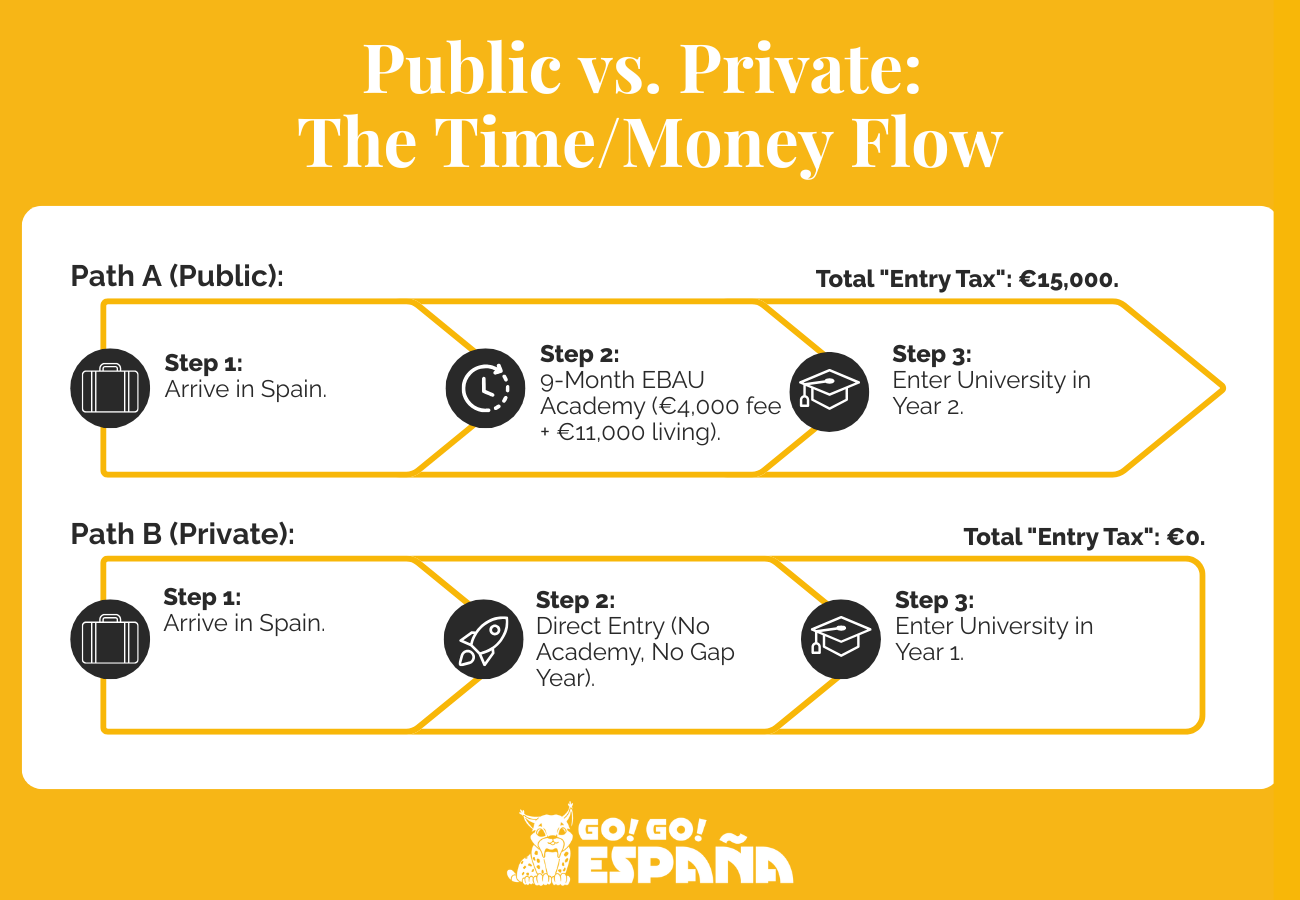
- The Exam Year “Tax”: Accessing cheap public universities usually requires a year of EBAU exam prep. This year can cost you upwards of ~€15,000 (Academy fees + 12 months of living expenses) before you even start your degree.
- Private = Faster ROI: Budget private schools like C3S or UCAM offer direct admission. You save the €15k exam year cost and enter the job market one year earlier, increasing your return on investment (ROI).
- The English Premium: Finding a cheap public degree in English is difficult. Partner schools like UC3M (International School) or C3S offer the rare combination of affordable tuition and a guaranteed English curriculum.
- Work While You Study: Many cheap universities in Spain for international students offer flexible schedules that allow students to take advantage of new visa laws to work up to 30 hours per week.
Table of Contents
Overview: The Cheap Universities in Spain for International Students at a Glance

Before diving into the details, here is a direct comparison of the most affordable options for 2026. We have categorized them into affordable public universities (subsidized for non-EU) and high value private universities (competitive total cost).
Top 5 Cheapest Public Universities (Non-EU Friendly)
Target these if you are fluent in Spanish and want the lowest possible tuition.
| University | Region | Approx. Tuition (Non-EU) | Est. Monthly Living Cost | Best For… |
| Univ. of Jaén (UJAEN) | Andalusia | €820 / year | €500 – €600 | Extreme budget optimization |
| Univ. of Granada (UGR) | Andalusia | €821 / year | €600 – €700 | Historic prestige & student life |
| Univ. of Seville (US) | Andalusia | €820 / year | €650 – €750 | Big city experience on a budget |
| Univ. of Valencia (UV) | Valencia | €1,200 / year | €700 – €850 | STEM & Health Sciences |
| Univ. of Salamanca (USAL) | Cast.-León | €1,300 / year | €600 – €750 | Humanities & Spanish Language |
Top 5 High Value Private Universities (English Taught)
Target these if you need English, direct admission (no EBAU), or career support.
| University | Location | Approx. Tuition | Key Value Proposition |
| UCAM | Murcia | €5,500 / year | Cheapest Private Option: Low tuition + ultra-low rent in Murcia. |
| C3S Business School | Barcelona | €6,000 / year | Budget Barcelona: The most affordable English business degree in Barcelona. |
| UC3M (Intl. School) | Madrid | €6,800 / year | Public Brand: Prestigious public university curriculum in English. |
| Universidad Europea | Madrid/Valencia | €9,000 – 24,000 / year | Modern facilities and international focus |
| GBSB Global | Barcelona/Madrid | €11,000 / year | Tech Focus: Microsoft Showcase School with high digital employability. |
Pro Tip: Notice that a private university like UCAM (€5,500) is actually cheaper than a public university in Madrid (which charges non-EU students ~€6,800–€8,200). Always compare the final number, not just the public vs. private label.
Is University Free in Spain? The Myth vs. Reality
The short answer: No. The long answer: It depends entirely on your nationality and your region.
Spain has 45 public universities and 31 private universities. Historically, the state subsidized tuition by ~85% for everyone. However, recent regulatory changes allow Autonomous Communities (like Madrid and Catalonia) to charge Non-EU students the “full cost” of education, removing the subsidy.
- For EU Citizens: University is nearly free (~€1,200/year).
- For Non-EU Citizens: You generally face two realities:
- The “Equality” Zones (ex: Andalusia): You pay the same cheap rate as locals (~€820/year).
- The “Surcharge” Zones (ex: Madrid): You pay 4x–6x more than locals (~€6,800–€8,200/year).
Pro Tip: If you choose a public university in Madrid thinking it is “cheap,” you might end up paying more than if you chose a private university in a lower-cost city once you factor in the non-resident tuition pricing and high rent
Learn More: To understand how these public options differ fundamentally from private institutions in terms of structure and governance, you can read our breakdown of private and public universities in Spain.
Spanish Public University Tuition Explained: Why Prices Change by Region
To understand where the cheapest universities in Spain are, you must understand how the billing works. You do not pay a flat annual fee; you pay per credit (ECTS). A standard year is 60 ECTS.
Important: Your Student Visa does Not Equal Residency
This is the most common mistake international students make. Having a TIE (Student ID) and a student visa does not make you a “resident” for tuition purposes. Therefore, in regions like Madrid, you are charged the non-resident price.
The “Cost Per Credit” System (And Why Failing is Expensive)
In the Spanish public system, the price of a credit increases if you fail the class and have to re-enroll.
- 1st Enrollment: The standard price (ex: €20/credit).
- 2nd/3rd Enrollment: The penalty price (ex: €40/credit).
- 4th Enrollment: The maximum penalty (ex: €130/credit).
Pro Tip: In Madrid, Non-EU students are often charged the 4th Enrollment price starting from day one.
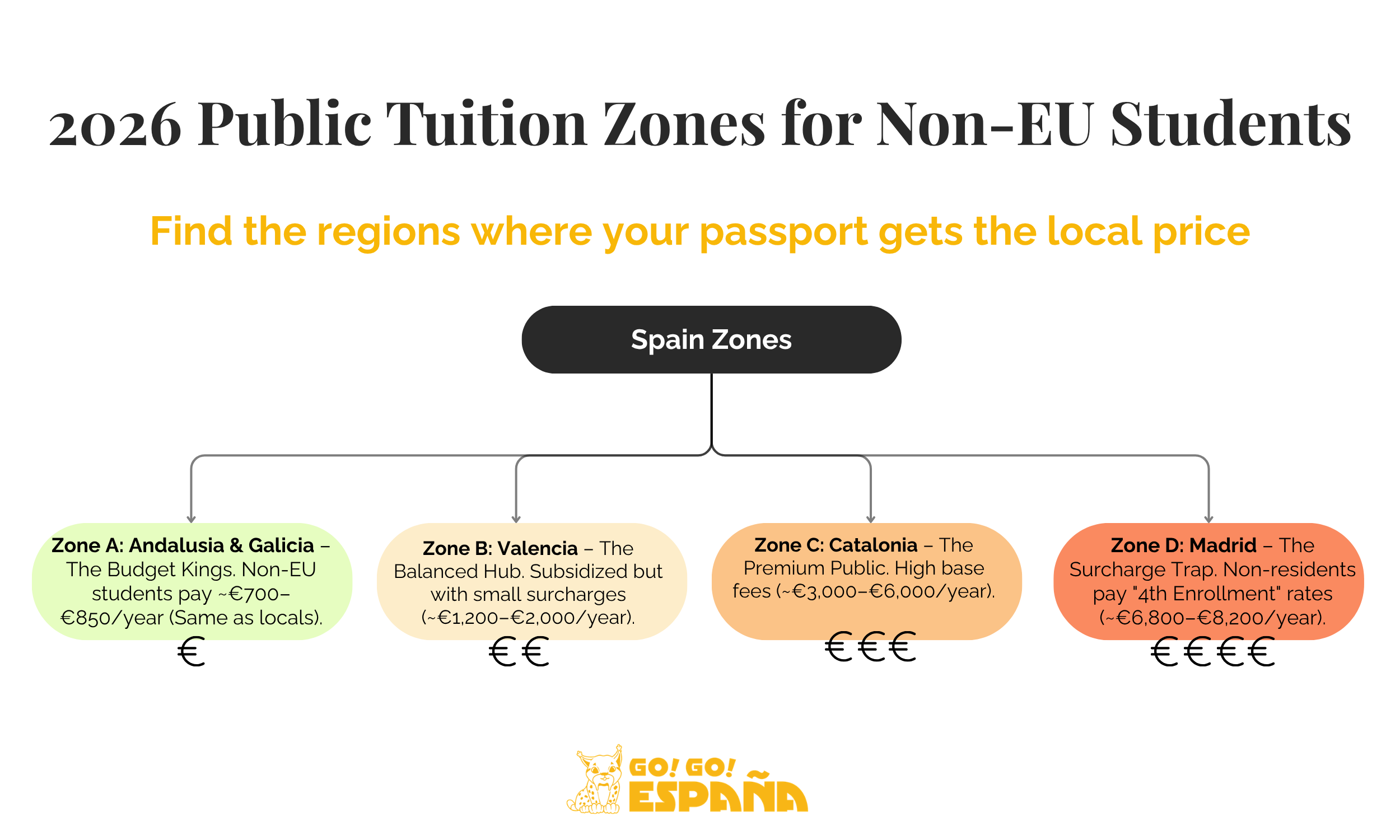
The 4 Price Zones of Spain (2026 Data)

Tuition fees in Spain are not set by the central government; they are set individually by each of the 17 Autonomous Communities. This creates a fragmented market where the price of the exact same degree can vary by 800% depending on the city.
For Non-EU students, this regional divide is critical. Some regions (like Andalusia) subsidize international tuition to attract talent, keeping prices identical to what Spanish citizens pay.
Other regions (like Madrid and Catalonia) view international students as a revenue source, charging non-resident rates that are up to six times higher than the local price. To see how these regional brackets fit into your broader educational financial plan, read our detailed guide on the cost of university in Spain.
Table 1: Comparative Public University Tuition Costs 2026 (Non-EU Students)
| Zone | Region | Non-EU Price Strategy | Approx. Annual Tuition |
| Zone A | Andalusia | Single Price Policy (Same as locals) | €820 – €850 |
| Zone B | Valencia/Galicia | Slight surcharge, still subsidized | €1,000 – €1,800 |
| Zone C | Madrid | Full “Non-Resident” Surcharge | €6,800 – €8,200 |
| Zone D | Catalonia | High base fees + Surcharge | €4,000 – €6,000 |
- Zone A (Andalusia): The absolute cheapest option. The government subsidizes 100% of the cost difference, meaning a student from New York pays the exact same €12.62 per credit as a student from Seville.
- Zone B (Valencia & Galicia): A middle ground. Prices are slightly higher for non-EU students but remain very affordable compared to Madrid.
- Zone C (Madrid): The most expensive for public education. Non-EU students are often charged the “4th Enrollment” price (maximum penalty rate) from day one.
- Zone D (Catalonia): Historically expensive base fees for everyone, plus an additional surcharge for international students.
Pro Tip: A student choosing a public university in Madrid may ultimately pay more than a student at a private university in Murcia once living costs and non-resident surcharges are factored in.
What are the Cheapest Public Universities in Spain for International Students?
If your primary goal is the absolute lowest tuition and you are willing to study in 100% Spanish, you should target the public universities in Zone A, Andalusia.
1. Universidad de Granada (UGR)
- Location: Granada (Andalusia)
- Tuition: ~€821 per year.
- Why it’s a winner: UGR is a prestigious, historic institution (founded in 1531) with over 80,000 students. Because the region of Andalusia subsidizes international students, you pay one of the lowest fees in Europe.
- Best For: Students fluent in Spanish who want a classic, massive university experience.
For a broader perspective on similar high-value options, you can consult our list of recommended universities in Spain for international students.
2. Universidad de Jaén (UJAEN)
- Location: Jaén (Andalusia)
- Tuition: ~€820–€900 per year.
- Why it’s a winner: Not only is the tuition rock-bottom, but Jaén has some of the lowest living costs in Spain (Rent ~€200/month).
- Best For: Extreme budget optimization.
3. Universitat de València (UV)
- Location: Valencia
- Tuition: ~€1,200 per year (varies by degree).
- Why it’s a winner: Valencia offers a perfect balance. It is a major coastal city with a tier 2 cost of living (cheaper than Madrid/Barcelona) and a university that consistently ranks high in global tables.
- Best For: STEM and Health Sciences students who want a big city vibe without Madrid prices.
Which Spanish Universities Offer the Best Value Tuition for English-Speaking Students?
The public universities listed above are cheap, but they are generally Spanish-taught.
If you need an English curriculum, cheap and public becomes harder to find. However, certain partners offer the best of both worlds: public prestige with international accessibility.
1. Universidad Carlos III de Madrid (UC3M)
- Type: Public
- The Value Prop: UC3M is one of the few public universities in Madrid with a robust offering of English-taught degrees. While the tuition is higher for non-EU students (Zone C pricing), the International School foundation programs offer a structured gateway into one of Spain’s most prestigious institutions.
- Why Choose It: You get the “brand” of Madrid and English access.
To see how this aligns with other English-taught paths across the country, check out our directory of English universities in Spain.
2. CETT School of Tourism, Hospitality and Gastronomy
- Type: Private/Public Affiliation (UB)
- The Value Prop: CETT is affiliated with the public Universitat de Barcelona (UB). This means you graduate with a degree from UB (huge prestige) but study in CETT’s specialized, modern facilities.
- Pricing: Compared to luxury private hospitality schools, CETT offers very reasonably priced Bachelor’s degrees with high employability.
You can read more about how this program compares to other culinary tracks in our overview of hospitality management and culinary arts schools in Spain.
What are the Alternative Private Universities in Spain for International Students?
Don’t forget the “early bird” discount! Unlike public universities, private schools function like businesses. Many offer 5% to 15% discounts if you pay your full tuition before a certain date (usually March or April). This can bring the cost down significantly.
These private universities are often cheaper than public Madrid universities for Non-EU students when you factor in that you do not need to pay for an entire year of EBAU exam prep, saving up to €15,000.
1. UCAM (Universidad Católica San Antonio de Murcia)
- The “Low Cost of Living” Champion
- Why it’s a Budget Winner: UCAM tuition is very reasonable (~€5,000–€6,000), but the real magic is the location. Murcia is incredibly affordable. You can live like royalty for €700/month.
- Total Cost Logic: €6k Tuition + €6k Living = €12k/year. (Cheaper than studying public in Madrid).
2. C3S Business School (Barcelona)
- The “Barcelona Budget” Option
- Why it’s a Budget Winner: Finding a cheap English-taught business degree in downtown Barcelona is nearly impossible, except for C3S. They offer competitive pricing for students who want to be in the startup hub of Europe without the €20k price tag.
Learn More: If you want to look at the full application process for an undergraduate degree, you can check out our guide on how to study a bachelor degree in Spain.
The Investment Choice: High ROI Business Schools
Sometimes, the cheapest option is the one that gets you the highest salary later.
While schools like EU Business School or GBSB Global might cost €12,000–€15,000 per year, it is important to contextualize this on a global scale.
A comparable Business Degree in London or Boston would cost €40,000+ per year. In that sense, these Spanish schools offer global, world-class, English-taught business education at 30% of the US or UK price.
Top High-ROI Options:
- EU Business School: Famous for its international network and transfer options to Munich/Geneva.
- GBSB Global Business School: Microsoft Showcase School focused on digital innovation. To evaluate their undergraduate business tracks, check out our complete guide to the bachelor of business administration in Spain.
- ESERP Business School: Excellent value for money with flexible degree options.
- EAE Business School: A heavyweight in MBA and Master’s rankings.
- ESIC Business & Marketing School: Spain’s leader in Marketing and Digital Business.
- Universidad Europea: A strong focus on international students (40% of students come from over 100 countries) and as career-ready education
Why pay more? You are paying for the career services as well. These schools have dedicated teams to get you internships in multinationals, ensuring a faster return on investment ROI.
Learn more: If you are planning your next academic step beyond an undergraduate degree, you can use our strategic analysis of master degrees in Spain taught in English vs Spanish or check out our guide to the top MBA schools and universities in Spain to make an informed choice.
Specialized & Design Schools (Value for Portfolio)
For Creative and Tech degrees, you are paying for access to expensive labs, software, and industry hardware. “Cheap” here REALLY means “High Value for Equipment.”
- U-tad (University of Technology, Arts and Design): The industry standard for Animation and Coding. You pay for the best tech stack in Spain.
- IED Istituto Europeo di Design / LCI Barcelona: You pay for the global design network and portfolio building.
- LABA Valencia: A boutique design school in Valencia, offering Italian design heritage with Valencia’s lower cost of living.
- StPOL University College: A hotel/school model where you live and work in a real operational hotel.
Learn more: If your creative path focuses specifically on structural drafting, spatial planning, or urban design, you can review our specialized directory of Architecture universities in Spain.
The Living Cost Matrix: Madrid vs. The Rest of Spain
Your tuition is paid once a year. Your rent is paid every month. Rent is the biggest variable in your budget.
Choosing a university in a Tier 2 city like Murcia or Valencia can save you enough money to pay for a private university tuition.
Table: Estimated Annual Living Costs (9 Month Academic Year)
| Expense Category | Tier 1 City (Madrid / Barcelona) | Tier 2 City (Murcia / Valencia / Granada) |
| Housing (Shared Room) | €6,300 (€700/mo) | €3,150 (€350/mo) |
| Food & Groceries | €2,700 (€300/mo) | €1,800 (€200/mo) |
| Transport | €450 (€50/mo) | €360 (€40/mo) |
| Leisure & Misc | €2,700 | €1,800 |
| TOTAL LIVING COST | ~€12,150 | ~€7,110 |
Pro Tip: You can save €4,000 – €5,000 per year just by choosing a university in a Tier 2 city. This savings is often enough to cover almost the entire tuition of a private university like UCAM.
Learn More: To map out a complete and detailed monthly budget for your move, you can look at our comprehensive resource on the cost of studying in Spain. If you are ready to start looking for a place to live, make sure to read our complete guide to student accommodation in Spain to understand contracts and avoid common rental scams.
What is the Total Cost of University in Spain? (Public vs. Private)
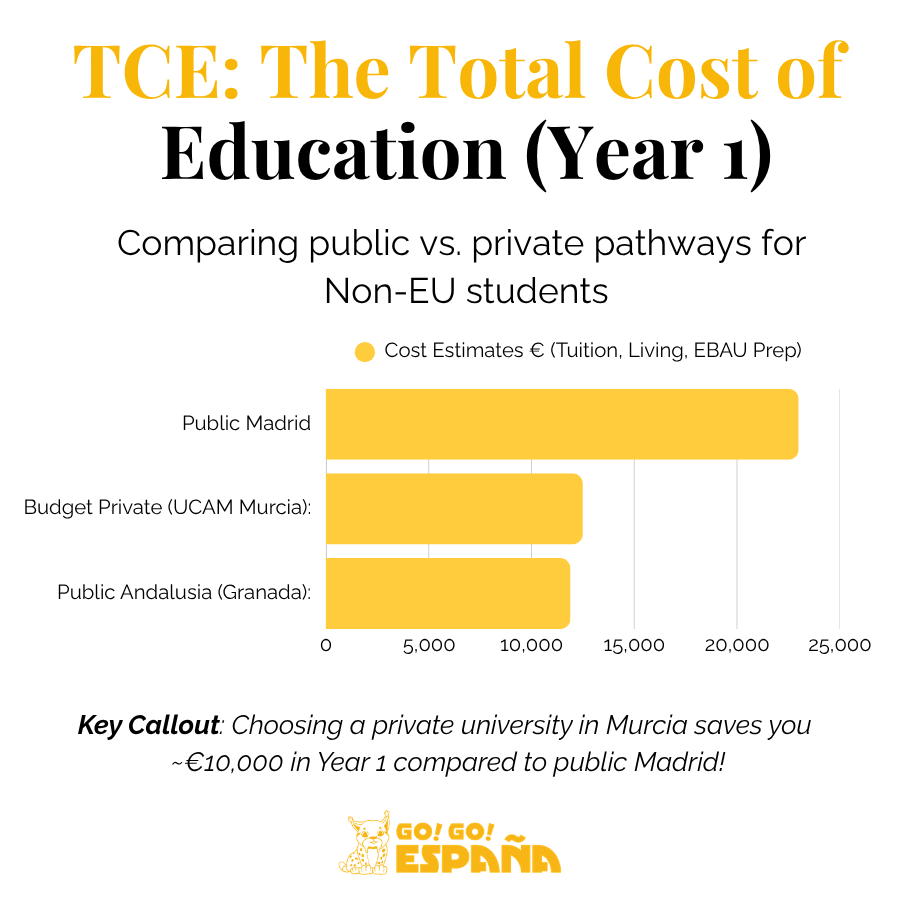
Let’s put it all together. Here are three realistic scenarios for a Non-EU Student in 2026.
Scenario A: The “Public Madrid” Illusion
Target: Public University in Madrid (Zone C) Verdict: High Cost, High Friction.
| Cost Category | Estimated Amount | Notes |
| Tuition (Zone C) | €6,800 | Non-resident surcharge applies. |
| EBAU Prep Academy | €4,000 | Required for admission (Exam prep year). |
| Living Costs (Tier 1) | €12,150 | Madrid rent & expenses (9 months). |
| TOTAL YEAR 1 COST | ~€22,950 | Most Expensive Option |
Learn more: To see how these entry exam requirements can inflate your first-year expenses, read our breakdown of the PCE exams vs EBAU exams or check out our tactical pruebas de competencias específicas PCE guide.
Scenario B: The “Budget Private” (UCAM Strategy)
Target: Private University in Murcia (Zone A Living Cost) Verdict: €10,000 Cheaper than Public Madrid in the first year.
| Cost Category | Estimated Amount | Notes |
| Tuition (Private) | €5,500 | Fixed price (No surcharge). |
| EBAU Prep Academy | €0 | Not required (direct admission). |
| Living Costs (Tier 2) | €7,050 | Murcia rent & expenses (9 months). |
| TOTAL YEAR 1 COST | ~€12,550 | Best Strategic Value |
Scenario C: The “Public Andalusia” (The True Cheapest)
Target: Public University in Granada/Jaén (Zone A) Verdict: The absolute lowest cost, IF you speak Spanish.
| Cost Category | Estimated Amount | Notes |
| Tuition (Zone A) | €850 | Subsidized single price. |
| EBAU Prep Academy | €4,000 | Required for admission (exam prep year) |
| Living Costs (Tier 2) | €7,050 | Andalusia rent & expenses (9 months). |
| TOTAL YEAR 1 COST | ~€11,900 | Lowest Possible Cost |
Learn more: Before committing to this pathway, make sure to understand the legal verification timelines by reading our manual on foreign qualifications homologation in Spain.
FAQ: Cheap Universities in Spain for International Students
1. What is the cheapest university in Spain for international students?
The University of Jaén and University of Granada are among the cheapest, with tuition often remaining under €1,000 per year for international students, provided you study in Spanish.
2. Is university free in Spain for international students?
No. While it is nearly free for EU citizens, non-EU students must pay tuition. In some regions (Andalusia), this is very low (~€850/year), but in others (Madrid), it is comparable to private tuition (~€6,000–€8,000/year).
3. How much is the tuition fee in Spain for international students?
It varies wildly by region. In “Zone A” (South), it is €800–€1,000. In “Zone C” (Madrid), it is €6,000–€8,200. Private universities range from €6,000 to €20,000+.
4. Can I study in English at a cheap public university in Spain?
It is difficult. Most cheap public degrees are 100% Spanish. Bilingual degrees exist but often still require B2 Spanish. For guaranteed English tuition, affordable private options like C3S or UC3M International School are safer bets.
5. Why are private universities sometimes considered better value?
Because they save you time. Private universities allow direct admission without the EBAU exam. Avoiding the 9-12 months of exam prep saves you roughly €15,000 in living costs and academy fees.
6. Are scholarships in private universities available for non-EU students?
Public: Non-EU students on a standard student visa are generally not eligible for the Spanish Ministry of Education (MEC) general grants, as these require legal permanent residency. However, you can apply for international grants through MAEC-AECID or specific bilateral agreements (like the Carolina Foundation for Latin American students).
Private: Private universities operate their own funds. Schools like EU Business School or EAE often offer “Early Bird” reductions (5-15%) or merit-based partial scholarships which are much easier for international students to access than government funds.
7. Which Spanish universities offer the best value tuition for English-speaking students?
UCAM (Murcia) and C3S (Barcelona) offer the best balance of low tuition and English instruction. UC3M offers the best value for a prestigious public brand in English.
In Summary: How to Find the True Lowest Price
Finding the cheapest universities in Spain for international students requires a calculator, not just a brochure.
If you focus only on the tuition fee, you risk falling into the Madrid “trap,” paying €6,800 for a public degree plus €12,000 in rent. In 2026, the smartest budget strategy is to look at the Total Cost of Education (TCE).
- Strategy A: Target the subsidized public universities in Andalusia (UGR/UJAEN) where tuition remains under €1,000.
- Strategy B: Choose a budget friendly private partner like UCAM or C3S. You pay slightly more for tuition, but you save €15,000 by avoiding the EBAU “gap year” and living in a cheaper city.
Stop guessing your budget. Contact us today for a free financial assessment. We will help you compare public vs. private options to find the cheapest universities in Spain for international students that fit your specific student profile and career goals.
Explore our Universities in Spain directory to find schools with accessible acceptance rates.