Skip to content



Gain a professional edge at partner universities that combine technical excellence with direct pathways to global architectural careers.
As a destination for creative studies, Spain is currently enjoying one of its most prestigious moments.
Barcelona has been named the 2026 UNESCO-UIA World Capital of Architecture, turning the entire city into an “urban laboratory” with more than 1,500 multidisciplinary activities and exhibitions.
This recognition, combined with Spain’s unique blend of historic heritage and cutting-edge technological innovation, makes choosing among the best architecture universities in Spain a strategic decision for international students seeking a global career in architecture.
This guide will help you understand which universities offer architecture programs in English, how Spanish architecture degrees align with international accreditation systems, and what academic pathways lead to professional licensure.
To see how creative fields fit into the wider higher education landscape, read our complete guide to Spanish universities for international students.
Key Takeaways
- UNESCO World Capital: Barcelona’s 2026 designation offers a once-in-a-lifetime “urban laboratory” experience for current students.
- Professional Roadmap: Becoming a licensed architect in the EU requires a 360 ECTS pathway (5-year Bachelor + 1-year Master).
- Global Portability: Partner programs like Universidad Europea hold NAAB (USA) and RIBA (UK) certifications for easier international practice.
- Dual Degree Advantage: Schools like Nebrija offer a unique 6-year double degree in Fundamentals of Architecture + Interior Design.
- Affordable Excellence: Spanish private universities offer high-prestige training at a lower price point than equivalent top-tier US or UK schools.
Table of Contents
Top Recommended Partner Architecture Schools in Spain for International Students
All of the universities listed below are partner schools featured in this guide, offering globally recognized architecture programs, hands-on experience, and strong professional outcomes:
| University | Location | Key Highlights | Accreditation / Notes |
| Universidad Europea | Madrid & Barcelona | Full English-language programs, advanced BIM LAB, 6,000+ internship agreements, NAAB & RIBA validated, strong global employability | EHEA, NAAB (USA), RIBA (UK) |
| Nebrija University | Madrid | Six-year double degree in Fundamentals of Architecture + Interior Design, 10:1 student-faculty ratio, hands-on mentorship, portfolio guidance | EHEA-accredited |
| UCAM (Universidad Católica de Murcia) | Murcia | Traditional architecture program with modern curriculum, recognized throughout the EHEA, offered in Spanish only | EHEA-accredited |
To compare how these specialized design programs perform against general public macro-campuses, look at our updated breakdown of Spanish university rankings.
Why We Recommend These Schools:
- Global Degree Portability: Universidad Europea’s NAAB and RIBA validations make it easier to practice in the USA and UK.
- Personalized Mentorship: Nebrija’s small class sizes provide one-on-one guidance in portfolios, licensure prep, and design projects.
- Hands-On Experience: All partner universities offer structured internships with real-world architectural projects, helping students build professional networks and portfolios.
- Professional Readiness: Graduates leave with both the technical skills and practical experience to enter the architecture field confidently, locally or internationally.
Choosing one of these top partner architecture universities in Spain allows international students to accelerate their path to licensure, gain global employability, and study in innovative urban hubs like Madrid and Barcelona.
What is the Roadmap to Becoming a Licensed Architect in Spain?
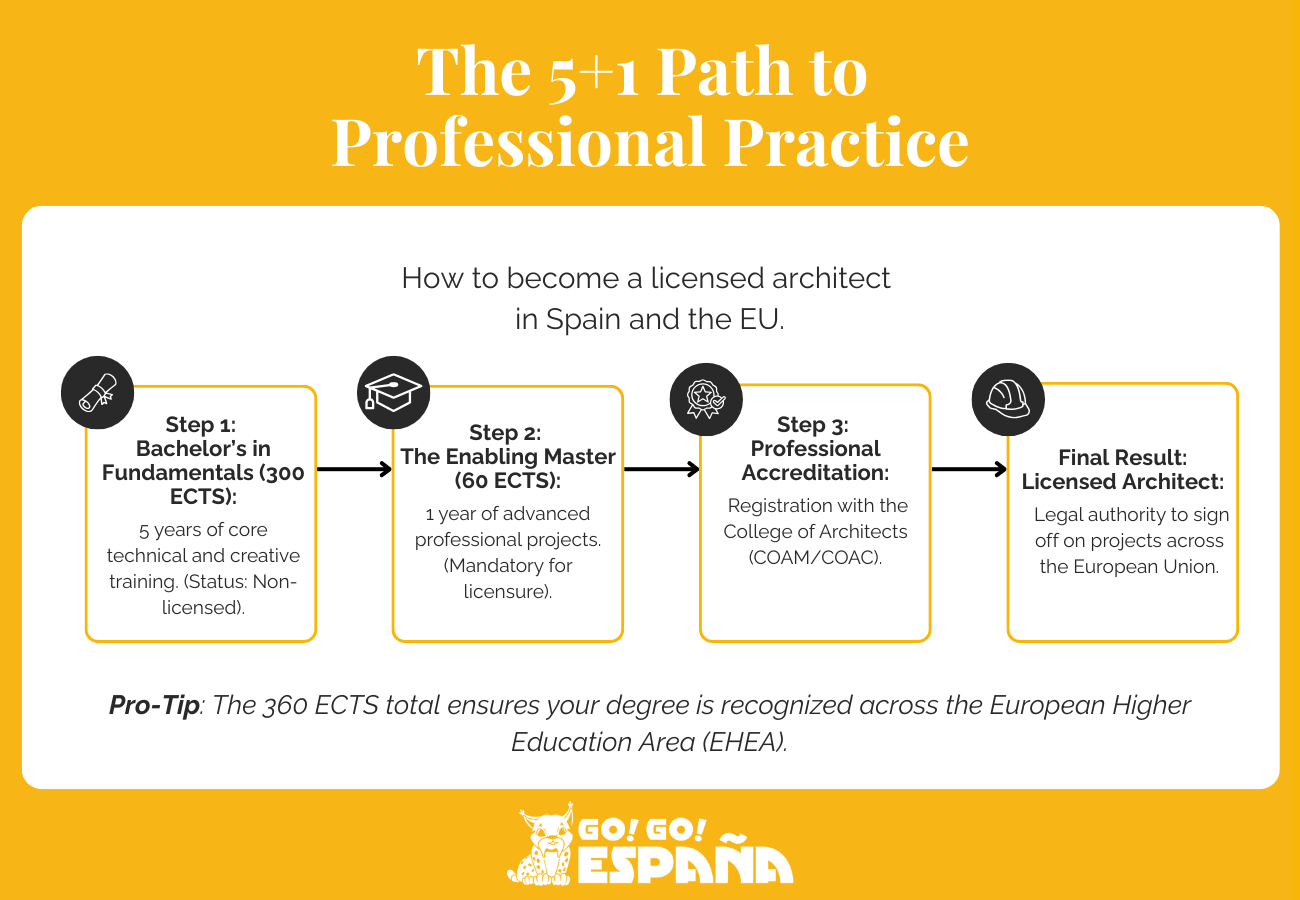
Becoming a licensed architect in Spain follows a structured “5+1” educational pathway required across the European Union and offered at recognized architecture universities in Spain.
In the Spanish system, students first complete a Bachelor’s Degree in Fundamentals of Architecture, which consists of 300 ECTS credits. ECTS (European Credit Transfer and Accumulation System) credits measure academic workload across European universities, making it easier for degrees and study periods to be recognized internationally.
During this first stage, students develop the technical and creative foundations of the profession. The curriculum typically includes architectural design, structural systems, urban planning, building technology, and digital tools such as Building Information Modeling (BIM).
While this degree provides the core knowledge needed to design and develop projects, it does not legally authorize graduates to sign architectural plans.
To gain full professional status, graduates must complete a one-year Enabling Master (Máster Habilitante) worth 60 ECTS credits. This final stage focuses on advanced project development, professional practice, and the integration of design, engineering, and regulatory requirements.
Together, these 360 ECTS credits ensure that the qualification is recognized throughout the European Higher Education Area (EHEA) and allow graduates to sign architectural projects as a fully licensed architect (Arquitecto).
How International Students Apply: Selectividad vs. UNEDasiss
One of the biggest challenges for international students applying to architecture universities in Spain is understanding the admission process.
Spanish students typically apply to public universities through Selectividad, a national university entrance exam that determines admission based on strict cutoff grades known as notas de corte. International students, however, usually follow a different pathway.
To see the complete calendar for institutional applications, review our guide on how to apply to university in Spain.
The UNEDasiss Credential
Students coming from non-EU education systems, such as the United States, Latin America, or many Asian countries, generallyneed to obtain UNEDasissaccreditation. This credential validates your high school diploma within the Spanish education system and allows universities to evaluate your academic background according to Spanish standards. Look at the required certifications, sworn translations, and tax codes in our guide to foreign qualifications in Spain homologation.
Holistic Admissions at Private Universities
Many private institutions featured in this guide take a more flexible, holistic approach to admissions. Universities such as Universidad Europea and Nebrija may consider multiple factors, including your academic record, design portfolio, personal interview, and English proficiency.
This approach allows creative and motivated students, especially those who may not be familiar with Spanish standardized exams, to access high-quality architectural education in Spain. If you prefer small class settings and high personal support over raw research numbers, see our analysis of recommended universities in Spain for international students.
What do Spanish Architecture Schools Look For in a Portfolio?
Spanish architecture programs often look for creative potential rather than technical perfection.
When applying to schools such as Nebrija or Universidad Europea, admissions teams want to understand how you think, observe, and develop ideas.
A strong portfolio should demonstrate the following:
- Process Over Product: Admissions officers are less interested in a perfectly polished final rendering than in how you arrived at it. Include sketches, drafts, and iterations that show your design thinking, experimentation, and problem-solving process.
- Spatial Awareness: Architecture is fundamentally about understanding space. Hand drawings of buildings, interiors, or everyday objects from different perspectives can demonstrate your ability to observe and interpret the physical world.
- Variety of Media: A diverse portfolio helps show your creative range. Combining manual sketches with digital work, photography, sculpture, or other artistic media highlights versatility, an important trait in Spain’s interdisciplinary architectural education.
Global Degree Portability & Expedited US Licensure
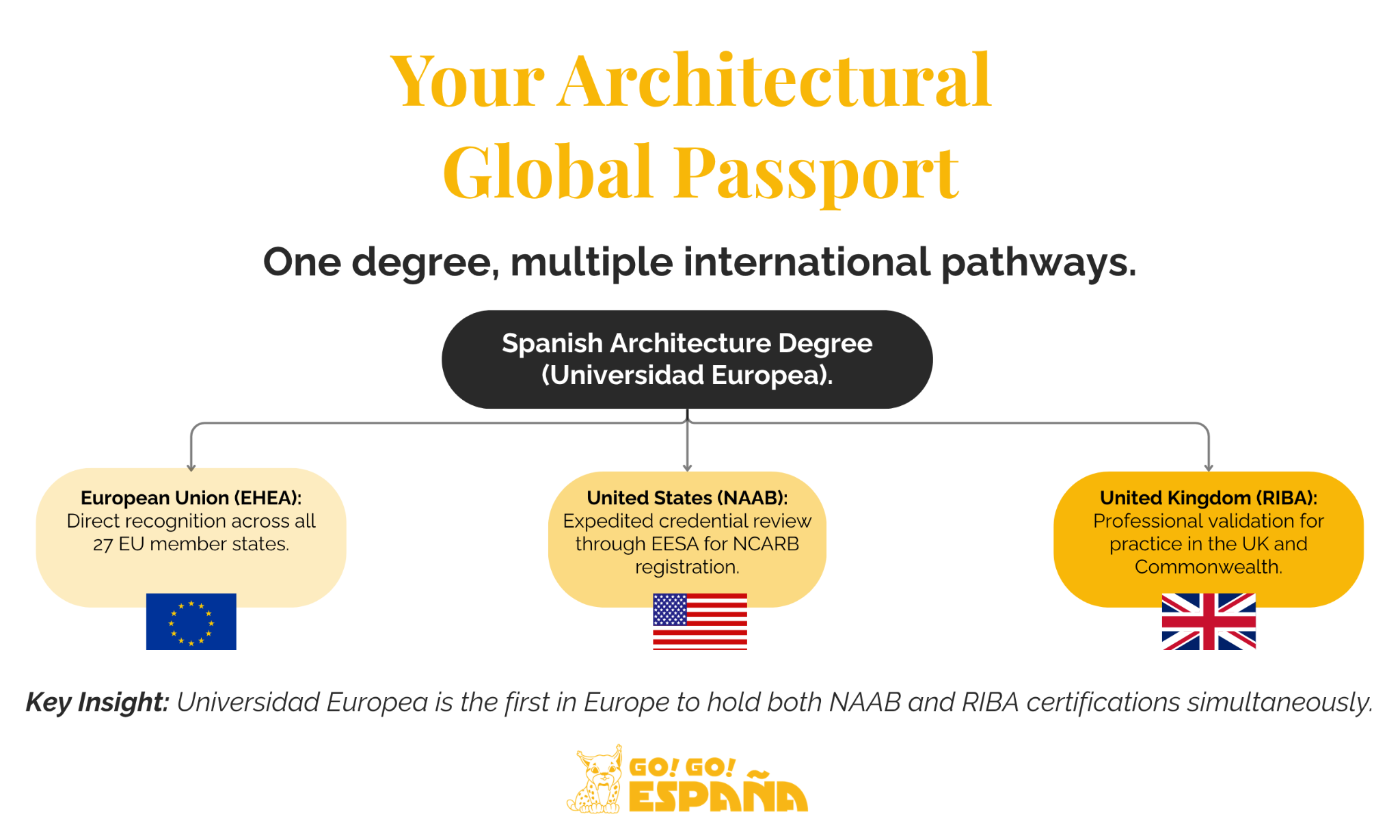
International students often choose specific architecture universities in Spain because their certifications allow for easier professional practice in the USA and UK.
Universidad Europea is a pioneer in this area, being the first institution in Europe with both NAAB (National Architectural Accrediting Board) certification from the US and RIBA (Royal Institute of British Architects) validation.
For American students, graduating from a NAAB-certified program allows you to apply for an expedited credential review through the Educational Evaluation Services for Architects (EESA). Additionally, the program is taught mostly in English, with the first two years entirely in English, making it an excellent option for international students.
By combining NAAB accreditation with English-language instruction, students can enter the NCARB process more quickly, reducing the overall time required to become a licensed architect in the United States.
Barcelona 2026: The UNESCO-UIA World Capital Hook

Barcelona’s designation as the 2026 UNESCO-UIA World Capital of Architecture transforms the city into a living classroom for international architecture students.
As the World Capital, Barcelona will host the UIA World Congress of Architects under the theme “Becoming”.
Students at partner universities such as Universidad Europea will have the unique opportunity to explore the city as a vast urban installation, participating in over 1,500 multidisciplinary architectural activities across the city’s 10 districts. These activities focus on sustainable urbanism, adaptive reuse, and the future of the built environment.
High-Tech Specialized Laboratories: The “Maker” Culture
Leading architecture programs in Spain integrate advanced technology through specialized fabrication and simulation labs:
- Building Information Modeling (BIM) is a core part of the curriculum in modern architecture. Universidad Europea pioneered the first BIM LAB on a Spanish campus, teaching industry-standard digital workflows.
- Digital Fabrication Labs at architecture schools allow students to translate complex digital models into physical prototypes using CNC milling, laser cutting, and industrial-scale 3D printing.
These labs equip architecture students with the technical skills necessary to execute contemporary architectural projects and compete globally.
Adaptive Reuse and Historic Preservation
Spain is a global leader in combining heritage architecture with sustainable modern solutions. In hubs like Madrid and Barcelona, architecture students learn to balance historical preservation with contemporary urban needs.
Programs at universities such as Nebrija University focus on:
- Urban regeneration projects
- Adaptive reuse of historical buildings
- Sustainable architectural solutions
By engaging with the “circular economy” of buildings, students gain the knowledge to repurpose existing structures to meet modern energy standards while preserving cultural integrity, a critical skill for architects working in Europe and internationally.
Multidisciplinary Dual Degrees: Architecture Meets Interior Design
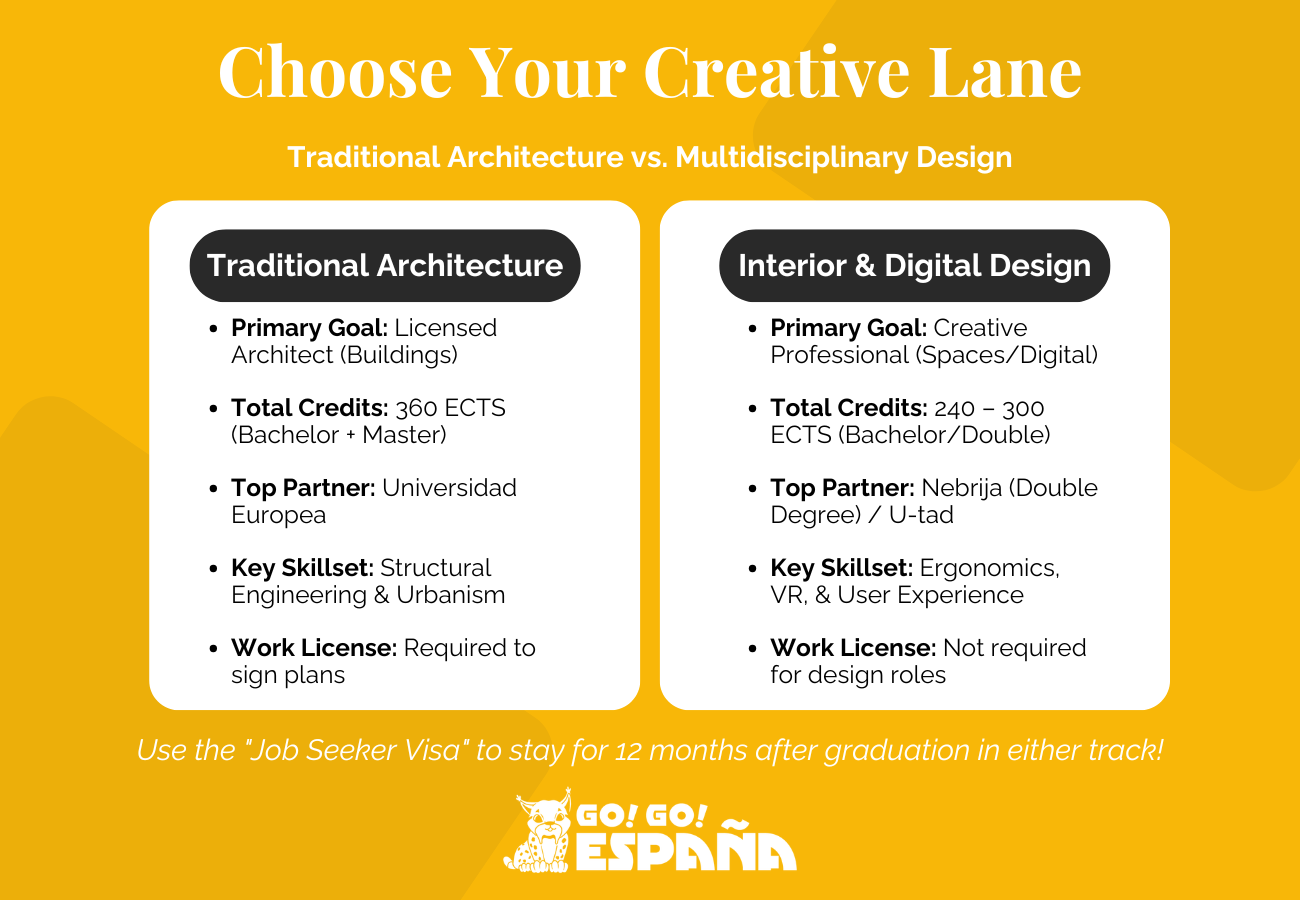
Some of Spain’s leading architecture universities, such as Nebrija University, offer programs that integrate architecture and interior design within a single curriculum.
Nebrija University’s flagship six-year double degree in Fundamentals of Architecture and Interior Design is designed for students who want to work across both the structural scale of a building and its interior spaces.
By combining these disciplines, graduates develop a versatile professional profile, capable of managing architectural structures while optimizing interior functionality. The program emphasizes personalized guidance, with a 10:1 student-to-faculty ratio that supports portfolio development and one-on-one mentorship throughout the degree.
Strategic Admission & Support for International Architecture Students
Studying architecture in Spain provides personalized mentorship, practical experience, and global career opportunities, helping international students build the skills and networks needed for success.
Personalized Mentorship
Top architecture universities provide close guidance to ensure students develop the skills needed for professional success:
- Nebrija University maintains a 10:1 student-to-faculty ratio, ensuring close guidance for things like portfolio development, support in navigating licensure pathways, and more.
Guaranteed Internships
Hands-on experience is key for aspiring architects:
- Nebrija University offers a 100% internship guarantee with real architectural projects
- Universidad Europea has 6,000+ agreements with firms offering internships and project collaboration
Internships help students gain practical skills, build portfolios, and connect with global networks.
Strong Graduate Outcomes
Spanish architecture programs focus on employability:
- Nebrija University boasts a 94% graduate employment rate
- Universidad Europea provides career services support licensure, placements, and international opportunities
Graduates leave with technical skills, practical experience, and professional confidence to work in Spain or abroad.
Post-Graduation Opportunities: The “Job Seeker” Visa
For international students, the ability to start a career in Europe after graduation is a key consideration. Spain offers a significant advantage through the “Job Seeker” Visa (Visado de Búsqueda de Empleo).
This visa allows non-EU graduates from recognized Spanish universities to remain in the country for 12 months to search for employment or launch a business, rather than leaving immediately after graduation. Once you secure a job contract or start a venture, you can transition to a standard work permit.
This extended period provides graduates with valuable time to build professional networks, gain experience, and explore opportunities in major architectural hubs like Madrid or Barcelona without the immediate pressure of visa expiration. Check the complete post-arrival documentation guidelines by following our Spanish student visa guide.
How Do English Taught Architecture Programs in Spain Benefit International Students?

Many architecture universities in Spain now offer programs fully taught in English, making them ideal for international students seeking a globally recognized degree.
Institutions like Universidad Europea provide English-language Bachelor and Master pathways with NAAB (USA) and RIBA (UK) validations, allowing students to communicate technical concepts and present projects to international clients and firms from day one.
Review the full portfolio of bilingual technical tracks in our listing of English universities in Spain.
The Reality of Bilingual Internships
While students can complete much of their coursework in English, a basic command of Spanish is essential during internships. Architecture is a collaborative profession, and local construction teams, municipal officials, and suppliers primarily communicate in Spanish.
Pro Tip: Leading universities often provide free or subsidized Spanish courses alongside the architecture curriculum. Participating in these courses ensures students maximize employability, navigate real-world projects effectively, and gain a professional edge in Spanish firms throughout the “5+1” pathway.
Cost of Living: Madrid vs. Barcelona
While tuition is a major factor, understanding the cost of living in Spain is crucial for planning your budget. Compared to other Western European cities, Spain remains highly affordable for international students.
- Housing: A shared room in a student apartment in Madrid or Barcelona typically costs €450–€700 per month, while private studios range from €900–€1,200.
- Transport: In Madrid, the “Abono Joven” (Youth Travel Card) offers unlimited metro and bus travel for around €20/month (for those under 26), providing huge savings compared to cities like London or New York.
- Food & Leisure: Students typically spend €300–€500 per month on groceries and leisure, depending on lifestyle and personal preferences.
Planning your budget is easier with our interactive Cost of Living Calculator and guide to the real cost of living in Spain.
To analyze complete first-year expense models for tuition and fees, read our guide on the cost of university in Spain.
FAQ about Architecture Universities in Spain
1. What are the best architecture schools in Spain?
The best architecture universities in Spain for international students include Universidad Europea for its global NAAB/RIBA accreditation and Nebrija for its personalized mentorship and double degrees.
2. Is Spain a good country to study architecture?
Yes, Spain offers a unique mix of world-class technical labs and a rich history of design, further elevated by Barcelona’s 2026 status as the UNESCO World Capital of Architecture.
3. How much does it cost to study architecture in Spain?
Tuition for private programs typically ranges from €10,000 to over €25,000 per year, though these costs are often lower than comparable high-prestige programs in the US or UK.
4. How long is architecture in Spain?
A standard path takes 5 years for a Bachelor’s in Fundamentals (300 ECTS) plus an additional 1-year Enabling Master for full professional licensure.
5. How to become an architect in Spain?
You must graduate from a recognized university with an “official” degree and complete a Master’s that includes a final project to gain the legal right to sign off on architectural works.
6. Can I study architecture in English in Spain?
Yes, partner institutions like Universidad Europea offer full degree paths in English to cater to international student cohorts.
7. Are Spanish architecture degrees recognized internationally?
Degrees from accredited architecture universities in Spain are fully recognized across the EHEA, and specific programs hold prestigious US and UK validations for global practice.
In Summary: Architecture Universities in Spain for International Students
Choosing the right architecture university in Spain means balancing professional accreditation with a creative environment in hubs like Madrid or Barcelona. Programs with NAAB or RIBA validation give students a strong advantage for practice in the USA and UK.
With Barcelona as the 2026 World Capital of Architecture, there’s no better time to start your studies in Spain’s innovative urban laboratories.
Contact our team for a free, personalized consultation to help you choose the right program and navigate the admission process.
Once you’ve selected a school, make sure to prepare all required application documents for a smooth submission.