 Skip to content



While B1 Spanish is sufficient for daily life and social interactions, a B2 level is a non-negotiable to succeed in a Spanish university classroom.
Despite Spain’s rise as a top global study destination, public university entry requirements are now more rigorous, whereas private universities often follow their own independent approaches.
Due to a student dropout crisis, the Ministry of Education now mandates a B2 Spanish level for most international applicants at public institutions, making it the essential language requirement for admission.
Key Takeaways
- The Standard Framework: All Spanish university language requirements (B1, B2, C1) are measured by the CEFR (Common European Framework of Reference for Languages), which is the universal standard for language proficiency.
- Mandatory Gatekeeper: A B2 Spanish certificate is no longer a suggestion; it is a regulatory requirement for most public universities (especially in Madrid and Valencia), to reduce student dropout rates.
- Certification Choice: Students must choose between the DELE (permanent and prestigious), or the SIELE (flexible and fast results), to meet UNEDasiss verification standards.
- The Fluency Gap: There is a significant difference between “Social Spanish” (navigating daily life at B1), and “Academic Spanish” (processing technical lectures and research at B2/C1).
- Cognitive Synthesis: Academic proficiency requires the ability to identify core arguments and synthesize specialized vocabulary in real-time, which social fluency does not cover.
- Technical Penalties: In PCE entrance exams, a lack of linguistic precision can lead to “time-outs” or unlimited point deductions (0.1 per error) for minor grammar and accentuation mistakes.
- Geographic Variation: While B2 is the standard, requirements vary by region; for instance, Barcelona often requires B2+ due to the bilingual (Spanish/Catalan) academic environment.
- The 6-Month Rule: The most effective strategy for success is the “6-Month Rule”, completing an intensive Spanish language (ELE) course before beginning technical subject preparation for university entrance.
Table of Contents
Which Language Exams are Accepted by Most Higher Education Institutions in Spain?
For most higher education institutions in Spain, the acceptance of language exams is standardized through the UNEDasiss platform and the CRUE (Conference of Spanish Universities Rectors) framework.
To meet the mandatory B2 Spanish level required for most degree programs, the following exams are the most widely accepted: the DELE and SIELE.
The Regulatory Shift and UNEDasiss
To mitigate these failures, universities have moved toward a standardized model of language accreditation, based on the CEFR (Common European Framework of Reference for Languages), and managed primarily through the UNEDasiss platform.
UNEDasiss acts as a verification body, ensuring that an applicant’s language certificate meets the rigorous standards recognized by the Association of Language Centers in Higher Education (ACLES).
Further Reading: Read our UNEDassis accreditation guide.
Official Certifications: DELE vs. SIELE
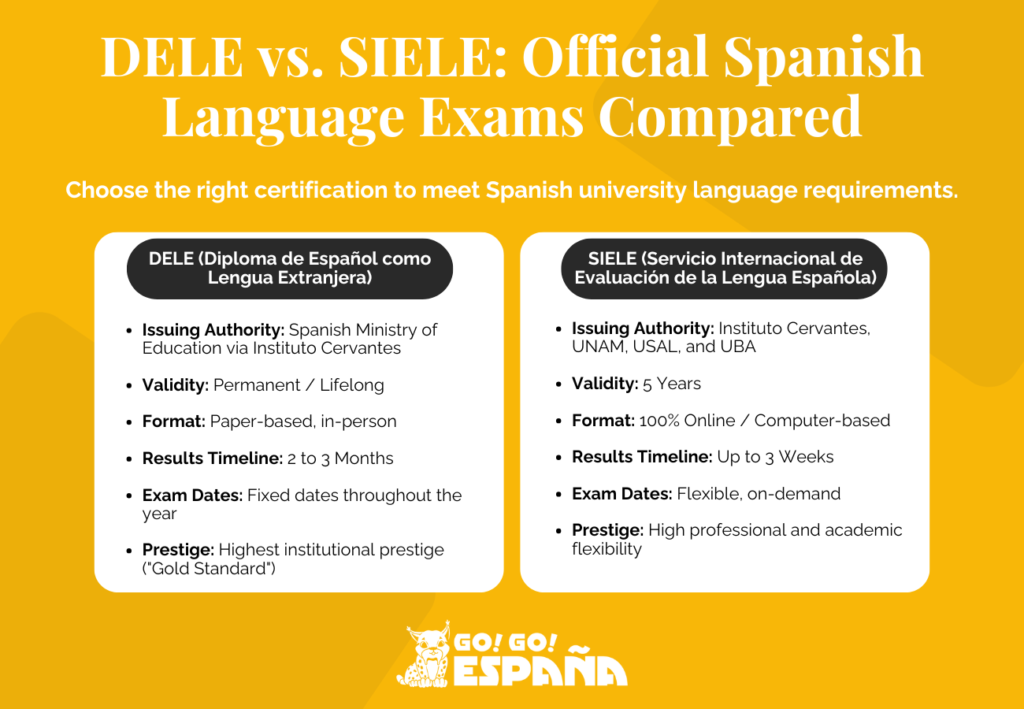
Choosing the right certification is a strategic decision that affects your application timeline.
| Feature | DELE (Diploma de Español como Lengua Extranjera) | SIELE (Servicio Internacional de Evaluación de la Lengua Española) |
| Issuing Authority | Spanish Ministry of Education via Instituto Cervantes | Instituto Cervantes, UNAM, USAL, and UBA |
| Validity | Permanent / Lifelong | 5 Years |
| Format | Paper-based, in-person | 100% Online / Computer-based |
| Results Timeline | 2 to 3 Months | Up to 3 Weeks |
| Exam Dates | Fixed dates throughout the year | Flexible, on-demand |
| Prestige | Highest institutional prestige (“Gold Standard”) | High professional and academic flexibility |
Further Reading:
It helps to compare options in our DELE vs. SIELE exam differences guide.
What are the Language Requirements for Postgraduate Degrees in Spain for English speakers?
The requirements for Master’s and PhD programs vary depending on whether the program is taught in Spanish, English, or whether it is bilingual.
Table: Overview of the language requirements for postgraduate
| Program Type | Teaching Language | Standard Spanish Requirement |
| Master’s Degree | Spanish | B2 Level |
| Master’s Degree | English | Not required for admission |
| Regulated Professions | Both Spanish and English | C1 Spanish Level |
For Spanish-Taught Master’s
While the B2 level is the baseline, many prestigious public universities (such as the Complutense University of Madrid) highly recommend or even require a C1 Spanish certificate for postgraduate studies.
This is because the academic workload,involving thesis defense and complex research,demands a higher level of “Academic Spanish” than a standard undergraduate degree.
For English-Taught Master’s
Spain has seen a massive increase in English-taught programs, particularly in Business, STEM, and International Relations.
- Native English Speakers: If you are from an English-speaking country or your Bachelor’s degree was taught 100% in English, you are typically exempt from proving English proficiency.
- Spanish Proof: For 100% English-taught degrees, a Spanish certificate is often not required for admission. However, some universities still request proof of a “basic knowledge” (often B1) for administrative purposes and daily life on campus.
For Regulated Professions
If your postgraduate degree leads to a regulated profession in Spain (such as Secondary Education Teaching or certain Health roles), you must typically prove a C1 Spanish level, regardless of your native language, to ensure you can practice professionally in the Spanish system.
What is the Difference Between Social and Academic Spanish?
Many international students arrive in Spain feeling confident because they can navigate a tapas bar, chat with roommates, or follow a Netflix series in Spanish.
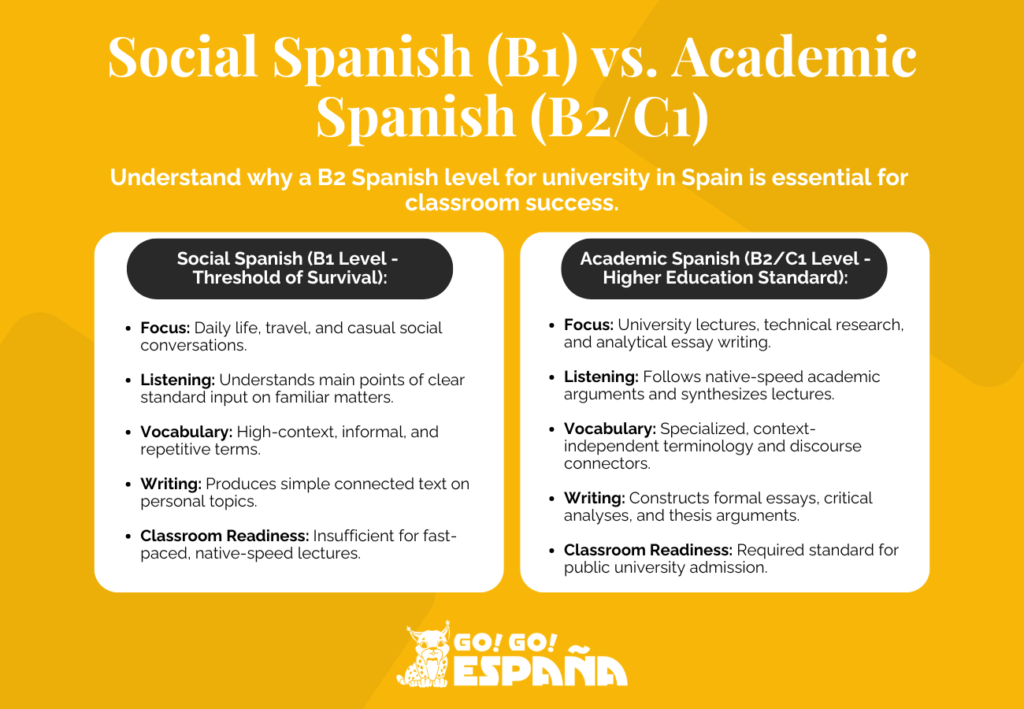
However, there is a significant barrier between being “conversationally fluent” and being “academically proficient.” This distinction is the difference between Social Spanish and Academic Spanish, and understanding it is the key to surviving your first semester.
Social Spanish (B1): The Threshold of Survival
The B1 level allows for functional independence in daily life. A student at this level can describe experiences, maintain casual conversations, and navigate city bureaucracy.
However, B1 communication is “context-heavy,” relying on familiar topics and repetitive vocabulary. While a B1 level allows you to survive a weekend in Madrid, it is insufficient for a two-hour university lecture where delivery speed reaches a native cadence.
Table: B1 (Social Proficiency) Spanish Language Capabilities
| Language Skill | B1 (Social Proficiency) Capabilities |
| Listening | Understand main points of clear, standard input on familiar matters. |
| Speaking | Deal with most situations while traveling; express simple opinions. |
| Reading | Understand straightforward texts about hobbies or travel; read simple news. |
| Writing | Produce simple connected text on familiar topics or personal interests. |
| Context | Relies heavily on context, informal, and repetitive social cues. |
Academic Spanish (B2/C1): The Language of Higher Education
Reaching a B2 Spanish level for university in Spain requires moving toward independent, objective analysis.
- Context-Independent Vocabulary: Moving from common nouns to specialized terminology (ex: using “liquidity crisis” instead of “doing bad”).
- Structural Complexity: Mastering discourse connectors to build complex arguments.
- Synthesis: The ability to identify core arguments in a lecture and synthesize them with textbook information while taking notes.
Reaching this “academic fluency” typically requires between 500 and 600 hours of study for B2, and up to 900 hours for C1.
What Are The Common Pitfalls In Meeting Spanish Language Admission Standards?

For many international students, the “language barrier” isn’t a single wall, but a series of hidden traps that only become visible when an application is rejected or an exam is failed. Avoiding these common pitfalls will help you have a successful experience rather than a wasted gap year.
1. The “B1 Survival Trap”
The most frequent mistake is assuming that being “fluent” in daily life is enough for university.
Students often arrive with a B1 level, feeling confident because they can navigate Madrid or Barcelona without trouble.
However, university lectures are delivered at a native cadence with zero concessions for non-native speakers. If you are still “translating in your head” during a lecture, you will miss approximately 30% of the content, leading to a cumulative academic lag that is almost impossible to recover from.
2. Technical Pitfalls: The PCE “0.1 Rule”
In the PCE Language and Literature exam, the grading system is merciless. Even if your analysis of a literary text is brilliant, the technical execution of your Spanish can ruin your score.
- The Penalty: In the development sections of the exam, examiners take unlimited deductions of 0.1 points for every single error in accentuation, punctuation, spelling, or grammar.
- The Result: It is common for high-achieving international students to lose 1 or 2 full points purely on “technicalities,” which can be the difference between getting into Medicine or being relegated to a lower-demand degree.
Further Reading: Read our guide on Pruebas de Competencias Específicas (PCE).
3. The “60/40 Math Problem”
When calculating scores under the 14-point Spanish university grading system, many students prioritize their high school grades, thinking a high GPA will carry them.In Spain, your high school record is only 60% of the Access Grade. The remaining 40% comes from your PCE results.
- The Pitfall: If your Spanish isn’t at a B2 level, your PCE scores will suffer. Even in more logical and numerical subjects like Biology or Mathematics, which are conducted entirely in Spanish. A “perfect” student with a 10/10 GPA who only scores a 4/10 on their PCEs (due to language struggles), ends up with a 7.6 admission grade, effectively barring them from most top-tier public universities.
4. Administrative Errors: Expiration and “Volantes”
The bureaucracy of admission has its own linguistic and temporal traps:
- The Homologation “Volante”: Students often mistake the volante acreditativo (the receipt showing you’ve applied for diploma recognition), for the final certificate. While some universities allow you to register with the volante, you must provide the final Credencial de Homologación to stay enrolled.
- Certificate Expiration: Many are unaware that UNEDasiss accreditations are only valid for two years. Similarly, while a DELE diploma is permanent, the SIELE certificate expires after five years. Submitting an expired certificate is an automatic rejection that can’t be appealed mid-cycle.
- Internal vs. Official Tests: A common pitfall is relying on an “Internal Placement Test” from a private language school. Unless that test is officially recognized by ACLES or the CRUE framework, most public universities in Madrid and Valencia will not accept it for admission.
5. The “Block” Failure (DELE Specific)
For those choosing the DELE B2 exam, the grading structure is a major hurdle. The exam is divided into two “blocks” (Reading/Writing and Listening/Speaking).
- The Trap: You must pass both blocks to receive the diploma. If you score a near-perfect 100% in the first block but fall just one point short in the second, you fail the entire exam and receive no certificate at all.
How to Verify if my Spanish Language Exam Scores Meet University Requirements?
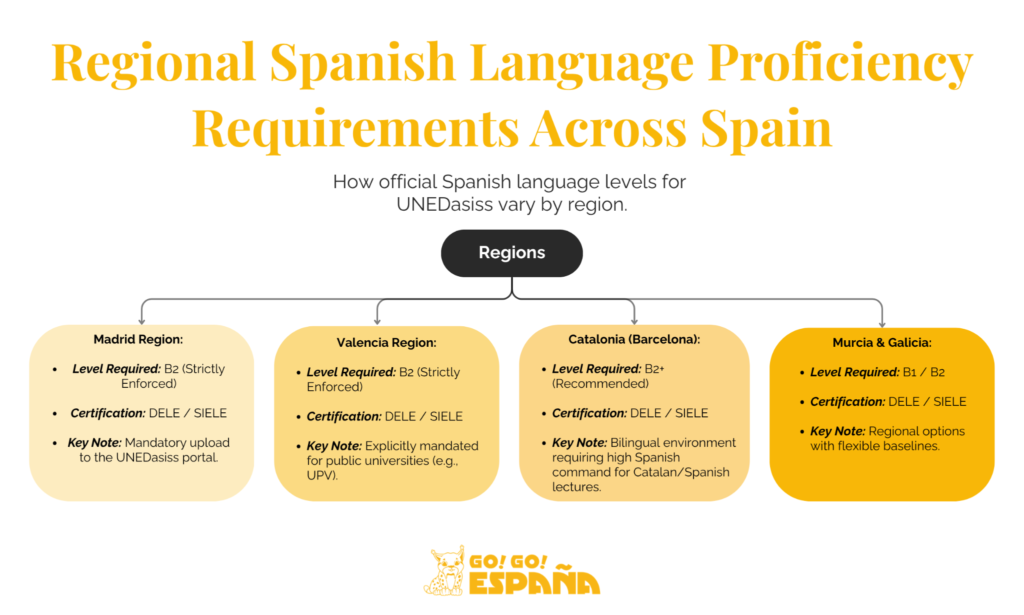
The requirement for B2 proficiency is not applied uniformly across Spain, creating a “strategic map” that students must navigate when selecting their target universities.
Requirements vary based on the autonomous community’s policies and the university’s specific internal regulations.
Madrid and Valencia: The Strict B2 Enforcers

Madrid and Valencia, popular with international students, have strict language requirements. Most public universities in these regions, utilizing the UNEDasiss system, require non-Spanish-speaking students to provide an official B2-level Spanish certificate for accreditation.
Institutions like UPV (Valencia), and UC3M (Madrid), explicitly mandate this B2 certificate, which must be uploaded to the UNEDasiss portal with high school transcripts.
| Region | Level Required | Certification Preference |
| Madrid | B2 | DELE / SIELE |
| Valencia | B2 | DELE / SIELE |
| Catalonia | B2+ (Recommended) | DELE / SIELE |
| Murcia/Galicia | B1 / B2 | DELE / SIELE |
The Catalonia Reality
In Barcelona, the pedagogical environment is bilingual. While exams are permitted in Spanish, seminars and textbooks may be in Catalan.
Prep schools like Academia Guiu emphasize that students need a very robust command of Spanish (B2+) to manage the cognitive load of this environment.
How to Prepare for Spanish Language Requirements for University Admission?
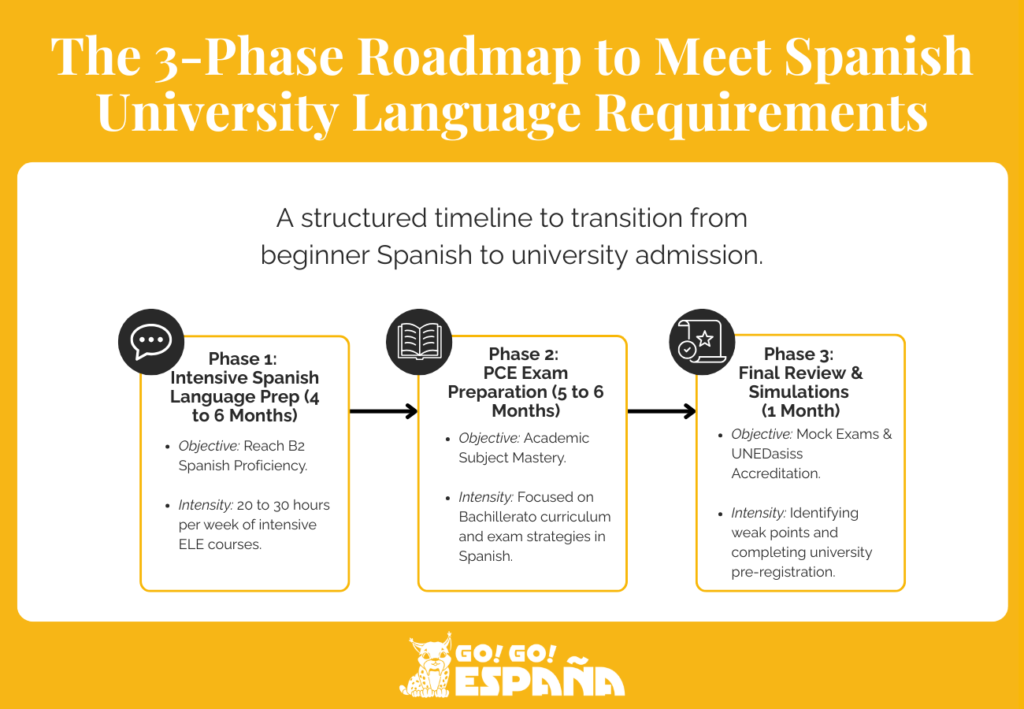
As part of your overall public Spanish university preparation, Go! Go! España recommends dedicating at least six months to an intensive Spanish as a Foreign Language (ELE) course before beginning subject-specific PCE study. Taking an intensive course in Spain can help a beginner reach B2 fluency in 6 to 9 months, compared to 12 to 18 months of part-time study abroad.
| Phase | Duration | Objective | Intensity |
| Phase 1: Intensive ELE | 4 to 6 Months | Reach B2 Proficiency | 20-30 hours per week |
| Phase 2: PCE Preparation | 5 to 6 Months | Academic Subject Mastery | Focused on exam strategy |
| Phase 3: Final Review | 1 Month | Mock Exams & Simulations | Identifying weak points |
Where can I find intensive Spanish language courses online for university preparation?
PCE Exams Preparatory School Online offers a 100% digital platform featuring ten-minute video lessons, live classes, and webinars specifically designed to help international students prepare for Spanish university entrance exams.
The school provides 24-hour asynchronous access, allowing students to study from their mobile devices wherever and whenever they want on a personalized schedule.
Beyond academic instruction, a dedicated team of specialists guide students through the bureaucratic maze of studying in Spain, offering comprehensive assistance with procedures like degree homologation and exam registration.
What Are Reputable Language Schools in Spain That Offer B2 Level Courses for University Entry?
Specialized preparatory schools offer integrated pathways to manage both language and bureaucracy.
- Academia Guiu (Barcelona): Requires at least a B1 Spanish level for academic subjects and offers Spanish (ELE) courses that can be completed before the university access pathway. They offer an “ELE SPRING” course (May to September), which precedes their “ANNUAL PATHWAY” (October to June).
- Costa de Valencia: Provides 9-12-month pathway that includes 4-6-month blocks of intensive Spanish. These schools also assist with homologación (diploma recognition), a prerequisite for entry.
Can I use language learning apps to satisfy Spanish university language requirements?
No. While apps are excellent for vocabulary and consistency, they cannot provide the official B2/C1 certificate (DELE or SIELE) required by the Spanish Ministry of Education and UNEDasiss. Use them as an additional language learning tool, not a primary qualification method.
FAQ About Preparatory schools in Spain
1. Is a B2 certificate mandatory for all universities in Spain?
Yes, for the vast majority of public universities (especially in Madrid and Valencia). While some private institutions may offer conditional admission at a B1 level, B2 is the regulatory and academic standard for most degree programs.
2. What is the main difference between DELE and SIELE?
The DELE is a paper-based exam with permanent, lifelong validity. The SIELE is a digital, computer-based exam that provides faster results (within three weeks) but is only valid for five years.
3. Why is conversational Spanish (B1) not enough for university?
Conversational or “Social” Spanish lacks the technical vocabulary and structural complexity required for “Academic Spanish.” At university, you must be able to synthesize long lectures, argue theories, and write formal essays at a native speed.
4. How does my Spanish level affect my PCE exam scores?
Even if you know the subject matter, a lower language level can cause “time-outs” where you cannot write fast enough. Additionally, examiners take unlimited deductions of 0.1 points for every error in accents, punctuation, or grammar.
5. What is the “6-Month Rule”?
It is a strategic recommendation to complete at least six months of intensive Spanish language (ELE) training before beginning your subject-specific PCE preparation to ensure you have a strong linguistic foundation.
6. Do postgraduate degrees have higher language requirements?
Often, yes. While B2 is the undergraduate baseline, many Master’s programs and regulated professions (like teaching or health), require a C1 level due to the high demands of research and thesis defense.
7. Does UNEDasiss accept internal language school certificates?
Generally, no. UNEDasiss requires official certificates recognized by ACLES or the Instituto Cervantes (such as DELE or SIELE). Internal placement tests from private schools are rarely accepted for public university admission.
Summary: University Pathway Programs in Spain
Meeting the official Spanish University Language Requirements is no longer just a recommendation; it is mandatory.
As we have explored, the “B1 survival trap” is real, while conversational fluency might help you navigate daily life, only a robust B2 level provides the “Academic Spanish” needed to process complex lectures and succeed in the PCE exams.
By prioritizing official certification through the DELE or SIELE and adopting a phased planning approach, you effectively eliminate the “language gap” that leads to academic attrition.
Treating your language preparation as the foundation of your journey is the only way to ensure that your hard work in the classroom translates into the high admission grades you deserve.
Take our Free Spanish Level Test , find out if your current skills meet the B2 university standard.
Book a Language + PCE Pathway, secure your spot in an intensive program that combines expert language coaching with university entrance prep.


