 Skip to content


Supercharge your Spanish language studies with our curated list of the top resources to learn Spanish for international students in Spain.
Your Spanish class is essential, but what you do in the other 20 hours of the day is what will truly make you fluent.
The right tools and resources to learn Spanish can supercharge your learning, making it more effective and a lot more fun.
Think of this guide as your personal toolkit. We’ve curated a list of the best apps to learn Spanish, media, and resources to help you learn faster, tune your ear to the language, and immerse yourself in Spanish culture.
While technology is a powerful ally, it is most effective when supporting a structured curriculum. To find the right foundation for your studies, explore our complete guide to Spanish Courses in Spain.
(Last Updated: April 2026)
Main Key Takeaways
- The most effective learners use a variety of resources to learn Spanish, combining vocabulary apps with real-world media like TV shows and podcasts.
- Apps like Duolingo are great for supplementary practice, but they cannot replace a structured course at a Spanish language school.
- The best way to improve your listening skills is to watch Spanish TV shows or listen to music and podcasts that you are genuinely interested in.
- The best app is the one you will actually use every day. Integrating these resources into your daily routine is the secret to making rapid progress.
- Use a dedicated dictionary app like WordReference for vocabulary, a flashcard app like Anki for memorization, and a language exchange app like HelloTalk for speaking practice.
Table of Contents
What are the Must-Have Apps for Your Phone?
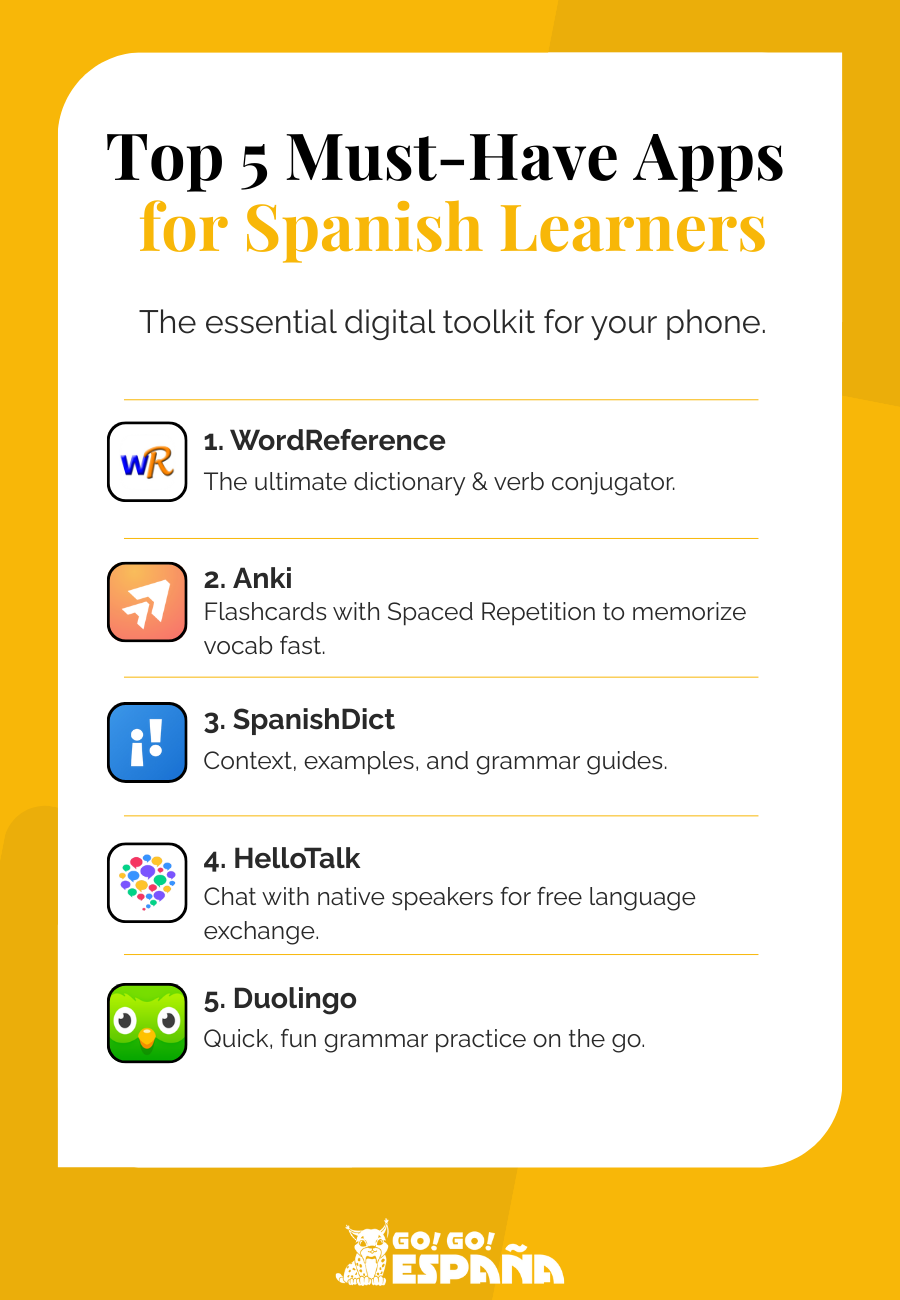
The most useful apps support specific skills such as vocabulary, verbs, grammar, speaking practice, and daily reinforcement.
Here are the tools worth downloading and how to use them effectively.
Dictionaries & Verbs
WordReference and SpanishDict are essential. They do far more than translate.
They offer context, example sentences, and full verb conjugation charts, which are crucial for improving accuracy.
For example, if you look up the verb llevar in WordReference, you won’t just see “to carry.” You’ll also see context-specific meanings such as:
- llevar puesto → “to be wearing.”
- llevar a alguien → “to give someone a ride.”
- llevar tiempo → “to have been doing something for a certain amount of time.”
Using a tool like this helps you understand how the word is actually used in different situations.
Vocabulary (Spaced Repetition)
Apps like Anki or Memrise use a scientifically proven flashcard system that helps you memorize new words much more efficiently. These are great for steadily building your word bank.
Quick Practice & Grammar Apps
Apps like Duolingo and Babbel are useful for daily reinforcement, especially for grammar patterns and basic reading skills.
However, they should be used only as a supplement, not your main learning method.
If you are using an app like Duolingo, be mindful of the heavy gamification system. It can be motivating at first, but many learners eventually find themselves playing to maintain streaks or rankings rather than truly learning.
These apps can help with reading and recognition, but they offer very little for speaking practice, so keep expectations realistic.
Language Exchange Apps (Highly Recommended)
For speaking improvement, which most apps do not offer, try using a language exchange app.
This is one of the most effective ways to build confidence and conversational fluency. Good options include:
- HelloTalk, which allows text, voice notes, and calls with native speakers.
- Tandem, which has a structured matching system for language partners.
- Meetup, which helps you find local groups where you can practice Spanish in person.
These platforms expose you to real conversations, authentic accents, and cultural nuances, all of which are difficult to learn through flashcards or game-style apps.
If you want to explore a broader range of useful apps and see detailed recommendations beyond what’s listed here, you can check out our article Best Apps to Learn Spanish and our full guide to Spanish learning resources on the Go! Go! España blog.
What are the Best TV Shows and Movies for Learning Spanish?
Table: The best Spanish TV shows for your level.
| Level | Show Recommendation | Why Watch? |
| Beginner | Pocoyó | Simple language & clear pronunciation. |
| Intermediate | La Casa de Papel (Money Heist) | Exciting plot & natural conversation. |
| Advanced | Films by Pedro Almodóvar | Nuanced language & cultural depth. |
Watching Spanish-language TV shows and movies is one of the most enjoyable and effective ways to improve your listening skills and learn natural expressions.
The key is to watch with Spanish subtitles, not English ones. This helps you connect the sounds you hear with the words on the screen. Here are a few suggestions grouped by level:
Beginner Level
Start with shows designed for children, like Pocoyó, which use simple language and clear pronunciation.
These programs are great for learning basic vocabulary and sentence structures in a fun, accessible way.
Intermediate Level
Dive into popular and addictive series on Netflix like La Casa de Papel (Money Heist) or Élite.
The exciting plots will keep you engaged while exposing you to more natural, conversational Spanish.
Watching TV news is also an excellent practice for intermediate learners. Newscasters usually speak clearly and with a neutral accent, making it easier to follow along and improve comprehension.
Advanced Level
Challenge yourself with complex dramas or films from famous Spanish directors, such as Pedro Almodóvar.
These works feature nuanced language, idiomatic expressions, and cultural references that help you refine comprehension and cultural understanding.
What are the Top Podcasts for Spanish Learners?

Podcasts are a fantastic resource for improving your listening skills while you’re on the go, whether you’re walking to class or on the metro.
For Learners
Podcasts specifically designed for Spanish learners are a great place to start.
Coffee Break Spanish and Notes in Spanish offer lessons for every level, from absolute beginner to advanced, making it easy to progress at your own pace.
For tricky sections, try using transcripts if available or slowing down the playback speed to better understand the conversation.
For Native Speakers
As you progress, challenge yourself by listening to podcasts made for native speakers. A great option is Hoy en El País, a daily news podcast that will help you tune your ear to natural, fast-paced conversation.
What are the Best Websites and Books for Reading Practice?
Reading is an excellent way to expand your vocabulary and see grammar used in context. Here are some resources to help you get started:
News Websites
Start with headlines and simple articles on major Spanish news sites like El Paísor El Mundo.
These sites expose you to current events and everyday language while keeping articles relatively short and manageable.
Blogs
Find Spanish-language blogs about your hobbies, whether it’s fashion, football, or food. Reading about something you’re already passionate about makes it much more enjoyable.
Books
Don’t start with Don Quixote just yet! Begin with graded readers, such as this compilation of short stories, or try a popular young adult novel.
These options allow you to build confidence and comprehension before tackling more challenging literature.
How Can You Find a Conversation Partner Online?
Language exchange apps are a powerful tool for practicing your speaking skills with native speakers from all over the world, right from your phone.
Apps like HelloTalk or Tandem connect you with native Spanish speakers who want to learn your language.
You can chat via text, send voice messages, and even have video calls. It’s a fantastic, low-pressure way to practice your conversation skills and make new friends.
Should You Consider Taking Online Courses?

Online Spanish courses provide structure, expert guidance, and a clear path to mastering the language, advantages that apps alone can’t offer.
With interactive lessons, quizzes, and instructor feedback, you can build all around skills in speaking, listening, reading, and writing.
While apps are great for quick practice and vocabulary review, courses give you a more immersive, consistent, learning experience that leads to faster progress.
Read more about how online courses and apps can work together and where to sign up for your first course by checking out Go! Go! España’s recommendations for the Best Online Spanish Courses.
FAQ On Best Apps, Media, and Resources to Learn Spanish
-
Can I become fluent just by using apps?
No. Apps are excellent supplementary tools, but they cannot replace the structured curriculum, expert guidance, and real-time speaking practice you get in a formal course at a Spanish language school.
-
Should I use English subtitles when watching Spanish TV?
It’s better not to. While it might feel easier, using English subtitles encourages your brain to read instead of listen. Using Spanish subtitles is much more effective because it forces you to connect the spoken sounds with the written words.
-
What’s the difference between a dictionary app and Google Translate?
Google Translate is great for a quick translation of a single word, but a dictionary app like WordReference is much more powerful. It provides multiple meanings, examples of how to use the word in a sentence, and important context that a simple translation tool often misses.
-
Are these resources free?
Many of them are! Most dictionary apps, news websites, and podcasts are free. Apps like Duolingo have free versions, and many TV shows are available on streaming services you may already have.
-
How much time should I spend using these resources each day?
Consistency is more important than quantity. Even just 15-20 minutes a day on a vocabulary app and listening to a podcast on your way to school can make a huge difference over time.
Conclusion: Ready to Supercharge Your Learning?
Think of this guide as your starter kit. The apps, TV shows, and podcasts help reinforce what you learn, improve listening, and connect you with Spanish culture.
The best resource is the one you enjoy and use consistently. Try new tools, make them part of your daily routine, and turn every experience in Spain into a fun
While these tools are great, nothing beats a real teacher.
Find your perfect accredited Spanish language school in Spain with free help from Go! Go! España!
Want more study tips? Check out our guide on How to Learn Spanish Fluently.


