 Skip to content


Securing a spot at a top Spanish university requires more than just academic talent; it demands a strategic secondary education plan that aligns with the country’s unique admission formula.
For international students, the diverse range of preparatory schools in Spain provides the bridge between a foreign high school diploma and the competitive entry exams required to access high-demand degrees in fields like Medicine or Engineering.
By choosing the right institution, whether it be a holistic international boarding school, a rigorous pre-university center, or a specialized PCE pathway academy, students can effectively navigate the bureaucratic hurdles of admission while maximizing their scores through expert subject coaching and linguistic immersion.
It’s important that you understand all of the ins and outs of the Spanish admission process before diving in further. Make sure to check out “How Does Admission Work at Public Universities in Spain?” section of this blog post to understand the detailed 14-point grading system that determines your admission eligibility.
Key Takeaways
- Barcelona Pathway Specialist: Academia Guiu, founded in 1892, offers intensive university access programs in Barcelona with a 90% success rate for its students. Annual pathway costs are approximately 4,700€, while specialized Spanish language (ELE) courses are available for 2,500€.
- Valencia Immersive Learning: Costa de Valencia provides personalized preparatory courses in Valencia’s university district, utilizing small groups and quarterly mock exams. Their total course costs for combined Spanish language and university prep range from 3,890€ to 6,990€.
- Flexible Online Preparation: The PCE Exams Preparatory School Online provides a 100% virtual platform with video lessons and live webinars starting at 1,499€. Their Superior Plan (3,799€) includes comprehensive support for degree homologation and university pre-registration.
- Essential Bureaucratic Support: Top preparatory schools provide critical administrative assistance beyond teaching, including the homologation of foreign diplomas, guardianship certificates for students under 18, and guidance on Student Visa applications.
Table of Contents
Types of Preparatory Schools in Spain
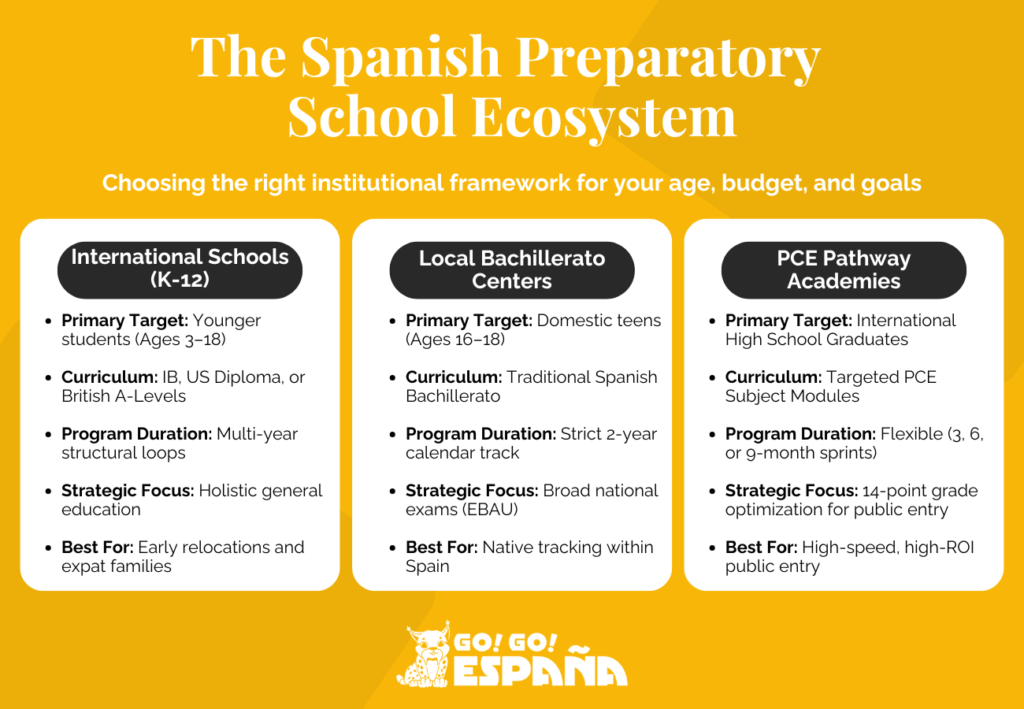
When searching for preparatory schools in Spain, international families often find a confusing mix of terms. Unlike the US system, where “prep” usually refers to a private high school, the Spanish landscape is divided into three distinct types. Understanding which one fits your goals is the first step toward university admission.
Table: Comparison of Preparatory School Types in Spain
| School Type | Best For | Core Curriculum |
| International K-12 Schools | Families with younger children seeking a long-term bilingual environment. | Foreign curriculums (UK, US, IB) from primary through high school. |
| Bachillerato Specialist Centers | Students aged 16–18 moving specifically to finish high school in Spain. | The final two years of Spanish secondary education (Bachillerato). |
| PCE Pathway Academies | International graduates who need higher scores to enter competitive degrees. | Intensive coaching for specific PCE exam subjects (0.2 weighting). |
1. International K-12 Schools (Colegios Internacionales)
Best for: Families moving with younger children or those wanting a long-term, holistic bilingual environment.
International K-12 Schools (Colegios Internacionales) are traditional private schools offering a continuous education from primary through high school. They often follow a foreign curriculum (such as the British National Curriculum or the US Common Core) alongside the International Baccalaureate (IB).
2. Pre-University Bachillerato Centers (High School Only)
Best for: Students aged 15–16 who are moving specifically to finish high school in a Spanish environment.
Pre-University Bachillerato Centers specialize exclusively in the final two years of secondary education (ages 16–18), known as the Bachillerato. They are designed to be high-pressure “launchpads” for university, focusing strictly on academic excellence and the national curriculum.
3. PCE Pathway Academies (Academias de Selectividad)
Best for: Students who already have a high school diploma from their home country but need to “bridge the gap” to reach the 14-point admission threshold.
PCE Pathway Academies (Academias de Selectividad) are specialized centers that do not grant high school diplomas themselves. Instead, they provide intensive preparation for the PCE (Pruebas de Competencias Específicas), the exams international students must pass to enter Spanish universities.
Our Recommended PCE Pathway Academies in Spain
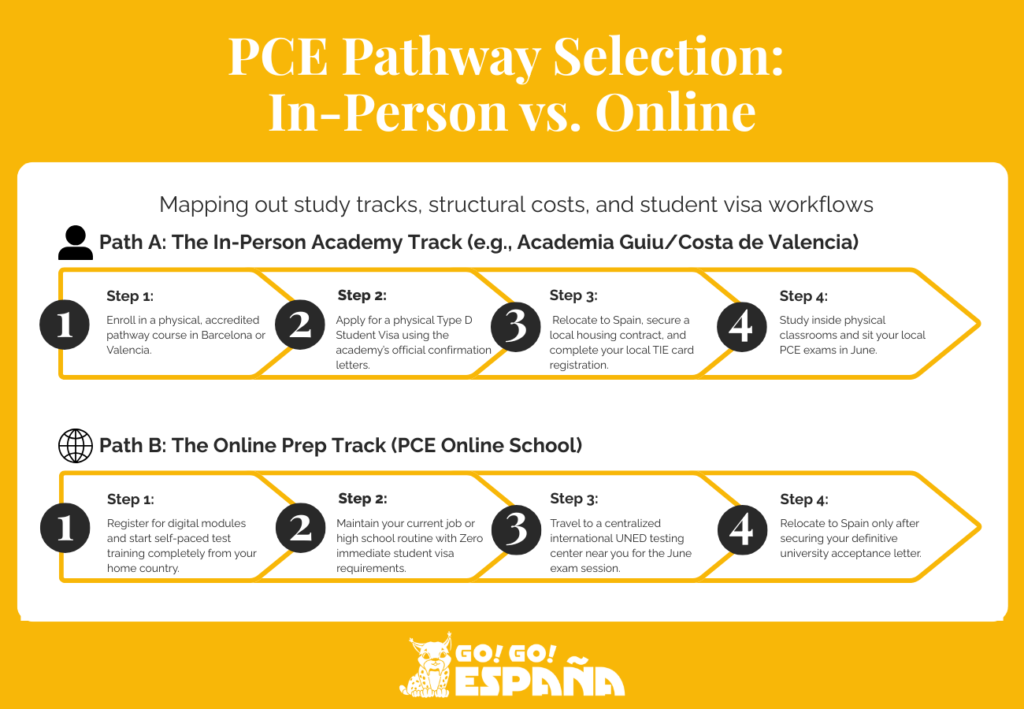
For most of our students, enrolling in a specialized PCE pathway academy will be the best fit to transition your foreign education into a high-demand program.
Below are Go! Go! España’s top recommendations for PCE pathway academies, all with proven track record in university placement.
Academia Guiu (Top Choice for Preparatory Schools in Barcelona)
Located in the heart of Barcelona since 1892, Academia Guiu is a pioneer in university pathway programs. It is widely considered a premier choice for students aiming for high-demand degrees like Medicine, Engineering, and Business.
- The Success Rate: An impressive 90% of students at Academia Guiu successfully reach or exceed their anticipated academic goals.
- Expert Instruction: The school employs over 40 highly qualified teachers with extensive experience in tailoring programs to the specific knowledge needs of both national and international students.
- Comprehensive Support: Beyond academic coaching, they handle bureaucratic procedures such as homologation (official recognition of foreign studies) and university pre-registration.
- Language Integration: Because students must have at least a B1 level of Spanish to follow academic lessons, Academia Guiu offers Spanish as a Foreign Language (ELE) courses that can be taken prior to the university pathway courses.
Costa de Valencia (Top Choice for Preparatory Schools in Valencia)
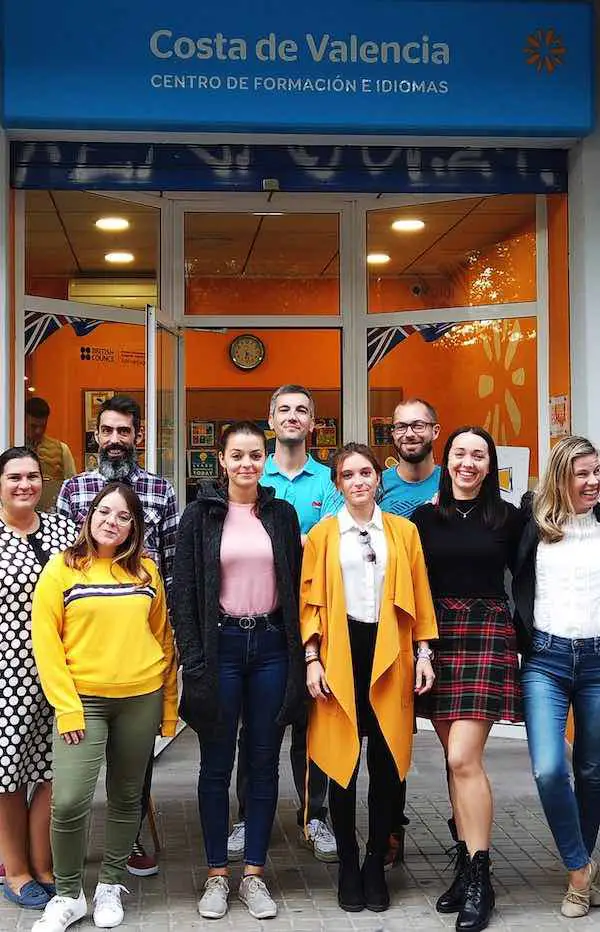
For students seeking a Mediterranean lifestyle alongside rigorous academics, Costa de Valencia has been dedicated to university preparation since 1995.
Its location in Valencia’s university district provides students with an immersive environment near major public institutions.
- Personalized Methodology: The school utilizes small group settings to provide a personalized follow-up that favors individual student evolution.
- Non-Native Specialists: As an accredited Instituto Cervantes center, their teaching methods are specifically adapted to help non-native speakers master complex subject matter in Spanish.
- Quarterly Mock Exams: To ensure readiness for the final 14-point goal, the school organizes quarterly mock exams that simulate the real PCE/EBAU environment.
- B1 Prerequisite: Similar to other top centers, a minimum B1 Spanish level is required; students below this level can take intensive language lessons on-site until they are ready to join the prep course.
PCE Exams Preparatory School (Online)
For students who prefer to start their preparation from their home country, the PCE Exams Preparatory School Online offers ultimate flexibility.
- Flexible Learning: The platform is fully responsive and accessible 24 hours a day, allowing students to study from any location via mobile or desktop.
- Dynamic Methodology: The course includes 10-minute video lessons, live classes, webinars, and access to all updated content for current exam cycles.
- Administrative Advocacy: Even in an online format, the school provides a team of specialists to guide you through homologating your degree and opening your UNEDasiss account.
- Community and Monitoring: Despite being virtual, students join a community of over 3,000 peers and 200 teachers, ensuring they are monitored and supported throughout the “bureaucratic maze” of university entry.
- Spanish Language Requirement: Like the other schools, all of the course content is in Spanish, so you will need to have a B1 level of Spanish or higher if you choose this route.
Why Choose These Spanish Preparatory Schools?
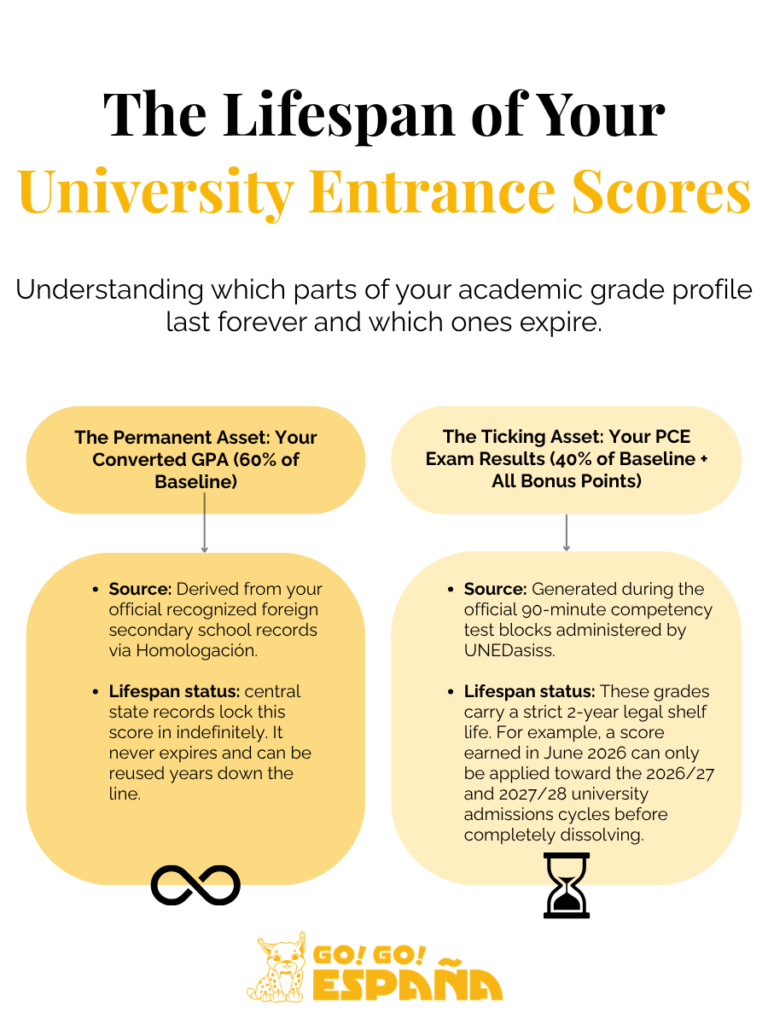
Unlike general international schools, these institutions are PCE specialists. They focus specifically on the complex math required to secure priority in degree selection.
This includes mastering the “60/40 split” (where your converted high school GPA accounts for 60% of your baseline score, and your core PCE exams account for 40%) as well as targeting the 0.2 weighting coefficients for bonus points.
By concentrating on the subjects most relevant to your chosen field, these schools ensure that your study time delivers the maximum possible return for your 14-point admission grade.
The Roles of Specialized PCE Pathway Schools
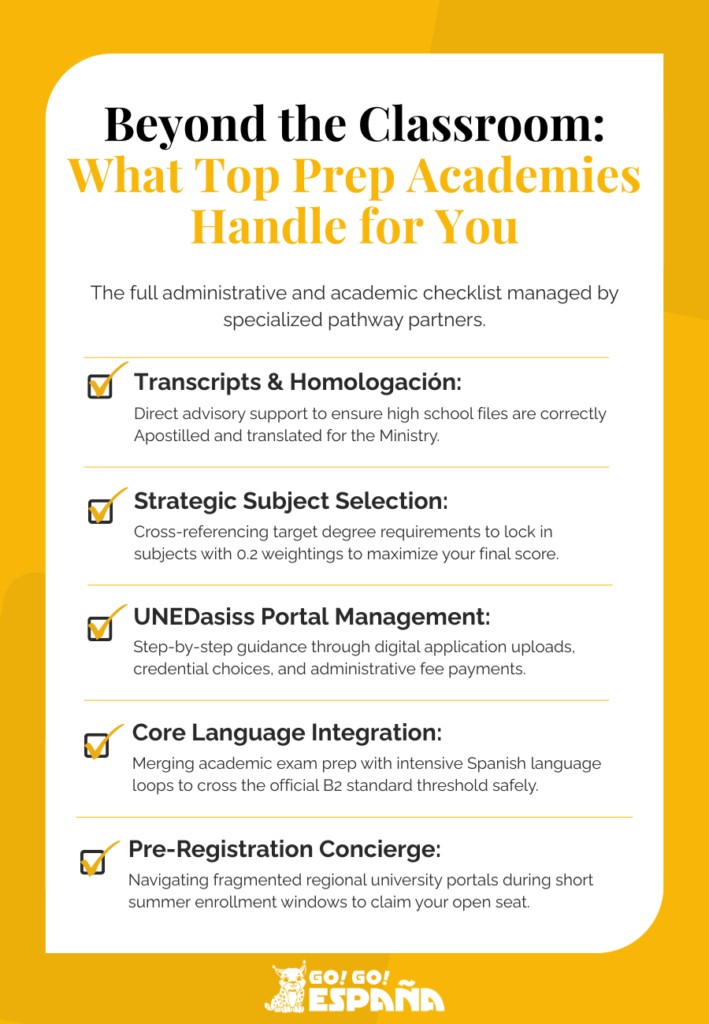
Unlike traditional secondary schools, specialized PCE pathway schools are designed with a singular focus: navigating international students through the “bureaucratic maze” of Spanish university entry.
Our partner institutions, Academia Guiu, Costa de Valencia, and the PCE Online School, act as more than just tutoring centers; they are academic launchpads that bridge the gap between your home country’s diploma and a 14-point admission score.
1. Intensive Academic Coaching & Expert Instruction
These schools strip away the non-essential components of a standard high school curriculum to focus entirely on the subjects that maximize your entry grade.
- Academia Guiu leverages over 130 years of history and a team of 40+ highly qualified teachers to ensure that 9 out of 10 students reach their goals.
- Costa de Valencia utilizes a methodology based on small groups, allowing for a personalized follow-up that is impossible in larger, traditional classrooms. This intensive focus is reinforced by quarterly mock exams that simulate the pressure and format of the real PCE environment.
2. Bridging the Language Barrier
One of the most critical roles of these schools is ensuring your Spanish proficiency matches your academic ambitions. Since a B1 level of Spanish is generally the “gatekeeper” for university-level coursework, our partners integrate language learning into the academic path.
- Schools like Costa de Valencia are accredited by the Instituto Cervantes, meaning their teaching methods are specifically adapted for non-native speakers.
- Both Guiu and Costa de Valencia offer ELE (Spanish as a Foreign Language) courses that students can take prior to their subject-specific preparation, ensuring you don’t just learn the facts, but the complex technical vocabulary required for exams in the sciences and humanities.
3. Bureaucratic Advocacy and Homologation Support
Perhaps the most vital role these schools play is as your administrative advocate.
Navigating the UNEDasiss platform and the legal homologation (official recognition) of your high school diploma can be a bottleneck for international students.
- Our partners provide dedicated educational advisors who manage these procedures “behind the computer.”
- Whether you are studying in person or via the PCE Online School, you receive guidance on opening your UNEDasiss account, managing validations, and ensuring your application is “visible” to the public university system.
4. Global Accessibility: The Virtual Gateway
The PCE Exams Preparatory School Online expands the role of the pathway school by removing geographical barriers.
It offers a 100% digital environment with live classes, webinars, and a community of over 3,000 students and 200 teachers.
This allows students to master the PCE curriculum from their home country, ensuring they are fully prepared before they even set foot on a Spanish campus.
The Typical Preparatory Timeline: When Should You Start?
Timing is everything when applying to Spanish universities. If you miss the annual PCE exam window, you may have to wait an entire year to apply. While intensive fast-track courses exist, the standard timeline for an international student looks like this:
| Timeframe | Process/Step |
| September – October | Program Start. Students arrive in Spain (or log in online), begin their ELE language courses if necessary, and start core PCE subject coaching. |
| November – February | Homologation Processing. Preparatory schools submit your foreign high school transcripts to the Spanish Ministry of Education for official recognition. |
| March – April | Exam Registration. Schools assist students in registering for the PCE exams via the UNEDasiss portal. |
| Late May – Early June | The PCE Exams (Convocatoria Ordinaria). Students sit for their official university entrance exams. |
| Late June – July | University Pre-Registration. Grades are released, and schools help students submit their 14-point admission scores to their chosen public universities. |
Tuition Fees of Preparatory Schools in Spain
The cost of preparatory schools in Spain varies significantly depending on the location, the duration of the course (annual vs. intensive), and whether you need additional Spanish language (ELE) training to reach the B1 gatekeeper level.
Table: The following table provides a reference for total course costs at our partner institutions. These figures are essential for international families planning their educational budget.
| Preparatory School | Starting Price | Primary Pathways & Total Costs |
| Academia Guiu (Barcelona) | 2,500€ | Annual Pathway: 4,700€ |
| Intensive Pathway: 3,100€ | ||
| Intensive II Pathway: 2,600€ | ||
| ELE Language Courses: 2,500€ | ||
| Costa de Valencia (Valencia) | 3,890€ | PCE/EBAU 2 (Basic): 3,890€ |
| PCE/EBAU 1 (Extensive): 5,330€ | ||
| ELE 1 + PCE/EBAU 1 (Hybrid): 6,990€ | ||
| PCE Preparatory School (Online) | 1,499€ | Basic Plan: 1,499€ |
| Extensive Plan: 2,299€ | ||
| Superior Plan: 3,799€ |
Detailed Pricing Breakdown
To help you choose the right investment, here is a more granular look at the pathways offered by each institution:
- Academia Guiu (Barcelona): Their pricing is tiered by intensity. The Annual Pathway (4,700€) offers the most comprehensive coverage, while the Intensive II (2,600€) is designed for students who need a fast-tracked review. For those needing language support, standalone ELE courses are available for 2,500€ per term.
- Costa de Valencia (Valencia): This school specializes in hybrid “Language + Prep” packages. The ELE 1 + PCE/EBAU 1 (6,990€) is the most robust option for students starting with lower Spanish proficiency, while the PCE/EBAU 2 (3,890€) serves as their base preparation for fluent speakers.
- PCE Online School: This is the most cost-effective entry point. The Basic Plan (1,499€) provides essential digital materials, while the Superior Plan (3,799€) includes maximum live interaction and administrative support, comparable to in-person tutoring.
How to Choose the Right College Preparatory School in Spain
Selecting the right institution is the most critical decision in your journey toward a Spanish degree.
While each of our partner schools has its own unique local flavor, they all meet a high standard of core services designed to ensure you don’t get lost in the “bureaucratic maze.”
To choose the right fit, you should evaluate schools based on the following five shared standards and two specific “tie-breaker” requirements.
The 5 Pillars of Support Every Spanish Preparatory School Should Provide
Regardless of whether you choose an in-person or online format, a high-quality preparatory school must offer these five pillars of support:
- Specialized Exam Pathways: The school’s primary focus must be preparing you for the specific exams required for university access (PCE, EBAU, or UNED). These courses are the only way to master the 60/40 academic split and secure your 14-point admission grade.
- Assistance with Homologation: You should never have to navigate the Ministry of Education alone. A good preparatory school provides hands-on help to ensure your foreign high school diploma is officially recognized as equivalent to the Spanish Bachillerato.
- University Pre-registration & Counseling: The registration process for Spanish public universities is complex. The right preparatory school in Spain acts as your advocate, handling pre-registration on your behalf and providing counseling to ensure you choose the degree and institution that best match your career goals.
- Visa and Administrative Support: For international students, the paperwork starts long before the first day of class. Your school should provide guidance on obtaining a Spanish Student Visa, tracking embassy paperwork, and helping with local requirements like TIE processing and City Hall appointments once you arrive in Spain.
- Inclusive Teaching Materials: Transparency in pricing is key. Your enrollment fees should generally cover all necessary educational materials, including student books, exercise folders, and updated exam notes, so there are no “hidden costs” mid-semester.
Choosing an Online Vs. In-Person Preparatory School
While the Online PCE Preparatory School offers unmatched flexibility and cost-savings, there are two specific scenarios where an in-person institution like Academia Guiu or Costa de Valencia is the superior choice:
- You Need Spanish Language (ELE) Integration: To succeed in university-level subjects, you must possess at least a B1 level of Spanish. If you are not there yet, the in-person schools are your best option. They offer integrated Spanish language courses that can be taken prior to or combined with your exam preparation, ensuring you have the linguistic fluency to understand complex academic topics.
- You are a Minor (Under 18): If you are under the age of 18, the Spanish government requires a Minor Guardianship Certificate for your Student Visa application. Only physical, in-person schools can provide this legal document, making them the mandatory choice for younger students moving to Spain without their parents.
The Decision Matrix
| Option | Ideal Learner/Preference | Key Benefit |
| Online PCE Preparatory School | Self-disciplined, B1 Spanish level, wants to save on living costs. | Study from home country, reduced living expenses. |
| Academia Guiu (Barcelona) | Prefers a high-energy, historic city, aims for a high-demand degree. | 90% success rate for high-demand degrees. |
| Costa de Valencia (Valencia) | Prefers personalized, small-group learning, desires a Mediterranean university district setting. | Strong focus on linguistic support, small group environment. |
FAQ About Preparatory schools in Spain
1. What is the main difference between a K-12 school and a PCE academy?
A K-12 international school provides a full high school diploma (like the IB), while a PCE academy is a specialized center that focuses exclusively on coaching you for the university entrance exams needed to boost your score to 14 points.
2. Do I need to finish high school before enrolling in a preparatory program?
Not necessarily. You can enroll in a Bachillerato center for your final two years of high school, or you can join a PCE pathway academy after graduating in your home country to bridge the gap before entering a Spanish university.
3. Will the preparatory school help me with “homologation”?
Yes. Most reputable preparatory schools and academies provide dedicated administrative support to help you homologate your foreign high school diploma, ensuring the Spanish Ministry of Education officially recognizes it as equivalent to the national Bachillerato.
4. Can I attend a preparatory school if I don’t speak Spanish yet?
Yes, but you will likely start with an intensive ELE (Spanish as a Foreign Language) course. Most subject-specific preparation requires a B1 level of Spanish to ensure you can understand complex academic topics in the sciences or humanities.
5. What is the “Guardianship Certificate” for students under 18?
International students under the age of 18 moving to Spain without a parent must have a legal guardian. Partner schools like Academia Guiu or Costa de Valencia can provide this official certificate, which is a mandatory requirement for your student visa application.
6. How long do PCE exam scores remain valid for university applications?
While your baseline 10-point Access Grade is permanent, the “bonus points” earned in the PCE exams generally expire after two years. This makes the timing of your preparatory course and university application critical.
7. Do I need a student visa if I choose an online preparatory school?
No. If you choose the Online PCE Preparatory School, you can study from your home country without a visa. You only need to apply for a student visa once you are admitted to a physical university in Spain and are ready to relocate.
Summary: University Pathway Programs in Spain
Managing the preparatory school landscape in Spain requires understanding the “Three Types” of education, ranging from traditional international K-12 institutions to specialized PCE pathway academies. These schools provide the essential academic and linguistic foundation international students need to master the 14-point admission system and access high-demand degrees like Medicine or Engineering.
By choosing a specialized partner like Academia Guiu, Costa de Valencia, or the PCE Online School, students benefit from high success rates and expert subject coaching tailored to the official exams. Beyond the classroom, these programs provide a vital support system for the “bureaucratic maze” of visa applications, diploma homologation, and university pre-registration.
Need help finding the ideal preparatory school in Spain? Contact Go! Go! España for personalized assistance.
To find out more, explore our complete list of College preparatory schools in Spain.


