Home - Spanish Universities Guide - University in Spain Application Process
How to Apply to University in Spain: Guide for International Students
A step-by-step roadmap to mastering UNEDasiss, PCE exams, and degree recognition for international students.

Learning how to apply to university in Spain as an international student is the first step toward accessing a world-class education system in one of Europe’s most vibrant cultural hubs.
Spain continues to be a top destination for global learners due to its balance of prestigious academic degrees and an exceptional quality of life. We have designed this guide to serve as a definitive 2026 roadmap.
Whether you are navigating the UNEDasiss portal for the first time or coordinating your diploma recognition, this article breaks down the entire study in Spain process to provide the technical clarity needed to secure your admission.
(Last Updated: March 2026)
Key Takeaways
- Public vs. Private Universities: Public universities follow a strict, centralized, score-based admissions system with fixed deadlines and cut-off scores, while private universities offer more flexible, direct, and holistic admissions processes that vary by institution.
- Primary Path: The PCE (Pruebas de Competencias Específicas) is the mandatory “master key” for international students to access Spanish public universities.
- Competency Shift: Starting in 2026, PCE exams include a 20-25% competency-based component focusing on critical application rather than memorization.
- Legal Foundation: Homologation (official diploma validation) is required for all non-EU students and should be started at least 6-9 months in advance.
- Provisional Entry: The “Volante Acreditativo” allows you to apply for university spots while your official homologation is still being processed.
- Grading Formula: Your final admission grade is a 60/40 split between your high school GPA and your PCE exam scores.
- Preparation Window: Successful applicants typically begin their preparation and subject selection 6 to 10 months before the May exam session.
University admission procedure in Spain
Is the Admission Process in Spain Different for International Students?

Yes, the admission process in Spain for international students. They follow a specialized admissions track designed to align foreign academic records with Spanish standards through the UNEDasiss portal.
Unlike the standard EBAU pathway, which is for students graduating from the Spanish high school system, the PCE path is exclusively for international applicants.
This pathway is more flexible, allowing you to select subjects that complement your intended degree rather than adhering to a fixed local curriculum.
Understanding the distinction between EBAU and PCE is essential for navigating how to apply to Spanish universities successfully and ensuring your application meets all requirements.
Public vs. Private University Application Pathways
Table: This table provides a high-level summary of the distinct steps required for each route, helping you understand exactly what to expect from start to finish.
Step | Public University Pathway | Private University Pathway |
Step 1 | Start Homologación (Degree Recognition): Begin the official process to validate your foreign secondary diploma within the Spanish education system. | Apply Directly to the Institution: Submit your application directly through the university’s official admissions portal without a regional pre-registration phase. |
Step 2 | Register with UNEDasiss: Use this official accreditation platform to upload academic documents, request GPA equivalency, and register for entrance exams. | Submit Academic Documentation: Provide your high school diploma and transcripts, which typically must be legalized and translated into Spanish. |
Step 3 | Take the PCE Exams: Sit for the standardized assessment (Pruebas de Competencias Específicas) designed for students from foreign education systems. | Complete Entrance Evaluation: Take the university’s internal evaluation, which may include an internal exam, online assessment, interview, or a motivation letter. |
Step 4 | Receive Accreditation and Results: Obtain your official UNEDasiss accreditation document detailing your GPA equivalency, subject scores, and final admission grade. | Provide Language Certification: Submit proof of language proficiency depending on the instruction language, such as a B2 level for Spanish or IELTS/TOEFL for English. |
Step 5 | Participate in Regional Pre-Registration: Submit a ranked list of your preferred degree programs through the regional admission portal during the July window. | Accept Offer and Pay Reservation Fee: Formally accept your admission offer and pay a reservation or enrollment deposit to secure your place. |
Step 6 | Confirm Enrollment: Formally accept your offered place, submit any remaining documentation, and pay the initial tuition installment. | (Private university pathway typically concludes at Step 5) |
Spanish public university application
How to Apply to a Public University in Spain?
The application process for international students in Spain can differ significantly between public and private universities.
Public institutions operate under a centralized, competitive admissions system based primarily on standardized evaluation and academic ranking. Your admission is determined numerically, not through interviews or holistic review, making preparation and timing essential.
Below is the full step-by-step process explained clearly and strategically.
Step 1: Start Homologación (Degree Recognition)
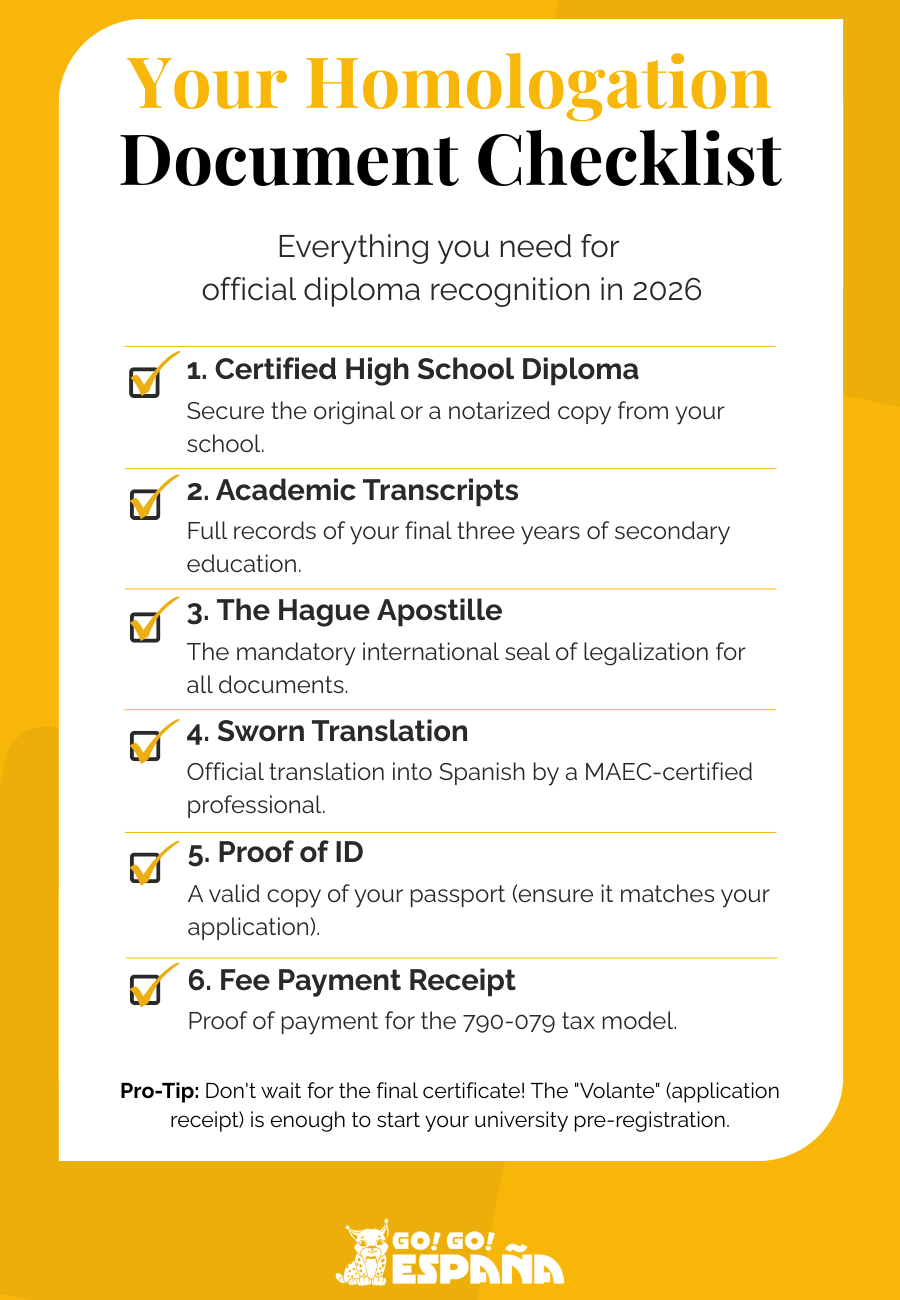
Homologación is the official process that validates your foreign secondary diploma within the Spanish education system. Without it, you cannot formally enroll in a Spanish public university, as it ensures your qualifications are recognized and considered equivalent to the Spanish Bachillerato.
To begin, gather your official diploma and academic transcripts, legalized via the Hague Apostille (or through diplomatic/legal channels if your country is not a signatory), along with sworn Spanish translations and the required administrative fee. Submit these documents to the Ministry of Education to start the process.
Because homologación can take several months, the Ministry issues a provisional certificate called the Volante Acreditativo once your complete application has been submitted. This document allows you to apply to universities and sit entrance exams while your official recognition is still being processed.
Pro Tip:
We suggest students start their homologation process as soon as they receive their high school diploma to avoid delays and ensure they have enough time to address any issues that may arise. For September start, it is ideal to begin between January and February
For a detailed, step-by-step explanation, including documentation requirements, timelines, and practical tips, see the full homologation guide here.
For official government information, consult the Ministry of Education’s page.
Step 2: Register with UNEDasiss
UNEDasiss is the official accreditation service for international applicants. Through its online platform, you will upload your academic documents, request GPA equivalency, and register for the required entrance exams.
At this stage, strategic decision-making becomes important. You must select the subjects that align with your intended university degree. Thoughtful subject selection can significantly increase your final admission score.
Step 3: Take the PCE Exams
The PCE (Pruebas de Competencias Específicas) is the standardized assessment designed for students coming from foreign education systems.
Unlike Spain’s domestic exam pathway, the PCE allows you to choose subjects individually, tailoring your exam profile to your intended field of study. While you may take up to six subjects, four are typically recommended to optimize your results.
Note:
Exams are generally held in May or early June. Most require answers in Spanish, and a B2 level is strongly recommended.
It’s important to note that Spain is not a single uniform system, and admission criteria can vary by region.
For example, Madrid often has stricter requirements, asking for higher Spanish proficiency (C1/B2) for many degrees, while Andalusia tends to be more flexible.
In regions with co-official languages, such as Catalonia (Barcelona), Valencia, and Galicia, you may encounter instructions or materials in Catalan, Valencian, or Galician, though PCE exams can still be taken in Spanish.
Latest Competency Reform
Under the updated PAU regulations (Royal Decree 534/2024), 20–25% of exam content now evaluates applied competencies rather than pure memorization. Students are expected to demonstrate analytical reasoning, critical thinking, and real-world application of knowledge.
Your final admission grade is calculated using a 60/40 formula:
- 60% from your converted high school GPA
- 40% from your PCE exam results
Strong exam performance can meaningfully boost your competitiveness for high-demand degrees. Students interested in taking the PCE tests are encouraged to enroll in a prep program to maximize their performance.
You can explore all options for studying the PCE tests in Spain or online here.
Step 4: Receive Accreditation and Results
PCE results are usually published in late June. Once released, UNEDasiss issues your official accreditation document, which includes your GPA equivalency, subject scores, and final calculated admission grade.
This document is required for the next stage of the process.
Step 5: Participate in Regional Pre-Registration
Public university admissions are managed at the regional level. In July, you must submit your ranked list of preferred degree programs through the corresponding regional admission portal.
Admission is determined by your final calculated score and the program’s nota de corte (cut-off mark), which varies each year depending on demand. Placement is strictly numerical and competitive.
Did you know?
Missing this window can result in waiting an entire academic year.
Step 6: Confirm Enrollment
If you are offered a place, you must formally accept it within the specified deadline, submit any remaining documentation, and pay the initial tuition installment.
Non-EU students will then proceed with the student visa process and finalize administrative requirements before the academic year begins in September.
Spanish private university application
How to Apply to a Private University in Spain?

Unlike public universities, private institutions manage their own admissions processes and are not bound by the centralized regional ranking system.
This generally makes the process more flexible, but requirements still vary by institution and degree. Below is a step-by-step guide on how the private university pathway typically works:
Step 1: Apply Directly to the Institution
Applications are submitted through the university’s official admissions portal. Unlike the public system, there is no regional pre-registration phase. Each private university evaluates candidates independently and may review applications on a rolling basis.
Because institutions set their own criteria, it is essential to verify the specific requirements of your chosen university and program before applying.
Step 2: Submit Academic Documentation
You will need to provide your high school diploma and academic transcripts, typically legalized and translated into Spanish if originally issued in another language.
Some private universities require full homologación (official diploma recognition), particularly for regulated or competitive programs. Others accept legalized diplomas without completed homologación at the time of application, allowing students to enroll conditionally while the process is underway.
This flexibility is one of the main differences between public and private admissions, but it should never be assumed, always confirm directly with the institution.
Step 3: Complete Entrance Evaluation (If Required)
Private universities often conduct their own internal evaluation process. Depending on the institution and program, this may include:
- An internal entrance exam
- An online academic assessment
- A personal interview
- Submission of a motivation letter or CV
Importantly, some private universities may still require the PCE, particularly for academically rigorous or high-demand degrees. In other cases, they may accept UNEDasiss accreditation without requiring specific PCE subject exams.
Because policies differ significantly between institutions, students should verify whether the PCE is mandatory for their intended program.
Step 4: Provide Language Certification
Language requirements depend on the language of instruction.
- Spanish-taught programs: Typically require proof of Spanish proficiency (often at a B2 level).
- English-taught programs: Require recognized English certification (IELTS, TOEFL, or equivalent).
Some institutions may conduct their own language assessment as part of the admissions process.
Step 5: Accept Offer and Pay Reservation Fee
If your application is successful, you will receive either a conditional or final admission offer. To secure your place, you must formally accept the offer and pay a reservation or enrollment deposit.
Once confirmed, you can proceed with visa arrangements (if applicable) and finalize enrollment documentation before the academic year begins.
- CETT School of Tourism, Hospitality and Gastronomy: Affiliated with the University of Barcelona, students gain real practical experience through internships starting in their first year.
- StPOL University College of Hospitality Management and Culinary Arts: A pioneer school on the Barcelona coast where students work with real customers in a training hotel and attend the top-ranked university for Hospitality in Spain.
Important Note:
While private universities generally offer greater flexibility and earlier admission decisions, the process is not automatically “easier.” Requirements vary widely by institution, and some programs may still require standardized exams, homologación, or additional academic assessments.
For this reason, careful research and early application are strongly recommended.
Key dates to secure your application
When Should I Apply to Universities in Spain?
Timing your application correctly is crucial because public and private universities in Spain follow very different schedules and admissions structures.
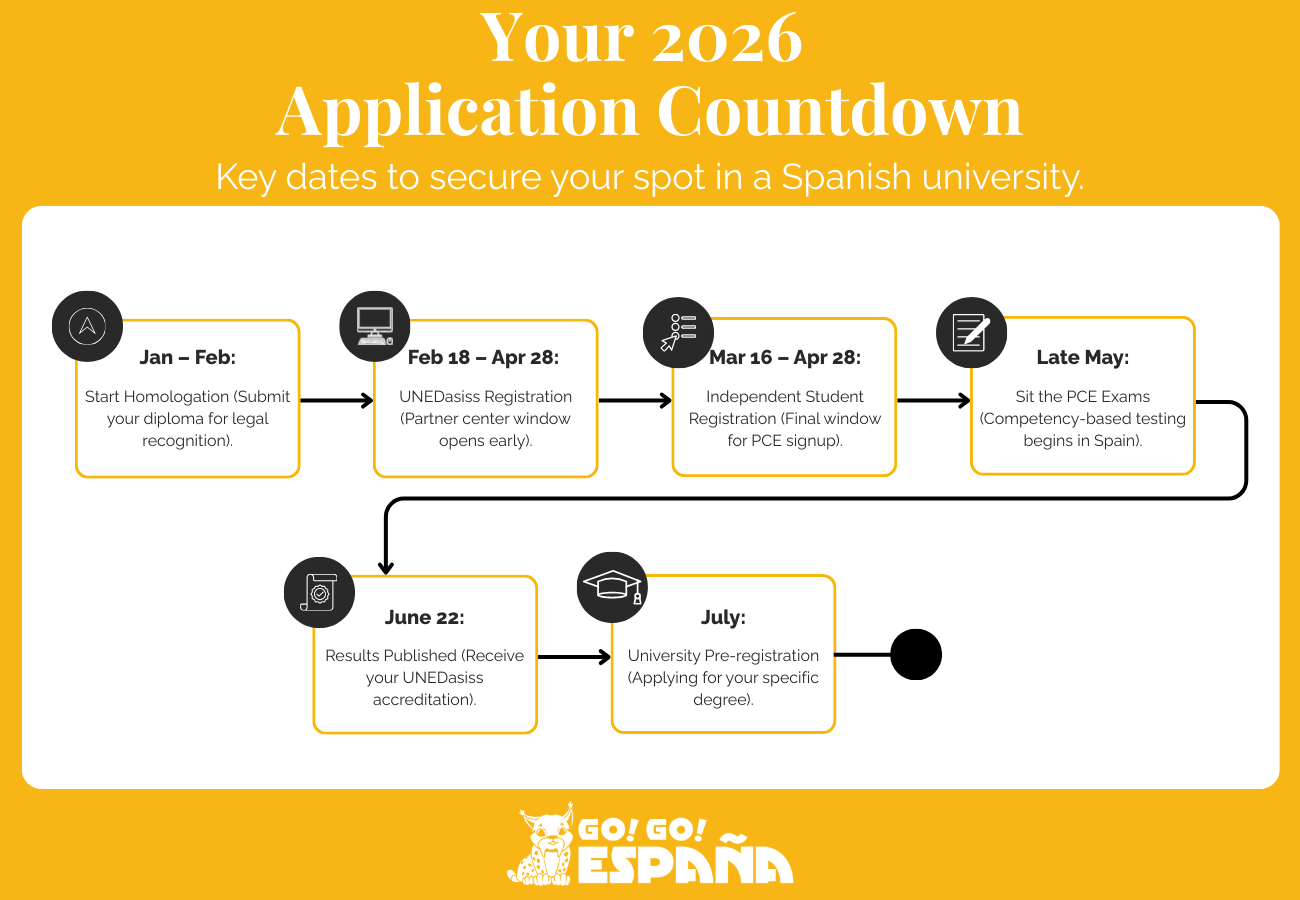
Public Universities Key Application Dates
Public universities follow a strict annual calendar. Key points to remember:
- Homologación: Begin at least 6–9 months in advance (ideally January–February for a September intake). Or as soon as you graduate high school.
- PCE Registration: Typically occurs in March–April.
- Exams: Held in May or early June.
- Results: Released in late June.
- Regional Pre-Registration: July is the critical window. Missing it can delay your enrollment by a full academic year.
- Intake: September is the primary intake; January enrollments are extremely rare.
Did you Know?
Early preparation is essential. Most successful international applicants start 6–10 months before exams to complete both academic and legal requirements.
Private Universities Key Application Dates
Private universities generally have a more flexible admissions timeline:
- Applications often open as early as November and run on a rolling basis.
- Some private institutions offer conditional acceptance even before homologación is complete.
- Main intake is in September, but some programs may allow January or February enrollments.
- Deadlines and evaluation methods vary, so checking each institution’s specific calendar is essential.
Pro Tip:
Because private universities are less tied to standardized exams and regional cut-offs, applying earlier can improve your chances of securing a preferred program and receiving timely admission confirmation.
Important application timeline
University Application Timeline in Spain
Public universities demand strict adherence to deadlines and standardized exams, whereas private universities allow more flexibility but still require careful attention to institutional requirements. Choosing the right timeline and starting early is critical for both pathways.
Month | Public Universities | Private Universities |
Jan–Feb | Start homologación (degree recognition) | Prepare documents; check institution-specific deadlines |
Mar–Apr | Register for PCE exams via UNEDasiss | Submit applications (rolling admissions often open) |
May–Jun | Take PCE exams | Some institutions may conduct internal exams, interviews, or assessments |
Late Jun | Receive PCE results and UNEDasiss accreditation | Receive admission decisions (rolling) |
July | Regional pre-registration for degree programs | Confirm acceptance and pay reservation/enrollment fee if offered a place |
Aug | Finalize visa, accommodation, and enrollment paperwork | Continue admissions for late applicants (conditional acceptance possible) |
Sep | Academic year begins (main intake) | Academic year begins (main intake) |
Jan–Feb | Rare secondary intake | Some private universities may offer secondary enrollment |
Working in Spain while studying
Key University Admission Terms to Know
- UNEDasiss: The official portal and accreditation service for international students applying to Spanish universities. It manages document verification, GPA conversion, and registration for entrance exams like the PCE.
- Homologación: The legal process that validates a foreign high school diploma, making it officially recognized in Spain. This step is mandatory for most non-EU students and ensures your qualifications are accepted for university admission.
- PCE (Pruebas de Competencias Específicas): Standardized competency tests designed for international students to demonstrate academic readiness for Spanish higher education. PCE results are combined with your GPA to calculate your final admission score.
- Volante Acreditativo: A provisional certificate issued once you submit your homologación application. It allows you to apply to universities and, in some cases, enroll while your official diploma recognition is still being processed.
- Nota de Corte: After taking the PCE exams, your competitiveness for different degrees is partly determined by regional cut-off scores, which vary by university and autonomous community. These “notas de corte” indicate the minimum grade required for admission to each program. For official, up-to-date lists, see:
- Madrid: Notas de Corte Madrid
- Catalonia: Notas de Corte Catalunya
FAQ
FAQ: How to Apply to University in Spain
- When to apply to universities in Spain?
For public universities, it’s important to begin gathering all your documents in January if you aim for a September start. The official pre-registration usually happens in July. Private universities have more flexible deadlines, with some accepting applications throughout the year, though many follow the September intake as well. - How early should you prepare to apply for universities as an international student?
We recommend a preparation window of 6 to 10 months. This allows enough time to handle both the academic requirements, such as transcripts and exams, and legal paperwork like visas and residence permits. This timeline applies to students applying to either public or private universities. - When are the intakes for Spanish universities?
For public universities, the main intake is in September. Most programs only admit students at this time. Private universities are more flexible: while many also follow the September intake, a small number offer a secondary intake in January or February. It’s important to check the specific university and program deadlines before applying. - Do I need to speak Spanish to apply?
Most public universities require at least a B2 level of Spanish, since the PCE exams and most degree programs are conducted in Spanish. Private universities often offer programs in English, but Spanish proficiency may still be necessary for administrative procedures or certain courses. Always confirm the language requirements of your chosen university. - Can I apply if my homologation is not finished?
Yes. Both public and private universities accept the “Volante Acreditativo”, a provisional receipt that allows you to secure your spot while the official homologation process is completed. This means you don’t have to wait for the full process to finish before applying. - Can I improve my admission score if I am unhappy with my results?
At public universities, you can retake specific subjects during the exam session, usually in September, to improve your final grade. Spain’s system always uses the highest valid scores over a two-year period, so your final accreditation reflects your best results. Private universities vary in their approach, but many offer reassessment or alternative evaluation options. - Does the level of Spanish required vary by region?
Yes. While a B1 level may be sufficient for smaller institutions, universities in major cities like Madrid generally require a B2 certificate. Before registering with UNEDasiss, make sure to confirm whether your university requires an official DELE or SIELE certificate.
Summary
In Summary: Spanish University Admissions for International Students
Learning how to apply to university in Spain as an international student can seem complex, but with the right guidance, you can turn your PCE exams, homologación, and admissions strategy into a smooth path toward your goals.
If you are ready to begin your application to a university in Spain, Contact Us for free, personalized support today.
With careful planning and the right resources, your Spanish university journey can be both manageable and highly rewarding.