Home - Learning Spanish in Spain - Planning Your Spanish Language Study
A Practical Guide to Your Spanish Language Study in Spain
We provide a clear, step-by-step plan for all the essential logistics, from visas and budgeting, to finding your new home.

Congratulations on choosing a language school in Spain, you’ve made a fantastic choice! The practical planning for your trip is an important step on this exciting adventure.
Whether you are just beginning your Spanish language learning journey, or are starting from scratch, Go! Go! España has all the tools you need to feel comfortable before starting your course. If you already have a knowledge base, we encourage you to take our Spanish level test to see what current level you sit at, or if you are a new student, try using our free Spanish course to familiarize yourself with some of the basics.
To properly plan your Spanish language study in Spain, firstly, you need to answer two simple questions: Are you an EU or a non-EU citizen, and how long is your intended course?
We’ve designed this guide to give you a clear roadmap based on your answers. Whether you’re an EU citizen coming for a year or a non-EU student on a two-week language holiday we’ll show you exactly what you need to do.
If you are just starting your research and want a complete overview of the process, learn more from our complete guide to learning Spanish in Spain.
(Last Updated: January 2026)
Key Takeaways
- The very first step in your planning is to answer two questions: Are you an EU or non-EU citizen, and is your course longer than 90 days?
- If you are a citizen of an EU/EEA country or Switzerland, the process to study in Spain is very straightforward and does not require any kind of visa.
- For non-EU students planning a course of 90 days or less, the process is also very simple and does not require a student visa, though some nationalities may need to obtain a Schengen visa.
- For non-EU students enrolling in a language course over 90 days, a Spanish student visa is required. Applications must be made from the Consulate of Spain in your home country, except for certain accredited university courses where applying from within Spain is permitted.
Determine your path and plan
Determine Your Path and Plan Based on Your Situation
The requirements for studying in Spain are very different depending on your nationality and the length of your course. Find your situation below to learn the exact steps you need to follow.
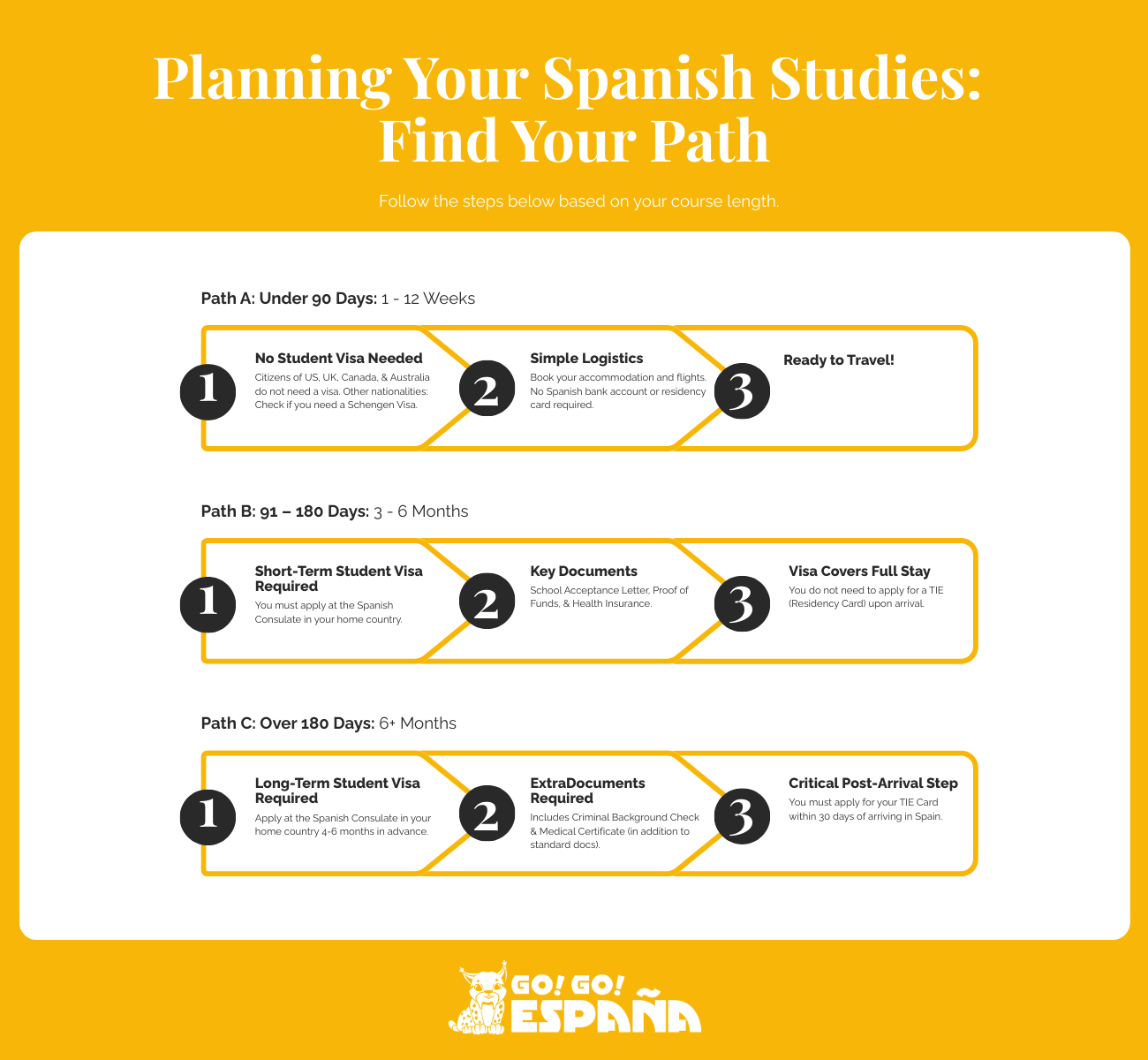
- Path A: The EU Citizen Path: For citizens of the EU/EEA or Switzerland.
- Path B: The Non-EU Citizen Path: Studying for 90 Days or Less.
- Path C: The Non-EU Citizen Path: Studying for More Than 90 Days.
Before you can begin your application, you must decide where you want to live; read our guide on choosing the best places to study in Spain to find your perfect match.
Path A: EU citizen requirements
Path A: What are the Requirements for EU Citizens?
For EU/EEA citizens, the process is very straightforward and does not require a visa.
If you are a citizen of an EU/EEA country or Switzerland, you have the right to live and study in Spain without a student visa.
For courses lasting longer than three months, your primary legal requirement is to register as a resident in order to obtain your European Union Citizen Registration Certificate.
Path B: Non-EU short course (< 90 days) study
Path B: What are the Requirements for Non-EU Citizens Studying a Short Spanish Language Course Under 90 Days?
For short courses, the logistics are simple, and many nationalities do not need a visa at all.
This is the simplest path for non-EU students. If your language course is 90 days or less, you do not need a student visa. Your entry is covered by the standard Schengen Area rules.
Do You Need a Schengen Visa for Spanish Language Study Under 90 Days?
For many nationalities (including the USA, Canada, and Australia), no visa is needed for short stays. For others, a Schengen Visa is required.
If your nationality is not visa-exempt for short stays in Europe, read our guide to the Spain Short-term Visa for a complete breakdown of the application process and requirements
Path C: Non-EU Spanish course requirements (> 90 days)
Path C: What are the Requirements for Non-EU Citizens Studying a Long Spanish Language Course Over 90 Days?
For most courses over 90 days for non-EU students, it is necessary to apply for the Spain student visa from their home country before travelling. However, it is possible to apply from within Spain for accredited university Spanish courses.
This path requires more detailed planning, but rest assured, it’s a standard process that thousands of students complete successfully every year.
For a complete walkthrough of the application process, see our step-by-step guide to applying for a Spanish student visa.
Important Things to Consider for Long-Term Spanish Language Students
Beyond the visa, a long-term stay in Spain requires a few other crucial planning steps.
- Finding Accommodation: For a stay of several months, a couple of your options include a room in a shared student flat (piso) or a student residence. For a full breakdown of your housing options, see our comprehensive guide to finding student accommodation in Spain.
- Planning Your Budget: You will need to create a realistic budget to cover your tuition, housing, daily living costs, and any forecasted travel expenses for your entire stay. To plan your finances down to the last euro, use our complete budgeting guide for the real cost of studying in Spain.
- Arriving in Spain (for stays over 180 days): If your course is longer than six months, you will have one critical, mandatory task once you arrive: applying for your Foreigner Identity Card (TIE). Your first task after arrival is getting your residency card. Follow our guide to getting your TIE card.
Once your paperwork is sorted, read our guide on what is it like to live in Spain to help you adjust to the local lifestyle and social scene.
FAQ
FAQ About Planning Your Spanish Language Studies in Spain
- How far in advance should I start planning?
For a long-term course that requires a student visa, you start planning at least 4 to 6 months before you intend to travel. The visa application alone can take several months, which is why the Go! Go! España team recommends allowing 9 to 12 months to comfortably gather all your documentation. - Can I come to Spain as a tourist and then decide to study long-term?
Yes, in certain cases this is possible for courses taking place at an accredited university, whether that is a Spanish language course or a degree-seeking program. The process for applying for a student visa from within Spain is different compared to applying from your home country. We have a separate guide that explains how to apply for a student visa from within Spain. - What is the single most important document for my planning?
While all documents are important, the most critical ones are your school acceptance letter, your proof of financial means, and your compliant health insurance policy. For students planning a course longer than 180 days, the criminal record certificate is an extremely important document, and depending on where you are based can take quite some time to obtain. An error on any of these can lead to a visa rejection. - Is it easier to get a Spanish student visa for a shorter course?
For a course that is under 90 days, the process is much easier because you do not need a student visa. Depending on your nationality, you may not need any visa at all. Once your paperwork is sorted, read our guide on what is it like to live in Spain to help you integrate into the local culture and social scene.
Summary
Summary: Your Journey Starts with a Plan
Planning your Spanish language study in Spain is an exciting process, and the logistics are very manageable when you know which path to follow.
By first identifying your situation based on your nationality and the length of your course, you can easily find the specific set of instructions you need for a smooth and stress-free journey.
Whether you are an EU citizen making a simple move or a non-EU student planning a long-term immersion, a clear plan is the key to your success.
Ready to take the next step? We can help you find the perfect school. Contact Go! Go! España for free advice!