


Learn how to navigate greetings, meals, and social norms with proper Spanish Etiquette to help you feel at home in Spain.
Ever hesitated before greeting a new friend in Spain, wondering if you should shake hands, hug, or go for the two-cheek kiss? You’re not alone.
Spanish social life has its own unique rhythm, but don’t worry, this isn’t a test. This guide is here to help you navigate the social customs in Spain and feel like a local.
This is not a strict rulebook, but a friendly guide to the most common points of Spanish etiquette. Learning these simple norms will help you show respect for the culture, connect more easily with locals, and feel less like a tourist.
Understanding these customs is a huge part of understanding what it is like to live in Spain. Let’s dive into the essentials.
(Last Updated: March 2026)
Main Key Takeaways
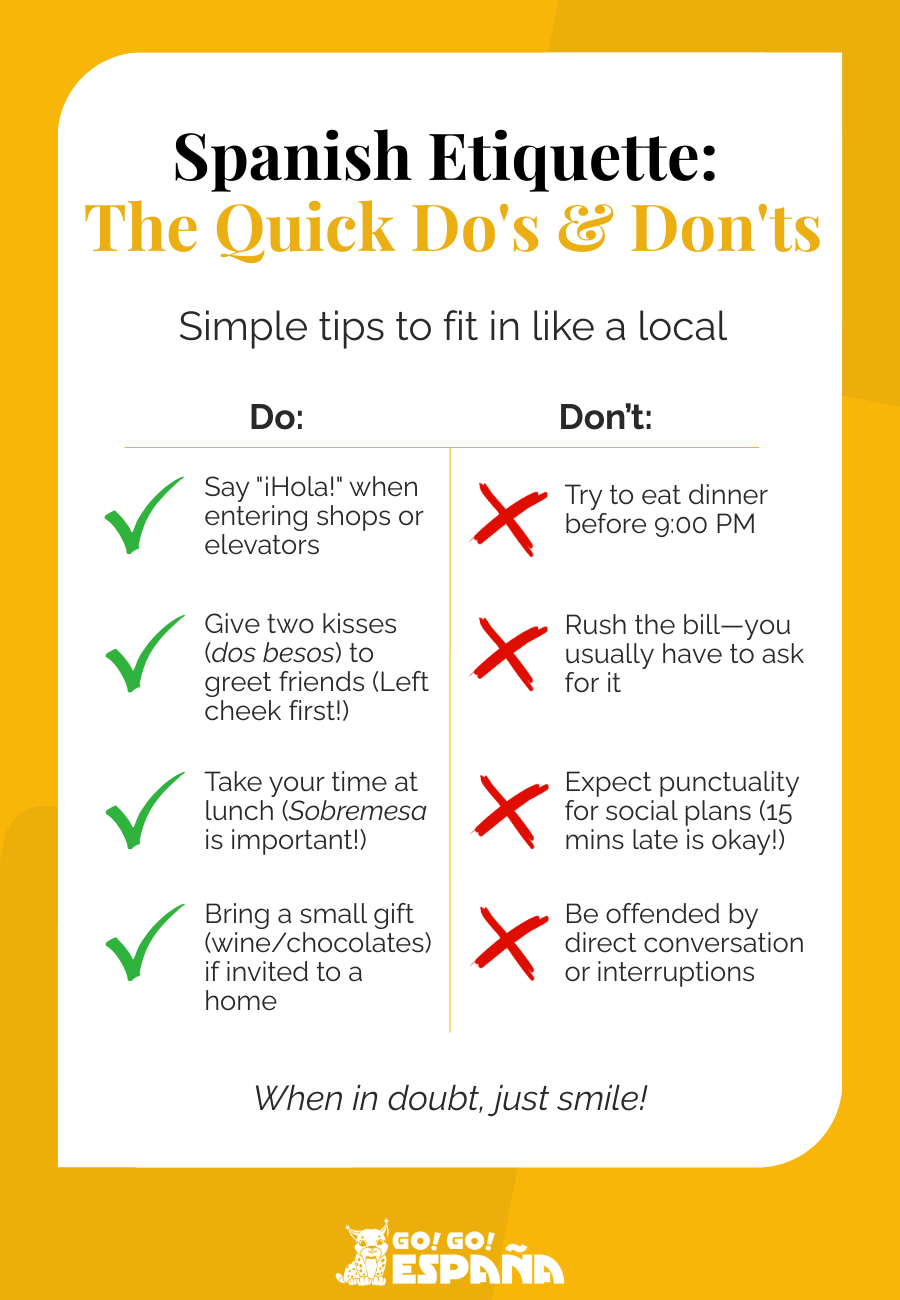
- A simple “¡Hola!” when entering a shop or “¡Hasta luego!” when leaving is a small but important part of daily Spanish etiquette. The dos besos (two kisses on the cheek) is a standard greeting between friends.
- Spanish meals, especially lunch and dinner, are meant to be enjoyed slowly. The tradition of sobremesa; relaxing and chatting long after the food is finished, is a cherished cultural practice.
- While you should always be on time for formal appointments and classes, being 10-15 minutes “fashionably late” for a social gathering is very common and not considered rude.
- Conversations in Spain are often lively, direct, and expressive, with less personal space and more physical contact (like a friendly touch on the arm) than in many other cultures.
- Unlike in some countries, tipping is not mandatory. However, leaving a small tip (5-10%) for good service at a restaurant is a nice gesture and is always appreciated.
What is the Correct Way to Greet Someone in Spain?
The rules of Spanish etiquette for greetings are warm and friendly. You should always offer a verbal greeting, and the dos besos is common for informal situations.
| Who are you greeting? | The Context | The Correct Greeting |
| Stranger / Shopkeeper | Public / Formal | Verbal (“¡Hola!”) or Handshake |
| Friend / Acquaintance | Social / Private | Dos Besos (Cheek kisses) |
| Close Family / Best Friend | Private | Hugs or Dos Besos |
| Business Contact | Professional | Handshake |
Greeting Context
Where you are and who is present matters in Spain.
1. In Public
More restrained. People tend to be polite but less physically expressive, especially with strangers or in professional settings. Follow the other person’s lead.
2. In Private
More relaxed and warmer. Physical greetings (kisses or hugs) are common among friends, family, and acquaintances once familiarity exists.
Greeting Style
How you greet depends on familiarity, age, and formality.

1. Kisses (Dos besos)
- Usually two cheek kisses, starting on the right cheek
- Common between women, and between men and women
- Typical in private settings and informal social situations
- Rare in formal business contexts
2. Handshake
- Standard in business and formal introductions
- Common between men, or when meeting someone for the first time
- Can be firm but not aggressive
- Often accompanied by eye contact and a smile
3. Hugs
- Reserved for close friends and family
- More common after you already know someone
- Often replaces kisses when there is strong familiarity
For more tips on connecting with people and breaking the ice, you can see our guide on 7 proven ways to make friends with locals in Spain.
Familiarity Level
Spain places more importance on relationships than strict rules.
- Strangers / First meeting → Handshake
- Acquaintances → Kisses (usually)
- Close friends / family → Hugs or kisses
One important rule to remember:
When in doubt in Spain, wait and mirror the other person.For more tips on connecting with people, you can see our guide on 7 proven ways to make friends with locals in Spain.
What is the Etiquette for Meals and Dining?
Spanish etiquette for dining revolves around enjoying the experience slowly. Meals are social events, and rushing is not part of the culture.
1. Meal Times
Be prepared for a different schedule. Lunch (la comida) is the main meal of the day and happens late, between 2pm and 4pm.
Dinner (la cena) is a lighter meal and often doesn’t start until 9pm or even later.
2. Sobremesa
This is a beloved Spanish tradition. It’s the art of lingering at the table for conversation, coffee, or drinks long after the meal is finished.
Soak it all in, practice your Spanish, and never feel like you need to rush off as soon as the plates are cleared.
3. Tipping
Tipping is not a requirement, and service staff are paid a full salary.
However, if you have received excellent service at a sit-down restaurant, leaving a small tip of 5-10% is a generous and appreciated gesture.
4. Split Bills
It is typical in Spain for tapas dishes to be shared socially amongst friends.
In saying this, many dining venues do not offer split bills, so this means maybe adopting a more casual mindset on paying the bill.
Whether that means having cash on you to contribute an even amount split amongst your group, alternating rounds, or transferring your share via Bizum (most common method amongst young people), Spaniards are less worried by the odd imbalance here and there.
5. Manners
Polite manners are a key part of the social culture in Spain.
When invited to someone’s house for a meal, it is always best practice to wait for the host to invite you to sit and eat.
Additionally, it’s polite to say “buen provecho” or at least not start eating before the host.
6. Toasting
With Spaniards loving to socialize or celebrate over a drink, often sharing a bottle of wine over lunch or dinner, toasts are evidently an important aspect to etiquette in Spain.
When someone toasts, make sure to maintain eye contact and of course take a sip after saying “¡Salud!”.
It’s also considered rude to not clink glasses, or to not partake in the toast without explanation.
To learn more about how to navigate your new schedule, read our international student’s guide to daily life in Spain.

How Does Punctuality Work in Spain?
The rules of Spanish etiquette regarding time can be flexible, depending on the context of the situation and the people you are meeting.
1. Formal Punctuality
For any official, formal professional appointments, like at a doctor’s office, a government office, or for academic classes, you should always be on time.
2. Social Punctuality
For social plans, like meeting friends for tapas, it is acceptable to be fashionably late by 10 to 15 minutes. So there’s no need to worry if you aren’t necessarily the type of person to be early, as that is not usually the expectation in Spain!
What is the Spanish Conversation Style Like?
Spanish conversations are often lively, expressive, and can involve more directness and physical contact than in other cultures.
Spaniards are expressive and often interrupt, this shows engagement, not rudeness. Talking with hands, overlapping speech, and animated reactions are normal.
So don’t be surprised if people stand closer to you when they talk, make a friendly touch on your arm to emphasize a point, or speak with a lot of passion and expression. It is a sign of warmth and engagement.
Spanish speakers can also be more direct in their opinions than in some other cultures, it’s helpful to see this not as rudeness, but as a form of honesty and engagement.
What is the General Dress Code?
While there is no strict dress code, Spaniards tend to dress more smartly for public outings than in many other countries.
To blend in, it’s a good idea to avoid overly casual wear like beach flip-flops, sweatpants or athletic wear when you are walking around the city center or going out in the evening.
You don’t need to be formal, but a “smart casual” approach is a good rule of thumb to fit into the daily Spanish clothing etiquette.
What Should You Do When Invited to a Spanish Home?
If you are invited to a Spanish home for a meal, it is a polite and common custom to bring a small gift for your host.
This is an important part of Spanish etiquette that shows your appreciation. You don’t need to bring anything expensive. A simple, thoughtful gift is perfect. Good options include:
- A bottle of wine.
- A small box of chocolates or pastries from a local bakery.
- A small plant or a bouquet of flowers.
This is particularly good advice for international students who are living in a homestay. A small gift for your host family when you first arrive is a wonderful way to start your stay on a positive note. This could even include bringing over a typical gift or treat from your home country to share a bit of your culture too as a nice gesture.
For a full breakdown of your housing options, including homestays, you can see our comprehensive guide to finding student accommodation in Spain.
FAQ About Spanish Etiquette for International Students
1. When should I shake hands instead of doing the dos besos?
In a formal or professional setting, or when meeting someone for the very first time (especially between men), a handshake is always appropriate. The dos besos is for more informal, social situations.
2. Is it rude to split the bill at a restaurant?
Not at all. It’s very common for a group of friends to split the bill (dividir la cuenta) or for each person to pay their share (pagar lo suyo).
3. Are there any topics I should avoid in conversation?
It’s always wise to be careful when discussing sensitive topics like regional politics (ex: Catalan independence) or bullfighting, as people can have very strong and differing opinions.
4. What is the most common etiquette mistake foreigners make?
One of the most common mistakes is trying to eat dinner at 6pm! Another is rushing a meal. Embracing the slower pace of life, especially around mealtimes, is the best way to adapt to the local culture.
Conclusion: Ready to Socialize with Confidence?
Don’t stress about getting every rule of Spanish etiquette perfect. Locals will always appreciate your effort to understand their culture, and a warm smile is a universal language.
Embracing these customs is part of the fun of your study abroad adventure!
The best way to learn Spanish culture is to live it. Let Go! Go! España help you find the perfect school or university to start your immersion journey today!
Want to know more about the daily routine? Read our Student’s Guide to Daily Life in Spain.


