


We explain what documents you need, which banks are best for international students, and how you can avoid common fees.
This guide will walk you through the process of how to open a bank account in Spain as an international student.
We’ll cover the difference between resident and non-resident accounts, what you need to prepare, and provide a list of important Spanish banking terms to help you navigate the process with confidence.
Setting up your finances is one of the first steps to feeling settled; see how this fits into your overall journey in our complete guide to learning Spanish in Spain.
(Last Updated: February 2026)
Key Takeaways
- If you are studying in Spain for more than a few months, a local bank account is necessary for paying rent and setting up utilities like a phone plan.
- To open a standard resident bank account, you will need your Foreigner Identity Number (NIE).
- It is possible to open a non-resident account with just your passport, but these often come with higher fees and are best used as a short-term solution.
- Many Spanish banks offer special accounts for young people (typically under 26 or 30) that have no or low monthly maintenance fees (comisiones).
- The process will be much smoother if you gather all your required documents—your passport, NIE, and proof of address—before you visit the bank.

Can You Open a Bank Account in Spain if You’re Not a Resident?
Yes, it is possible to open a bank account in Spain as a non-resident, but the process and requirements are different, and most long-term international students will need a resident account.
This is the most critical question for many new arrivals. The type of account you can open depends on your legal status in Spain.
- The Non-Resident Account (Cuenta de No Residente) This type of account can sometimes be opened with just your valid passport. It is a good temporary solution if you need an account immediately upon arrival and are still waiting for your TIE card. However, these accounts often come with higher monthly fees and more limitations.
- The Resident Account (Cuenta Corriente) This is the standard, everyday account that most long-term foreign students will need for their daily life in Spain. It requires you to have your Foreigner Identity Number (NIE) or TIE card. These accounts offer much better terms, including access to more services and, most importantly, special fee-free options for young people.
What Documents Do You Need to Open an Account?
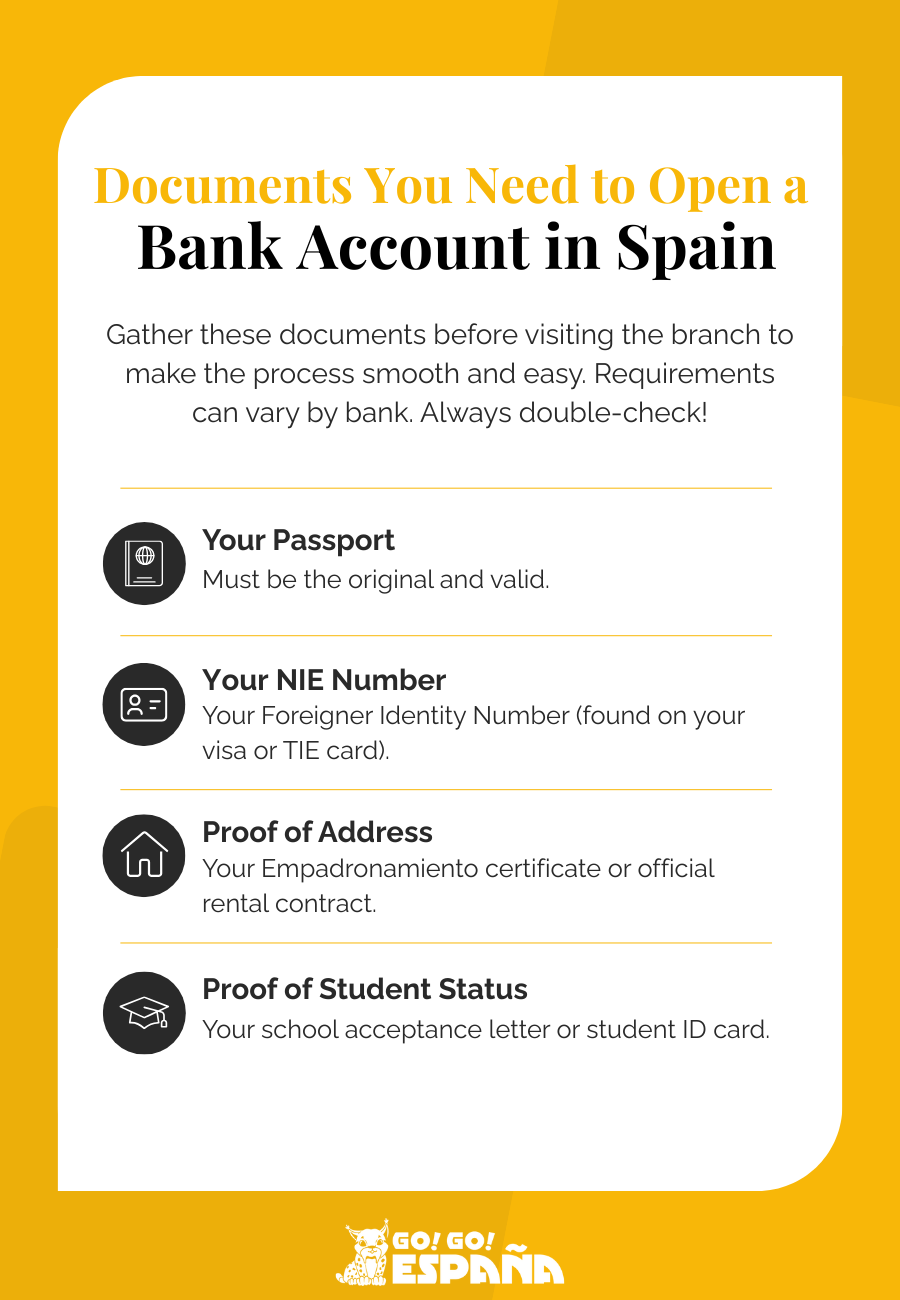
The exact documents can vary slightly by bank, but you will always need to prove your identity, your address, and your student status.
To make the process of opening a Spanish bank account as smooth as possible, you should prepare the following documents in advance.
- Your Passport: You will need your original, valid passport.
- Your NIE Number: This is the most important requirement for a resident account. The number can be found on your student visa or your TIE card.
- Proof of Address in Spain: This can be your empadronamiento certificate (proof of registration at the town hall) or your official rental contract. Read more about the empadronamiento process.
- Proof of Your Student Status: This is usually your official acceptance letter from your Spanish language school or Spanish university, or your student ID card.
Most traditional banks will eventually require your physical residency card. If you haven’t started that process yet, follow our step-by-step guide to getting your TIE card.
What Should You Look For in a Student-Friendly Bank?
The best banks for international students are those that offer accounts with no fees, a good mobile app, and a large network of ATMs.
When comparing banks, here are the key criteria to look for:
- No/Low Fees (Sin Comisiones): This is the most important factor. Look for special “youth accounts” (cuentas jóvenes) that waive the monthly maintenance fees, often for clients under 26 or 30 years old.
- A Good Mobile App: As a student, you’ll be managing your money on the go. A user-friendly mobile app is essential.
- A Large ATM Network: Sticking to your own bank’s ATMs will help you avoid withdrawal fees. Choosing a bank with a large, nationwide network is a smart move.
- English-Speaking Support: While not always available, some larger branches in major cities have English-speaking staff, which can be very helpful.
What are the Best Banks for International Students in Spain?
Table: Compare the features to find the best fit for your student life in Spain.
| Feature | Digital Banks (N26, Revolut, Wise) | Traditional Banks (Santander, BBVA) |
| Best For | Convenience & managing money on the go | In-person service & depositing cash |
| Sign-Up Process | 100% Online & Fast (often minutes) | Visit a branch (appointment often needed) |
| Maintenance Fees | Usually no monthly maintenance fees | Watch for fees unless you get a “Youth Account” |
| Language | App interfaces & support often in English | Contracts in Spanish; English support varies by branch |
| ATM Access | Free withdrawals often limited to a set amount | Large network of own-brand ATMs to avoid fees |
Major Spanish banks like Santander and BBVA can be a solid choice, but our team at Go! Go! España strongly encourages students to choose a digital bank for greater convenience.
Digital banks let you manage your finances entirely online, avoid the need to navigate in Spanish, and often charge lower fees. Some even offer free ATM withdrawals.
Here are some popular options for international students:
Digital Banks
These app-based banks are extremely popular with international students.
- Wise, N26, and Revolut: These app-based banks are extremely popular with international students. Sign-up is quick and easy, and they offer low fees for international transfers and payments.
Traditional Spanish Banks
These are large, established banks with physical branches all over Spain. They are a good choice if you prefer in-person service. Many offer special ‘Cuentas Jóvenes’ (Youth Accounts) for people under 30 that waive most fees.
- Santander: One of Spain’s largest banks, Santander offers a wide network of branches and ATMs along with student-focused accounts.
- BBVA: Known for excellent digital banking and a user-friendly mobile app, BBVA combines traditional banking with modern convenience.
- CaixaBank: With an extensive network across Spain, CaixaBank is a popular choice for both locals and international students.
Choosing the right bank can save you hundreds in currency exchange fees. Factor these savings into your total budget by reading our guide to the real cost of studying in Spain.
You can read more about banking options for expats in Spain here.
What is the Process for Opening Your Spanish Bank Account?
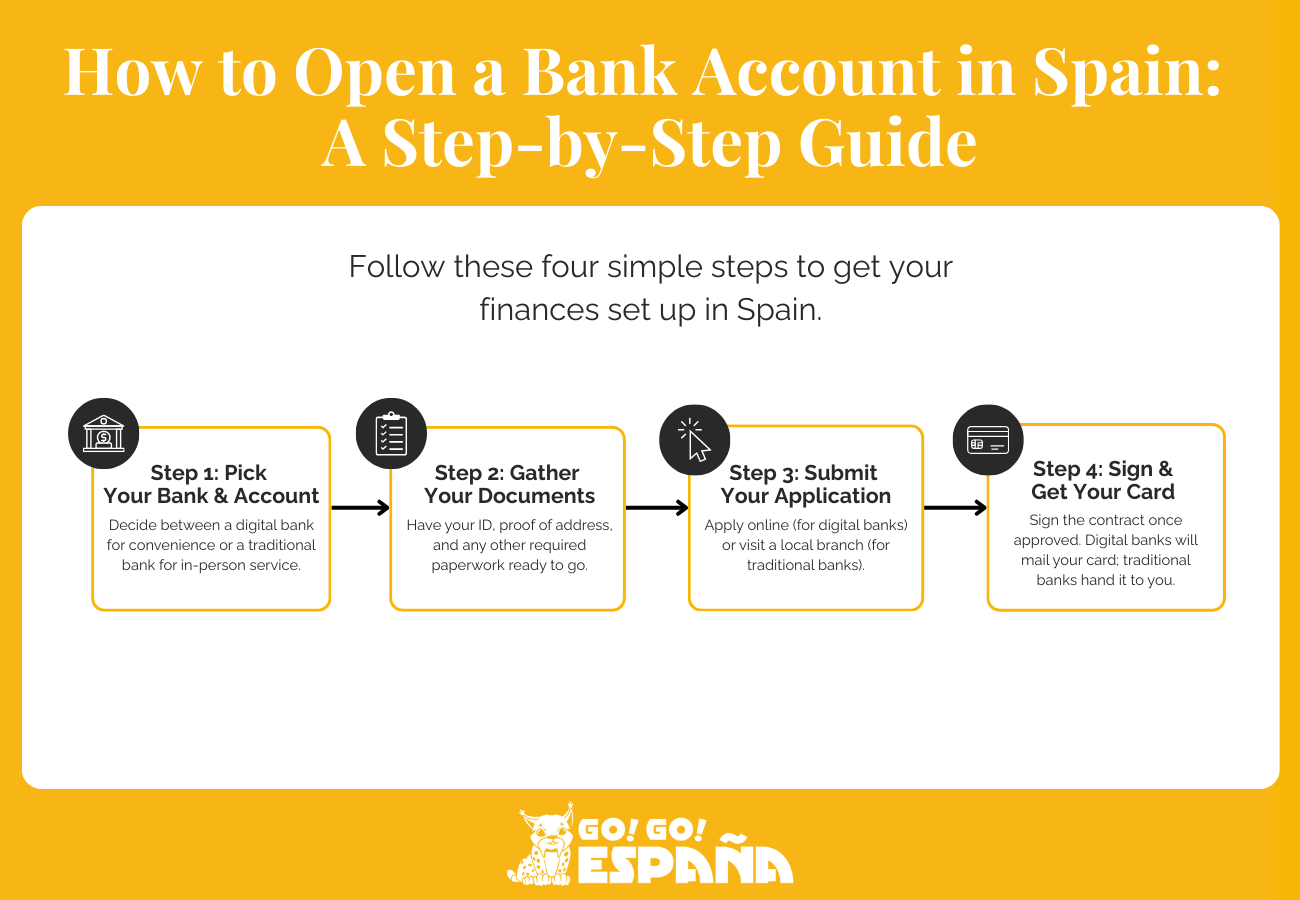
- Pick Your Bank and Account Type: Decide between a digital bank for convenience or a traditional bank for in-person service.
- Gather Your Documents: Have your ID, proof of address, and any other required paperwork ready.
- Apply: Submit your application online for a digital bank or visit a branch for a traditional account.
- Sign and Get Your Card: Once your account is approved, sign the contract. Digital banks usually mail your debit card within 1–2 weeks. For traditional banks, you can ask questions in person, like “Are there any monthly fees?” (¿Hay comisiones de mantenimiento?)
Important Spanish Banking Terms to Know
A mini-glossary to help students with the language barrier.
- Cuenta Corriente (Current Account)
- Tarjeta de Débito/Crédito (Debit/Credit Card)
- Comisión (Fee / Commission)
- Transferencia (Bank Transfer)
- Cajero Automático (ATM)
- Saldo (Account Balance)
- Extracto Bancario (Bank Statement)
- Domiciliación Bancaria (Direct Debit)
- Número de Cuenta / IBAN (Bank Account Number)
- Ingreso (Deposit)
- Retirada / Sacar Dinero (Withdraw Money)
- Interés / Tipo de Interés (Interest Rate)
- Oficina Bancaria (Bank Branch)
- Horario de Atención (Customer Service Hours)

FAQ On How to Open A Bank Account in Spain for International Students
1. Which Spanish bank is best for a non-resident?
As mentioned above, our team strongly recommends that students open a digital bank account, since these accounts usually have no fees or commissions.
While major banks like Santander and BBVA can open non-resident accounts, they often charge a quarterly or annual fee. Traditional banks might be a better choice only if you need more complex financial products, such as a mortgage or a car loan, but for students, digital banks are generally the most convenient and cost-effective option.
2. Can I use my bank account from my home country in Spain?
Yes, you can, but you will likely face high fees for international ATM withdrawals and card transactions. Many everyday expenses, such as paying your Spanish phone bill or rent, may also require a local bank account. If you plan to stay longer than a few weeks, opening a Spanish bank account is usually more cost-effective and practical.
3. Do I need a lot of money to open an account?
No. Most standard student accounts do not require a minimum deposit to open.
4. Can I open a bank account before I get my TIE card?
Yes, if you have your NIE number (which is often on your visa sticker), you can open a resident account. If you only have your passport, you can open a non-resident account and then change it to a resident account later once you have your TIE.
5. Is it difficult to close my bank account when I leave Spain?
It can be. It’s very important to visit your branch in person to formally close your account before you leave Spain to ensure you do not get charged any future fees.
Conclusion: Ready to Manage Your Finances?
While it may seem like just another piece of paperwork, opening a Spanish bank account is a major step toward feeling settled and independent in your new home. With the right documents and a little preparation, it’s a straightforward process that will make your daily life in Spain much easier!
A local account is essential for long-term stays; learn more about planning these arrival logistics in our guide to planning your Spanish language studies.
Now that your bank account is sorted, are you ready to explore? Discover the best student activities in your new city in our city guides.


