 Skip to content



The Spanish university system uses a centralized and rigorous framework for international student admissions, managed primarily through the UNEDasiss platform.
As an initiative of the Universidad Nacional de Educación a Distancia (UNED), it functions as the essential administrative bridge between foreign educational systems and Spanish higher education within our broader public Spanish university preparation guide.
Each year, UNEDasiss assesses the transcripts of thousands of students, ensuring their previous studies are recognized within the Spanish grading scale.
Key Takeaways:
- The Essential Bridge: UNEDasiss is the centralized body that converts international grades into a base Spanish score of up to 10 points. It also manages the specific PCE exams that you will need to help push your final university admission score to the maximum 14 points
- The Official Accreditation: This digital certificate serves as a verified academic record that Spanish universities check in real-time. It ensures international applicants are evaluated fairly against domestic students who finished the Spanish Bachillerato.
- Choosing Your Modality: Students must pick one of four academic tracks, like Science or Arts, to align with their target degree. You typically need to pass three subjects to unlock a modality, though Madrid universities often require four.
- The Volante Connection: You can upload a Volante de Inscripción Condicional to get a provisional accreditation if your final diploma validation is pending. This status allows you to sit for exams and meet June application deadlines on time.
- Understanding Service Fees: Basic file processing costs between €50 and €100, plus approximately €40 – €50 for each PCE subject exam. An official digital certificate with a secure verification code costs an additional €35.86.
- Support and Accessibility: General phone support is available on weekdays until 14:00, while technical help for portal errors extends to 20:00. You can also book personalized video calls or in-person sessions through the Cita Previa system.
Table of Contents
What is UNEDasiss?
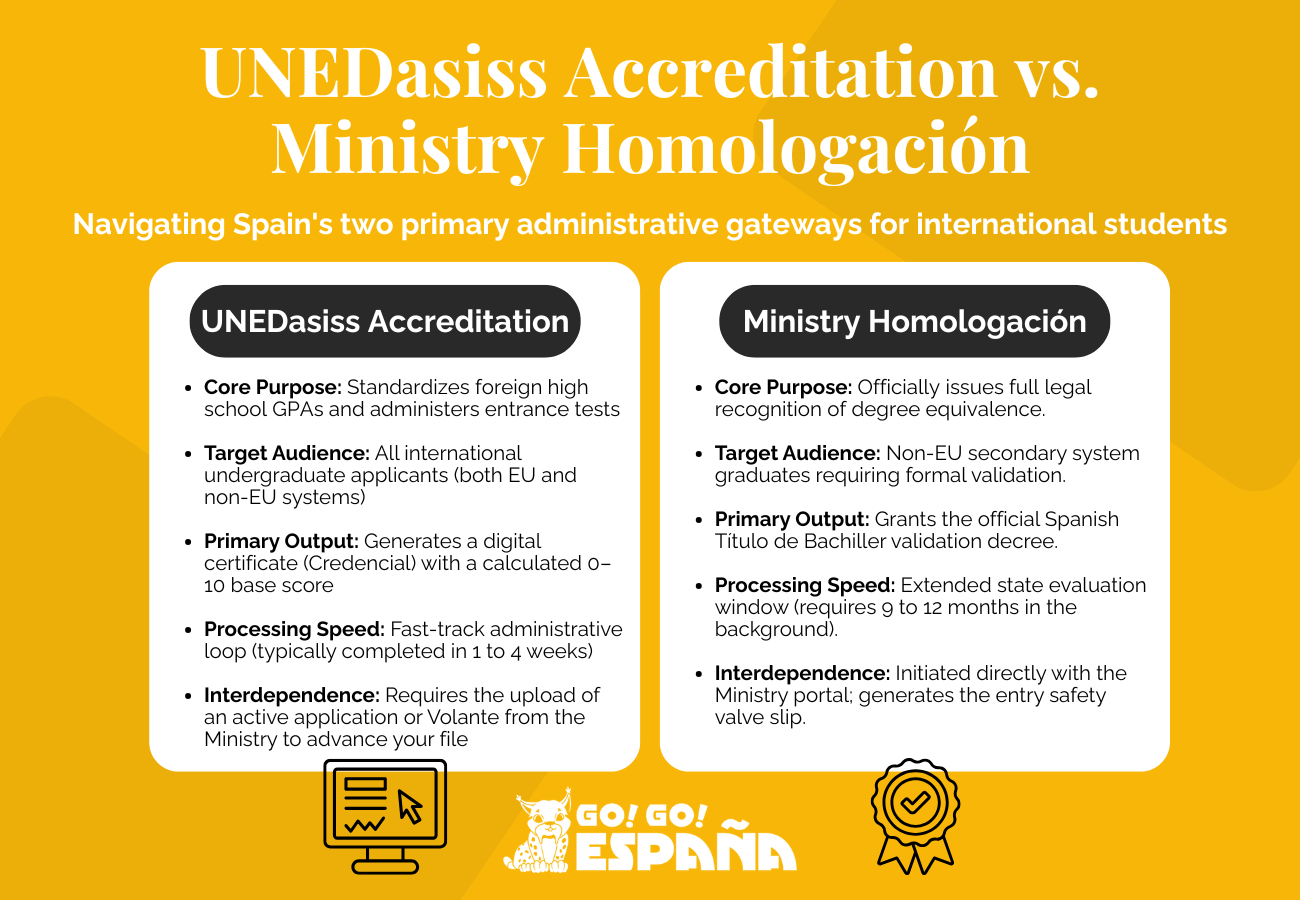
UNEDasiss is the specialized body responsible for evaluating the academic eligibility of students with international diplomas. It serves two primary functions:
- Academic Assessment: It converts original grades from a student’s home country into the Spanish 0-10 point scale.
- Examination Management: It conducts Specific Competency Tests (PCE), often taught at specialized academies featured in our preparatory schools in Spain guide, which are subject-specific exams that allow students to increase their admission score to a maximum of 14 points.
By centralizing these services, UNEDasiss creates a level playing field between international applicants and domestic students who completed the Spanish Bachillerato.
The UNEDasiss Accreditation (Acreditación)

The core output of this process is the UNEDasiss Accreditation, a digital certificate that serves as your standardized academic record for Spanish universities.
- Standardization: It is a formal assessment verified for use by Spanish universities, not just a simple translation of your grades.
- Digital Verification: Universities have access to a digital verification tool that allows them to check your credentials in real-time before strict Spanish university application deadlines close, speeding up the pre-enrollment phase and minimizing the risk of fraud.
- Finality: For students from systems with reciprocity (like the EU or IB), this accreditation is often the only document needed for entry.
Which Academic Track Should I Pick?
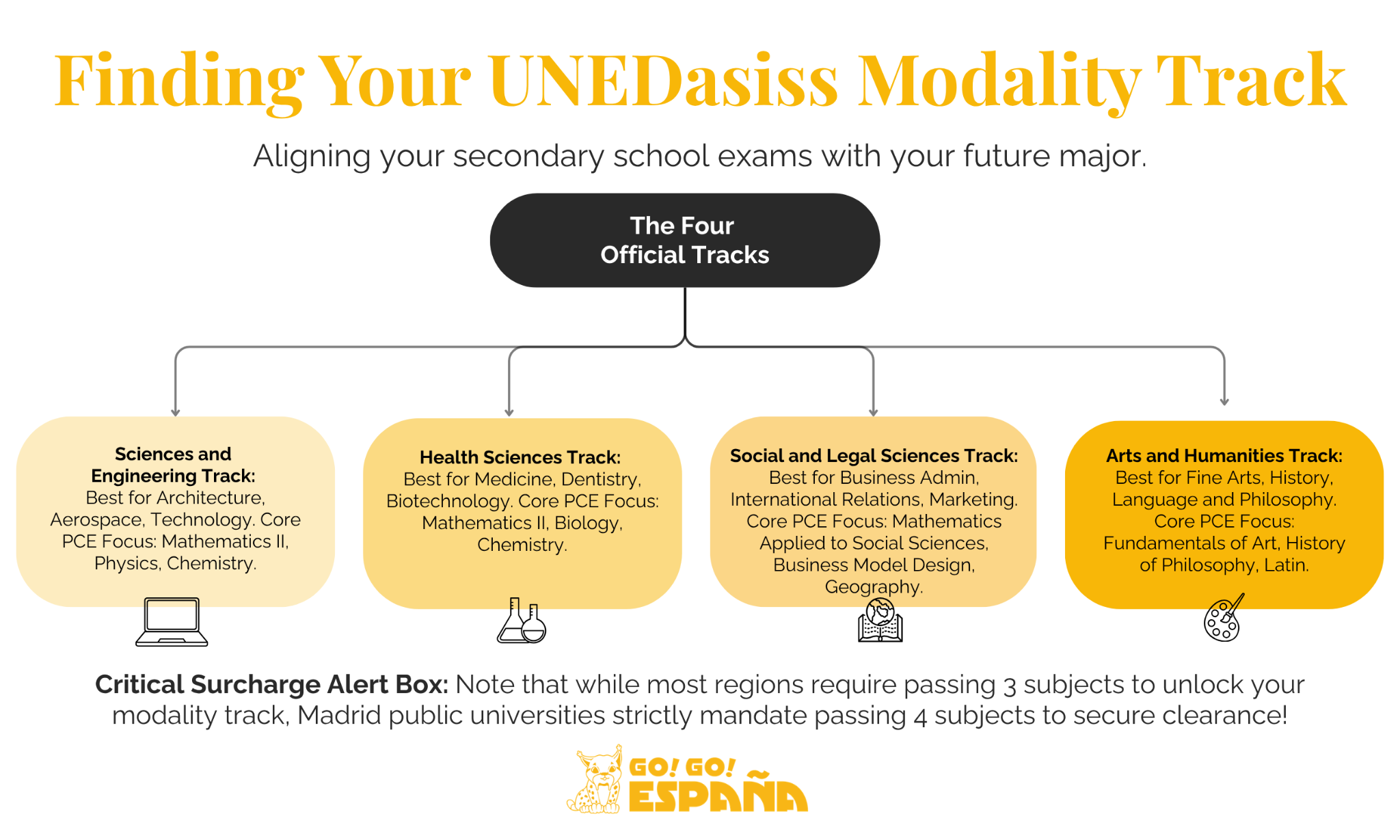
To qualify for specific degrees, students must achieve a “Baccalaureate Modality” (Modalidad de Bachillerato) that aligns with their desired field of study. There are four official tracks:
- Sciences and Engineering
- Health Sciences
- Arts and Humanities
- Social and Legal Sciences
Your chosen track dictates which specific PCE exams you must take during Spanish university pathway programs; for example, the Sciences track requires subjects like Mathematics II or Physics.
Beyond just choosing a track, you will need to select the right mix of UNEDasiss services to build your file. Here is a breakdown of the services you can purchase:
| Service Category | Purpose | Target Demographic |
| Grade Conversion | Converts foreign GPAs to the Spanish 0-10 scale. | All international students. |
| Specific Competency Tests (PCE) | Subject-specific exams (up to 6) to improve entrance scores. | Non-EU and competitive EU applicants. |
| Subject Recognition | Validates home curriculum subjects as equivalent to PCE exams. | EU, IB, China, and Colombia systems. |
| Language Certification | Accredits B1, B2, or C1 levels in SAccredits levels to meet official Spanish university language requirements for B2 proficiency in Spanish or other languages. | Non-native speakers. |
Pro-Tip: If you are aiming for high-demand programs like Medicine or Engineering, you must reach the 14-point threshold by taking PCEs in subjects like Physics, Chemistry, or Biology.
Pro Tip: If you are aiming for high-demand programs like Medicine or Engineering, you must reach the 14-point threshold by taking PCEs in subjects like Physics, Chemistry, or Biology.
GPA Conversion and the 14-Point Admission Score
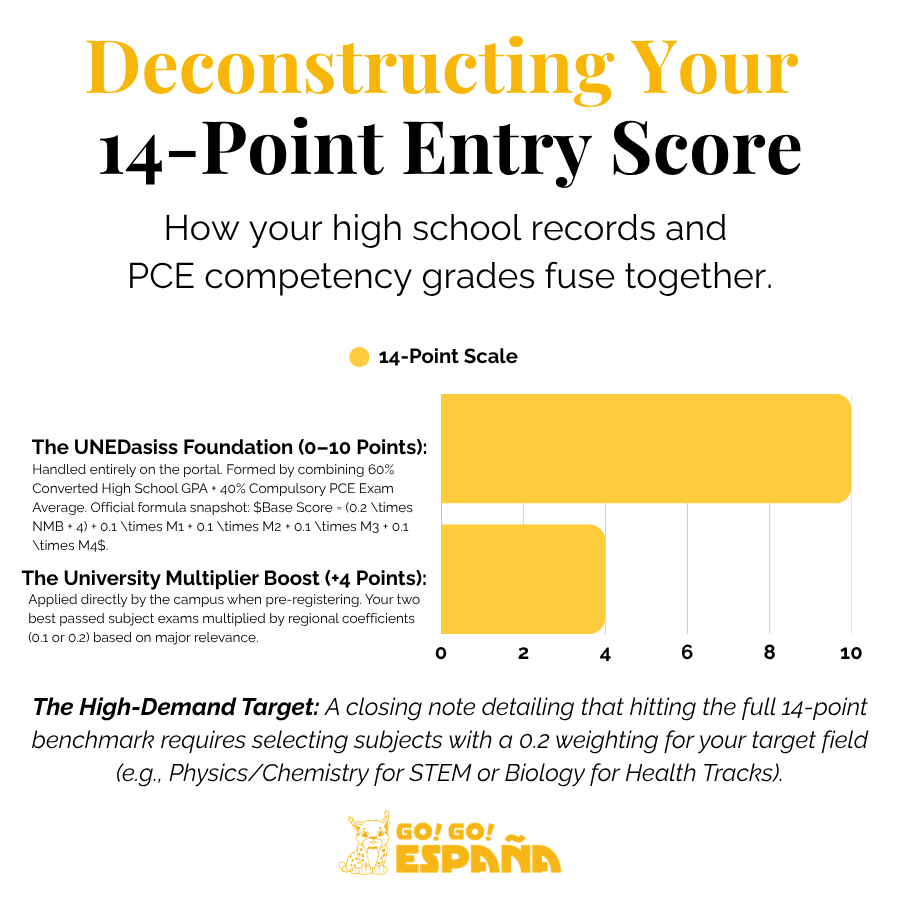
When understanding the 14-point Spanish university grading system, a common misconception is that UNEDasiss gives you a score out of 14; in reality, UNEDasiss calculates your base admission score out of 10 points.
The final 4 points are added later by the specific Spanish university you apply to.
Here is how UNEDasiss calculates your base score (Calificación de Admisión) if you require degree validation:
- NMB (Nota Media de Bachillerato): Your high school GPA converted to the Spanish scale.
- M1 to M4: Your scores on up to four PCE exams (you must score at least a 5/10 on an exam for it to count).
Reaching the 14-Point Maximum
Once UNEDasiss issues your base score out of 10, the universities look at your two best PCE scores related to your degree. They multiply those scores by a weighting factor (usually 0.1 or 0.2) depending on how relevant the subject is to the degree.
Final University Score = UNEDasiss Base Score + (a x E1) + (b x E2)
If you score a perfect 10 on two highly relevant PCE exams (weighting of 0.2), the university adds 4 points to your UNEDasiss base score, bringing you to the ultimate 14 points needed for highly competitive programs like Medicine.
Uploading the Volante: Using the Conditional Enrollment Slip (Volante de Inscripción Conditional)
As discussed in our guide to the Volante de Inscripción Condicional, this provisional document is a vital component of your UNEDasiss file.
While UNEDasiss does not perform the legal validation (Homologación) of your degree, it requires proof that you have initiated the process with the Ministry of Education.
If your Homologación is still in progress, UNEDasiss will issue a “Provisional Accreditation”. This allows you to sit for exams and apply for university spots while waiting for your final legal certificate.
UNEDasiss Service Fees and Costs
No accreditation request is processed until the required fees are paid in full. UNEDasiss offers a secure payment gateway within their application software.
| Fee Type | Approximate Amount | Purpose |
| Accreditation Fee | Varies by service | Standard processing of academic records. |
| Official Certificate | €35.86 | Digital certificate with a CSV for third-party verification. |
| PCE Exam Fee | Varies by subjects | Registration for subject-specific tests. |
| Processing Fee | €100 – €235 | Additional handling fees for specific partner universities. |
How Can I Contact UNEDasiss Customer and Technical Support?

Managing the UNEDasiss portal is largely a digital journey, but administrative hurdles or technical glitches can occasionally stall your progress. Below are the specialized contact points organized by the type of assistance they provide.
UNEDasiss General Administrative Support
This is the primary point of contact for most students. Use these channels to inquire about the status of your accreditation, document requirements, or general admission procedures.
| Contact Method | Detail | Availability (Madrid Time) |
| Primary Email | unedasiss@adm.uned.es | 24/7 (Monitored business hours) |
| General Phone | +34 91 398 6612 | Mon – Fri: 09:00 – 14:00 |
| Information Channels | WhatsApp & Telegram | Periodic news and alerts |
UNEDasiss Technical and Multilingual Assistance
If you encounter “bugs” while uploading files or if you prefer to communicate in a language other than Spanish, these specialized lines ensure your application isn’t stalled by technical or language barriers.
| Support Type | Contact Detail | Availability (Madrid Time) |
| Technical Help Desk | +34 91 398 8801 | Mon – Fri: 09:00 – 20:00 |
| English/French Support | +34 91 398 6612 | Tuesdays Only: 09:00 – 11:30 |
UNEDasiss Specialized Academic and Accessibility Services
These departments handle specific aspects of the student experience, such as the logistics of the PCE exams or providing necessary accommodations for students with disabilities.
| Department | Contact Method | Purpose |
| Exam Secretariat | secretaria.selectividad@adm.uned.es | PCE exam grades, centers, and packaging. |
| Accessibility (UNIDIS) | secretaria@unidis.uned.es | Support for students with disabilities. |
| UNIDIS Phone | +34 91 398 6074 | Specialized disability support line. |
Securing an Official Cita Previa UNED Session
For matters that require a face-to-face or deep-dive conversation, UNEDasiss offers both physical and virtual appointment services.
| Service Type | Detail | Location / Platform |
| Madrid Headquarters | C/ Juan del Rosal, 14, 28040 | Edificio Facultad de Educación |
| In-Person Appointment | Book via UNED Portal | Highly recommended to avoid queues. |
| Video Call Session | Virtual Cita Previa | Accessible via the UNEDasiss portal. |
Reminder: When emailing any of these departments, always include your Full Name and Surname. If you have already started an application, include your File Number or Passport/ID number to ensure the staff can locate your records quickly.
Source: Visit UNEDasiss contact page
FAQs About UNEDasiss
1. What services does UNEDasiss offer in Spain?
UNEDasiss provides academic transcript evaluation, grade conversion to the Spanish scale, Specific Competency Tests (PCE), subject recognition for reciprocity systems, and language level accreditation.
2. What payment methods does UNEDasiss accept for their services?
UNEDasiss accepts online payments via Credit or Debit Card (instantaneous) and Bank Transfers. Transfers require uploading a PDF receipt to the portal manually.
3. Can I track my UNEDasiss service request status online?
Yes, the “Comprobantes” (Vouchers) section of your user portal allows you to monitor if payments were recorded, documents received, and whether your status is “In Process,” “Provisional,” or “Granted”.
4. How long does it take for UNEDasiss to activate a new service?
Card payments are instant, while bank transfers take 3-5 days. Once documents are received (10-15 days via post), the accreditation is usually issued within 1 to 4 weeks depending on the volume of applications in July or September.
5. Does UNEDasiss provide services for validating foreign qualifications?
UNEDasiss provides academic Accreditation for university admission. However, the legal Homologation (validation) of your degree remains the exclusive responsibility of the Spanish Ministry of Education.
In Summary: UNEDasiss Accreditation
UNEDasiss is the indispensable administrative engine behind the Spanish international admission process, turning foreign transcripts into official university credentials.
Whether you are converting your GPA, selecting a degree-specific modality, or using your Volante for a provisional application, mastering this portal is the only way to secure your spot in a Spanish classroom.
Ready to start your application without the stress?
Get expert help from Go! Go! España now to ensure your accreditation is processed correctly.
After you’ve secured your portal access, the next step is boosting your admission score, read our deep dive into the PCE Exams.


