 Skip to content


Discover the essential techniques and daily habits for understanding how to learn Spanish fluently and accelerate your journey beyond the classroom.
You’re in Spain, surrounded by the language, so you’ve already taken the biggest and most important step toward fluency. But how do you turn that daily exposure into real, rapid progress?
Everyone wants to know, “What is the best way to learn Spanish?” The answer isn’t just one thing; it’s a combination of quality classroom instruction and smart, daily immersion habits.
This guide moves beyond the classroom to give you practical habits and techniques to help you learn Spanish fast. To get started, you can explore our complete guide to Spanish courses in Spain, which will help you structure your academic path from day one.
(Last Updated: February 2026)
Key Takeaways
- The fastest way to learn Spanish fluently is to combine structured learning in a high-quality language school with active, daily immersion in the culture outside of class.
- Small, consistent habits, like changing your phone’s language to Spanish or trying to have a short conversation every day, are what build real fluency over time.
- You cannot achieve fluency without practicing speaking every single day. Joining a language exchange (intercambio) is one of the best ways to do this.
- With an intensive course and full immersion, many students can reach a strong conversational level (B2) in about 7 to 9 months, but true mastery takes time and patience.
- The hardest part of learning Spanish for many is overcoming the fear of making mistakes. Every error is a learning opportunity and a step closer to your goal.

What is the Most Effective Method of Learning Spanish?
Table: Comparison of classroom learning vs daily immersion for Spanish fluency
| The Classroom (The “Why”) | Daily Life (The “How”) | |
| Focus | Grammar, Structure, Rules | Speaking, Listening, Context |
| Activity | Drills, Exercises, Exams | Ordering coffee, Chatting, Shopping |
| Benefit | Builds a strong foundation | Builds confidence & speed |
| Goal | Accuracy | Fluency |
The single most effective method to learn Spanish fast is to combine structured learning in a high-quality language school with active, daily immersion in the culture.
Your language school is your foundation. It’s where you will learn the essential grammar rules, build your core vocabulary, and have your questions answered by qualified, native teachers.
However, the real magic happens when you take what you’ve learned in the classroom and apply it in the real world. This hybrid approach works so well because:
- The Classroom Provides the “Why”: It teaches you the structure and rules of the language.
- Daily Life Provides the “How”: It forces you to use what you’ve learned in practical, real-world situations.
This combination is the proven path to Spanish fluency.
What’s the Fastest Way to Learn Spanish Fluently? A Daily Immersion Routine
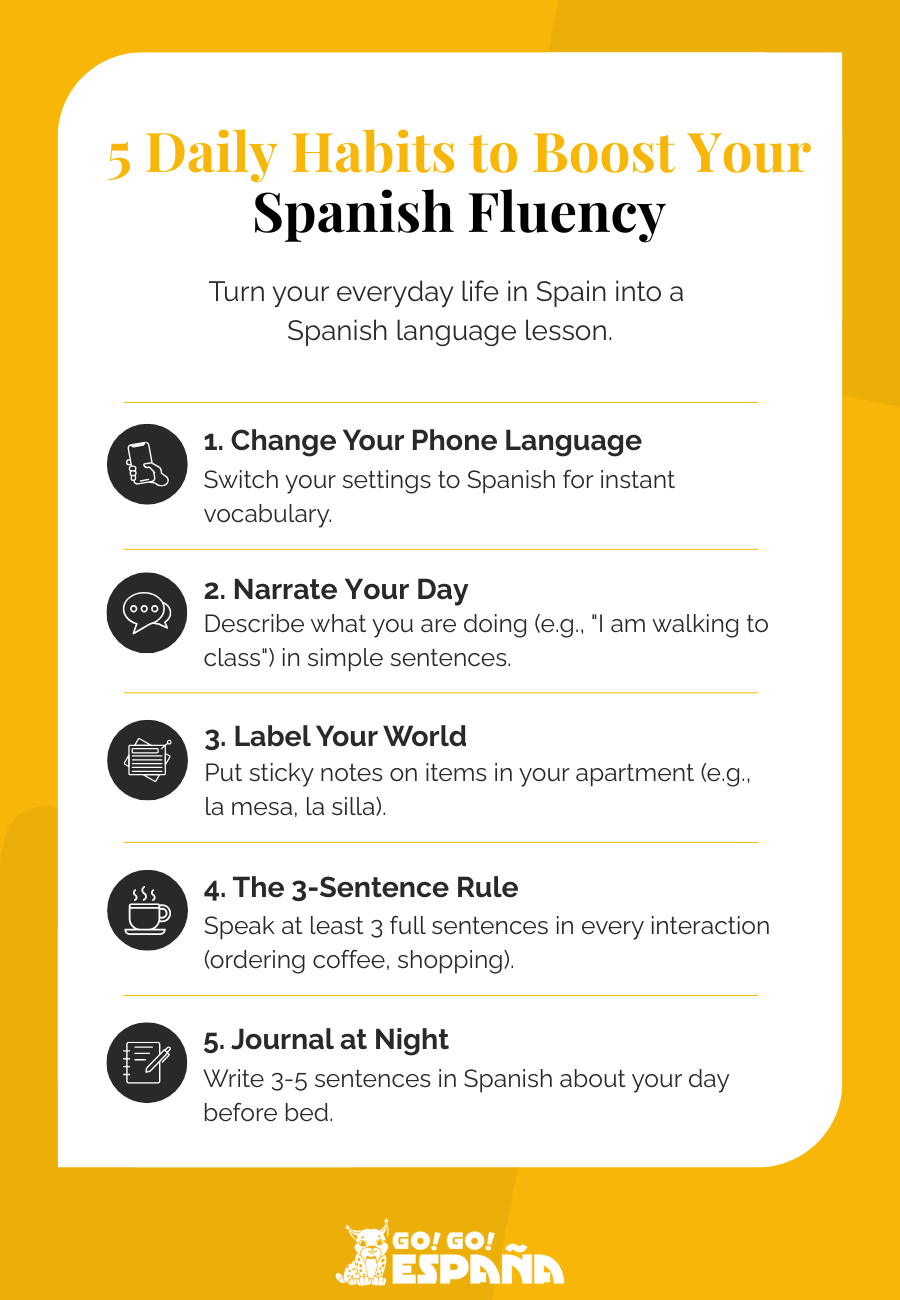
The fastest way to learn is to apply these practical tips for learning Spanish that turn your entire day into a language-learning opportunity with a series of small, consistent habits.
- Change Your Phone’s Language to Spanish: This is the simplest and most effective immersion trick. You will learn dozens of new, practical words every day without even trying.
- Narrate Your Day in Spanish: As you go about your day, try to describe what you’re doing in simple Spanish sentences, either out loud or in your head. It sounds silly, but it’s an incredible way to start thinking in the language.
- Label Your World: Use sticky notes to label common items in your apartment (la mesa, la silla, la ventana). This visual connection is a powerful memory tool.
- Consume Spanish Media: Switch your Netflix profile to Spanish, listen to Spanish music on Spotify, follow Spanish news sites or influencers on social media, and try reading books in Spanish. Start with simple children’s books to build confidence, then move on to your favorite genres as your language skills grow.
Living the language is the only way to move past the intermediate plateau. Explore the science and benefits of Spanish language immersion for a deeper look.
The Key to Confidence: How to Practice Spanish Speaking Skills Daily
You cannot improve your Spanish speaking skills without practicing every single day. The key is to find low-pressure environments where you feel comfortable making mistakes.
- Join an Intercambio (Language Exchange): This is a social event where you can meet locals who want to practice your language in exchange for helping you with their Spanish. It’s the perfect environment for a student. Your language school will make sure you know when and where these are happening.
- Make the Most of Your Spanish Classes: Challenge yourself to speak and participate as much as possible during your Spanish classes. The more you use the language in a structured environment, the faster your confidence will grow.
- The 3-Sentence Rule: Set a small, achievable goal for every daily interaction (ex: ordering coffee, buying bread). Try to use at least three full sentences.
- Embrace Mistakes: Reassure yourself that every error is a sign that you are trying and pushing your limits. Native speakers are almost always friendly and will appreciate your effort.
Proven Study Techniques for a Smarter Brain
Supplement your classroom learning with a few proven study techniques to help you memorize vocabulary and improve your pronunciation more effectively.
- Spaced Repetition System (SRS): Use an app like Anki or Memrise to create digital flashcards. SRS is a scientifically proven method for memorizing new vocabulary.
- Shadowing: It is a study technique designed to improve your accent and intonation. It involves listening to a short audio clip from a native speaker and repeating it exactly, attempting to mimic their pronunciation and rhythm perfectly.
- Daily Journaling: End each day by writing a few simple sentences in Spanish about what you did, what you saw, or how you felt.
While immersion is key, reinforcing your studies with the right apps, podcasts, and digital media can accelerate your progress significantly. You can find our curated list of tools in our guide to resources to learn Spanish
Putting It All Together: A Sample Weekly Fluency Plan
The key to Spanish language fluency is consistency. By incorporating a variety of activities into your week, you can keep your learning fresh, fun, and highly effective.
It can be hard to imagine how all these new habits fit into a busy student schedule. Here is a simple, visual table showing a sample week that balances classroom learning, dedicated study, and real-world immersion.
Table: Weekly schedule sample for learning Spanish fluently in Spain
| Day | Morning (9am-1pm) | Afternoon (3pm-6pm) | Evening (8pm onwards) |
| Monday | Attend Spanish Class | Review class notes & do homework | Listen to a Spanish music playlist while making dinner |
| Tuesday | Attend Spanish Class | Use a flashcard app (SRS) for 20 minutes | Go to an intercambio (language exchange) event |
| Wednesday | Attend Spanish Class | Go to a local market and practice your food vocabulary | Watch a Spanish movie or a new episode of a Spanish series |
| Thursday | Attend Spanish Class | Review class notes & do homework | Meet classmates for tapas and practice conversation |
| Friday | Attend Spanish Class | Explore a new neighborhood or visit a museum | Write a short journal entry in Spanish about your week |
| Saturday | No Class | Day trip to a nearby town or city | Go out with new friends (both local and international) |
| Sunday | Relax & Prepare | Light review of the week’s lessons | Watch a Spanish news broadcast or read a book in Spanish |

FAQ on How to Learn Spanish Fluently
1. What level of Spanish is considered fluent?
While “fluency” is subjective, a B2 level on the official CEFR scale is generally considered conversationally fluent. At this level, you can interact with a degree of spontaneity with native speakers, and it’s also the minimum level that most universities in Spain require for admission into a Spanish-taught program. A C1 level, on the other hand, is considered advanced fluency, allowing for more complex and nuanced communication.
2. How long does it take to become fluent in Spanish?
With an intensive course and full immersion, many students can reach a strong conversational B2 level in 7 to 9 months. However, reaching advanced C1 or C2 fluency can take a year or more of dedicated study.
Take our Free Spanish Level Test to discover your current Spanish level and gain a better understanding of your timeline.
3. What’s the hardest part of learning Spanish?
Often, the hardest part of it all is overcoming nerves, like feeling shy or afraid to speak. Remember, making mistakes is part of the learning process, and every attempt brings you closer to fluency.
For many English speakers, mastering the subjunctive mood (used to express desires, doubts, and hypotheticals) and distinguishing between the two “to be” verbs, ser and estar, can be particularly challenging. If you’d like to get a headstart, you can sign up for our Free Online Spanish Beginner Course to start advancing today!
4. Is it better to focus on grammar or speaking?
You need both, but to achieve Spanish fluency, you should prioritize speaking Don’t wait until your grammar is perfect to start having conversations. The more you speak, the more your grammar will naturally improve! To stay on the right track, read our companion piece on the habits to avoid when learning Spanish in Spain.
5. How can I stop translating in my head?
The best way is through immersion and practice. The more you surround yourself with Spanish and force yourself to use it, the more your brain will start to make direct connections without needing English as a middleman.
Conclusion: Ready to Start Your Journey to Fluency?
The journey to learn Spanish fluently is a personal one, built through the consistent, small, daily habits you create. Your language school will give you the essential tools and knowledge, but your real progress will come from your own courage to practice, your curiosity to explore the culture, and your willingness to embrace mistakes as part of the process.
Remember that fluency is not a final destination you arrive at, but a continuous path you walk. By following the strategies in this guide and making the most of your incredible immersion experience in Spain, you are not just learning a language; you are unlocking a new way to see the world. To see how these habits fit into your total relocation plan, follow our Complete Guide to Learning Spanish in Spain.
The best way to get fluent is to start with a great school. Find your perfect language program in Spain with free help from Go! Go! España!


