 Skip to content


Learn how to successfully get your TIE card in Spain, your first and most important administrative task after arriving.
Congratulations on arriving in Spain to begin your studies! It’s an exciting time, and your first official task is to get your Tarjeta de Identidad de Extranjero (TIE). Think of this as your official Spanish residence permit.
The process to get your TIE card in Spain can seem confusing at first, but don’t worry.
This guide walks you through every step in a clear, simple way. Getting your TIE is a standard procedure for all long-term international students, and with the right preparation, you’ll have no problem obtaining it.
If you are just starting your research and want a complete overview of the entire study abroad journey, read our complete guide to learning Spanish in Spain.
Getting your TIE Card is a crucial step for your studies in Spain. Let’s begin!
(Last Updated: January 2026)
Key Takeaways:
- The TIE is the physical, credit-card-sized ID card that proves you are a legal resident in Spain. You are required to carry it with you.
- You only need to apply for a TIE if your study program in Spain is for more than 180 days.
- If you arrive in Spain with a student visa, it is a legal requirement to start the application process and have your initial appointment (cita previa) within your first 30 days of your arrival.
- If you arrive as a tourist and choose to apply for a visa from within Spain, you will not be able to apply for your TIE card until your visa is approved. Once approved, you also have 30 days to schedule your initial appointment.
- The TIE process involves two separate appointments: the first to submit your documents and provide fingerprints, and the second (usually a month later) to pick up the physical card.
- The most important part of the process is gathering all the correct documents before your first appointment.
What is a TIE Card and How is it Different from the NIE?
The TIE (Tarjeta de Identidad de Extranjero) is a physical identity card for non-EU citizens who are legal residents in Spain. It is different from your NIE, which is just your identification number.
- NIE (Número de Identidad de Extranjero): Your Foreigner Identity Number, used for all official paperwork in Spain, from opening a bank account to signing a rental contract. You will also need it to schedule a TIE card appointment. Your NIE may appear printed on your student visa.
- TIE (Tarjeta de Identidad de Extranjero): The physical, credit-card-sized photo ID you carry in your wallet. It contains your personal details, photo, fingerprint, and NIE number. This is the official document proving your legal residence.
To see how this residency card fits into your broader logistical timeline and deadlines, read our practical guide to planning your Spanish language studies.
The TIE Card Application Process in 7 Steps
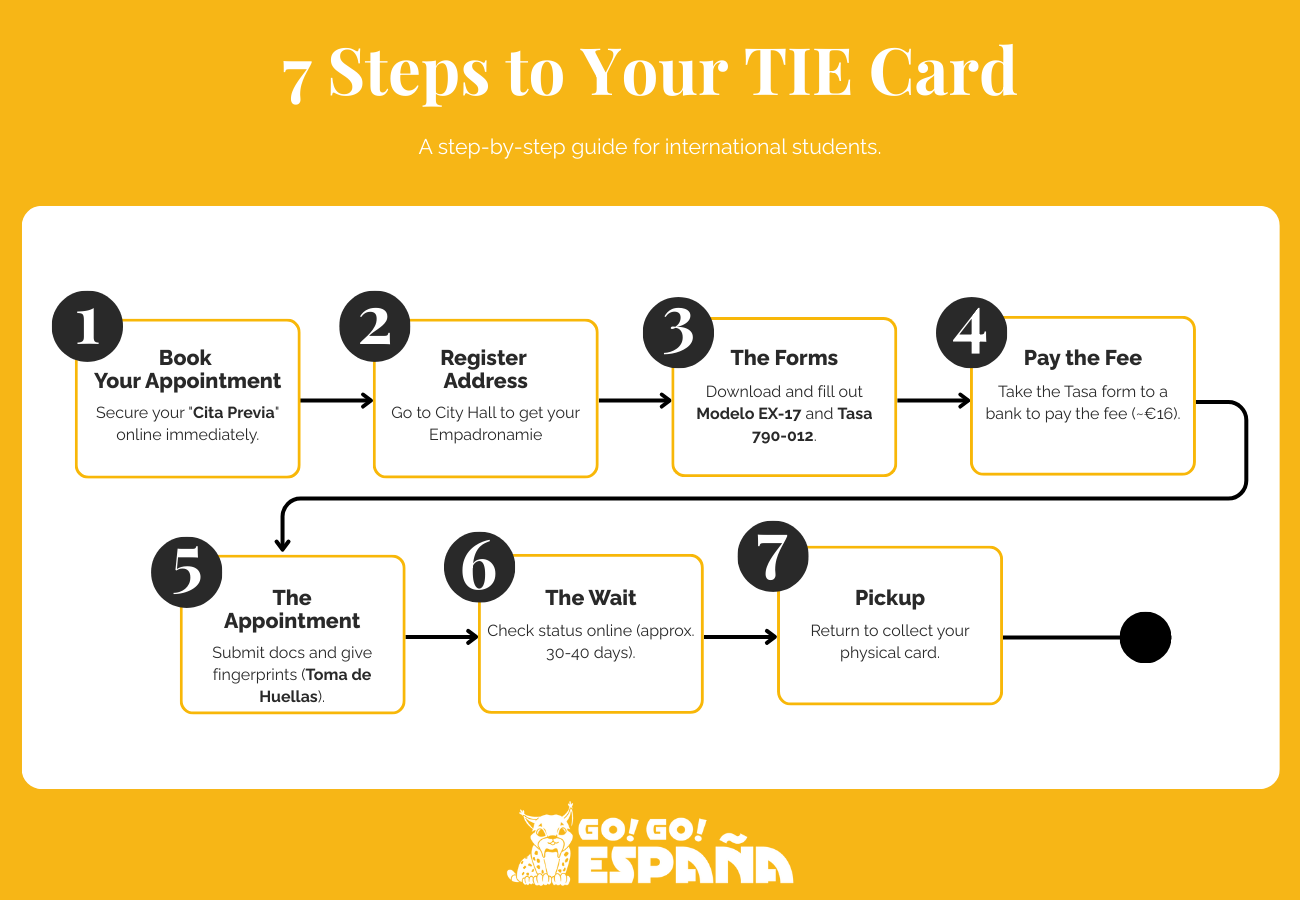
Now that you’ve secured your appointment, it’s time for the next steps: gathering your documents, paying the required fee, attending your appointment to submit everything, and returning later to pick up your card.
Some of these steps can be tricky and require careful attention to detail. Our team at Go! Go! España has broken down each stage and its sub-steps so you can navigate the process with confidence.
Step 1. Book Your Appointment (Cita Previa) Online:
Booking an appointment to apply for your TIE (Tarjeta de Identidad de Extranjero) is the first step to getting your residence card in Spain.
These appointments can be difficult to secure, so start checking the official website as soon as you arrive in Spain. Remember you have 30 days from the day you arrive in Spain (if arriving with a student visa) or from the day your student visa is approved (if applying for a student visa from within Spain) to book your initial TIE appointment.
a. Navigate the Spanish Public Administration Portal
Go to the Spanish Public Administration portal and select your province from the drop-down list.
Important Note: The website to book your TIE card appointment is only accessible from within Spain, so if you try to use it from your home country, it will appear to be down/blocked. One way to work around this is to use a VPN. You also must have a valid NIE to successfully book an appointment.
Once you’ve selected the relevant province, click Aceptar.
On the next page, you will see a drop-down box labeled “Selecciona Oficina” asking you to choose an office.
You can skip this step and go straight to “TRÁMITES POLICÍA NACIONAL” to view all available processes at once. This lets you see appointment availability for every immigration office in your region in one glance.
Select the option titled “POLICÍA-TOMA DE HUELLAS (EXPEDICIÓN DE TARJETA) INICIAL, RENOVACIÓN, DUPLICADO Y LEY 14/2023” and click Aceptar to continue.
b. Log In to the Portal
On the following page, you will find a list of all of the necessary documents you will need to bring to your appointment and other important reminders.
If you continue to the bottom of the screen, you will find two login options: “Presentación con Cl@ve” or “Presentación sin Cl@ve.” Choose the option that works best for you to continue your TIE card application in Spain. Both lead to the same form.
Option 1: Access with a Digital Certificate (con Cl@ve)
You can log in using a digital certificate (Certificado Digital). This is the most secure and convenient method, however, it is only possible if you already have a Spanish NIE.
To get a Certificado Digital in Spain, visit the official Fábrica Nacional de Moneda y Timbre (FNMT) website. The best option for most foreigners is to apply“Con acreditación presencial en una oficina. Obtener Certificado Presencial.”
Once issued, your digital certificate can be used to securely access Spanish government services online, including your TIE application.
If you do not have a digital certificate, you can still access the portal by entering your personal information directly. Both options allow you to complete your application online without any additional setup. There is no real advantage to one method over another, so choose whichever is easiest for you.
Option 2: If You Do Not Have a Digital Certificate (sin Cl@ve)
c. Request Your Appointment
You have now reached the correct place to request your Cita Previa. Proceed by clicking “Solicitar Cita” to see what appointments are available.
If you do not see any available slots immediately, expand your search to other immigration offices within your province. You may need to travel farther, but this often increases your chances of securing an appointment.
Tips for increasing your chances:
- Check multiple immigration offices within the province you will be studying, not just the closest one. Do not search in other provinces as you are only allowed to schedule an appointment at the immigration office within the province you will be studying at.
- Be patient. It’s normal not to see an available slot immediately. It is very common to have to check the website several times on different days and times in order to find an appointment.
- Check the site during high-probability windows when new appointments are released:
- Late Sunday night to early Monday morning (around 12:00 a.m.)
- Monday and Friday mornings (around 7:00–9:00 a.m.)
- Friday midday (around 12:00–2:00 p.m.)
Step 2. Register Your Address (Empadronamiento)
Once you have your TIE appointment, you will need to complete your empadronamiento before that date. To do this, visit your local town hall (ayuntamiento) to register your official address in Spain.
After registering, you will receive a certificate called a padrón, which is required for your TIE application. You can learn more in our guide to getting your empadronamiento in Spain.
Step 3. Fill Out the Application Form (Modelo EX-17)
This is the official application form for the TIE card. You must download it, fill it out, and bring it to your appointment.
Step 4. Pay the Application Fee (Tasa 790-012)
Before your TIE appointment, you must download and complete the Tasa 790-012 fee form. This form must be taken to a local bank for payment prior to your appointment. The bank will provide a stamped receipt, which you must bring with you.
You can download the tasa form here: Tasa 790-012
Instructions for completing the form:
- Under the section “Tarjetas de identidad de extranjeros (TIE) y certificados de registro de residentes comunitarios,” select the option: “TIE de residencia temporal de familiares de personas con nacionalidad española, Certificado de registro de residente comunitario o TIE de familiar de un ciudadano de la Unión y TIE asociada al Acuerdo de Retirada de ciudadanos británicos y sus familiares (BREXIT).”
- Under “Forma de pago (*)” in the INGRESO section, select “En efectivo.”
- Once completed, the form will generate a triplicate document with a barcode. One copy is for you, one copy is for the bank and one copy is for the immigration office (Ejemplar para la Administración).
Important: You must bring the Ejemplar para la Administración and your payment receipt to your appointment. Without it, your application will not be accepted.
Paying the fee:
Bring all three copies mentioned above with you to the bank. You can pay this fee at major Spanish banks such as Santander, BBVA, or Caixabank. Some bank branches may require you to have an account with them. If a branch refuses, try a different branch or a different bank.
Pro tip:
The tasa form has restrictions on printing. You cannot generate multiple copies with the same barcode. Make sure to print all three copies immediately after completing the form.
You can view an example of the completed document that you bring to the bank here: Example Tasa 790-012
Step 5. Gather All Your Documents
Use the checklist below to prepare all your original documents and photocopies.
Step 6. Go to Your Appointment
On the day of your appointment, you will submit all your paperwork and they will take your fingerprints. If you have brought all of the correct documents, the entire process starting from when they call your number should only take 10-15 minutes.
Once your TIE process is complete, you will receive a receipt containing all your information and a “número de lote” (lot number).
You can check the status of your card online to see if your lot number has been processed and your TIE is ready for pickup. To do this, go to the same website where you booked your appointment: https://icp.administracionelectronica.gob.es/icpplus/index.html
- Select your province.
- Select the immigration office where you completed your process.
- Under procedure, choose “POLICÍA – RECOGIDA DE TARJETA DE IDENTIDAD DE EXTRANJERO (TIE).”
Once you access the page, you will see a message in Spanish like: “EL ÚLTIMO LOTE RECIBIDO EN LA OFICINA SELECCIONADA ES EL 40.”
The number at the end indicates the last lot number received at that office. If your lot number is equal to or lower than this number, your TIE is ready for pickup.
Step 7. Return to Pick Up Your Card
Some immigration offices require you to book a separate appointment to pick up your TIE, while others do not. The office will explain the procedure during your first appointment.
In order to collect your TIE, it is very important that you bring both your passport and the receipt mentioned in the previous step. At the end of your first appointment, you will be informed when and how to return, usually after 30 to 40 days, for a second, much shorter appointment to pick up your finished TIE card.
Your Document Checklist for the TIE Appointment
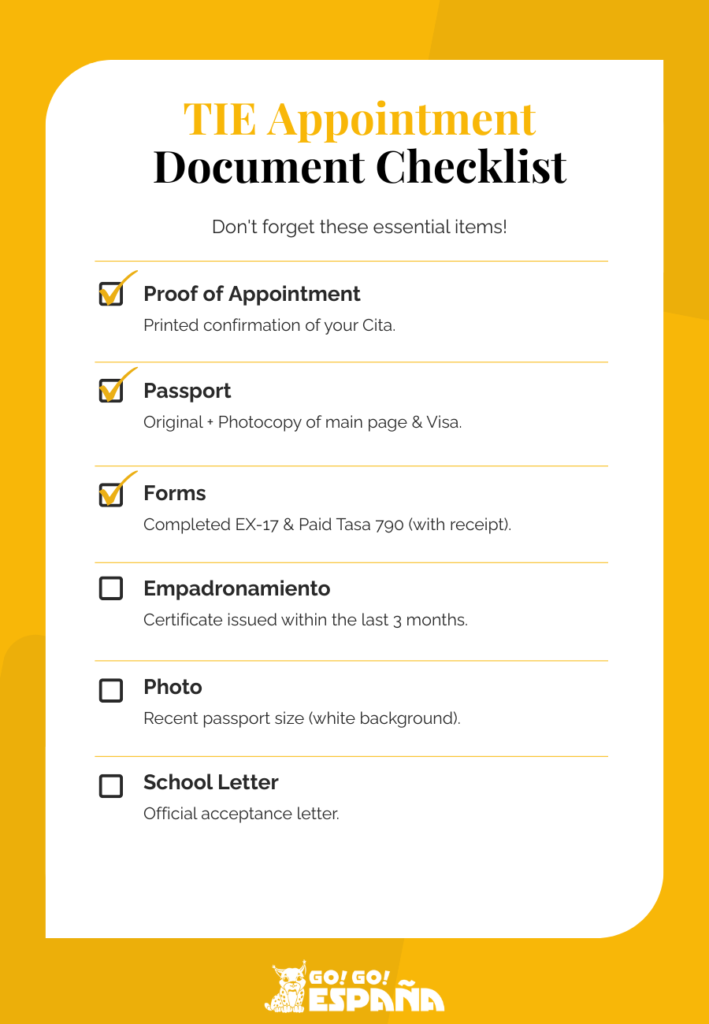
You will need your passport, proof of your appointment, the completed forms, photos, and your padrón certificate. Always bring the original and at least one photocopy of every document.
Bring originals and at least one photocopy of each:
- Proof of your appointment (cita)
- Valid passport
- Photocopy of your passport’s main page
- Passport with student visa sticker (or Resolución / notificación positiva if you applied for the visa from within Spain)
- Completed and signed application form (Modelo EX-17)
- Stamped receipt showing payment of Tasa 790-012
- Certificado de Empadronamiento (issued within last 3 months)
- Recent passport-sized photo (32×26 mm) with white background
- School acceptance letter
Because you cannot get your TIE without a registered address, read our guide to finding student accommodation in Spain to learn how to secure a rental contract that allows for the ‘padrón’.
Pro Tips for a Smooth TIE Appointment Day
- Arrive Early: Get to your appointment at least 15 minutes before your scheduled time.
- Bring Copies of Everything: It is always a good idea to have extra photocopies of all your documents, just in case.
- Be Patient and Polite: Bureaucratic processes in Spain can sometimes be slow. A polite and patient attitude goes a long way.
- Don’t Be Afraid to Ask: If you are unsure about something, don’t be afraid to ask for clarification.
FAQ About How to Get Your TIE Card in Spain
When do I need to apply for my TIE card?
You must have your first appointment within your first 30 days of arriving in Spain. It is very important to book your cita previa as soon as you arrive.
Remember, if you arrive as a tourist and choose to apply for a visa from within Spain, you will not be able to apply for your TIE card until your visa is approved.
Where do I book the appointment?
Appointments are booked online through the official Spanish Public Administration portal (Sede de Administraciones Públicas).
Do I need a TIE if my course is only for 6 months (180 days)?
No. The TIE card is only mandatory for students who are staying for longer than 180 days.
What happens if I can’t get a TIE Card appointment within 30 days?
This is a common problem. The most important thing is to have proof that you have been trying. Take screenshots of the appointment website showing that there are no available slots. As long as you can prove you started the process, you are generally okay.
How much does the TIE card cost?
The fee for the Tasa 790-012 is a small administrative fee that changes slightly each year. You can expect it to be around €15-€20.
Conclusion: You’ve Got This!
Navigating Spanish bureaucracy for the first time can seem intimidating, but getting your TIE card in Spain is a major milestone that will make you feel officially settled in your new home. By following these steps and being prepared, you can complete the process successfully.
Once you have submitted your TIE application, you are officially settled! Start making the most of your new home by reading our guide on what is it like to live in Spain as a language student.
Does navigating Spanish bureaucracy seem complicated? The Go! Go! España team is on the ground in Spain and can help you with your TIE application. Learn more about our Settling-In Services!


