


Learn the best tips for traveling around Spain on a student budget with these essential transportation tips.
One of the best parts of studying in Spain is the chance to explore its incredible diversity. From the art galleries of Madrid to the beaches of Andalusia, Spain really has it all.
Thankfully, Spain has an excellent and affordable transportation network that makes it easy for international students to take weekend trips and discover new cities.
This guide will show you the best ways of traveling around Spain without breaking your student budget. We’ll compare the main modes of transport, trains, buses, planes, boats and more, to help you plan your next adventure.
Exploring beyond your host city is one of the most rewarding parts of the journey. To see how travel fits into your new lifestyle, check out our guide on what it is like to live in Spain.
(Last Updated: March 2026)
Key Takeaways
- The country has a modern and extensive transportation network, making it simple for students to travel between major cities and smaller towns.
- For students on a tight budget, the bus system (led by companies like ALSA) is almost always the cheapest way to travel.
- Spain’s high-speed AVE trains are the fastest and most comfortable way to travel between major cities, and you can find good deals by booking in advance.
- For cross-country travel around Spain (ex: Barcelona to Seville) or visiting the islands, budget airlines are often the quickest and most practical choice.
- Regardless of how you travel, booking your tickets at least a few weeks in advance will almost always get you a much better price than booking at the last minute.
Table of Contents
At a Glance: How Do Trains, Buses, Planes, and Ferries Compare?

Deciding between a high-speed train and a long-distance bus often comes down to balancing your time against your budget. Here is a quick snapshot to help you choose the right option for your next trip.
| Transport | Best For… | Average Cost | Speed |
| Train (AVE) | Speed & comfort between major cities | €20 – €120 (can be as low as €7– €15 when booked very early; higher close to departure) | Very Fast |
| Bus | Budget travel, reaching smaller towns | €10 – €40 | Slow |
| Plane | Long distances & traveling to the islands | €20 – €80 base fare (often €50 – €150 total after bags and fees) | Fastest |
| Ferry | Traveling to the Balearic Islands with more luggage or a scenic journey | €25 – €90 (higher with cabins, vehicles, or summer travel) | Slow to moderate |
What Is the Best Way to Travel by Train in Spain?

Traveling by train is one of the easiest, most comfortable, and most efficient ways to get around Spain.
The country’s national rail service, Renfe, operates an extensive network of modern trains that connect nearly every corner of the country, from major cities to smaller regional hubs. The journeys are scenic, stations are usually located right in the city center, and the trains are very comfortable.
Booking tickets in advance is especially important on popular routes, as prices tend to increase closer to departure and high-speed trains can sell out. The network includes:
- AVE: The high-speed train that connects major hubs like Madrid, Barcelona, Seville, and Valencia, often traveling at speeds over 300 km/h (186 mph).
- Alvia / Euromed: Long-distance trains that are also fast and connect a wider range of cities.
- Cercanías: Local commuter trains that operate in and around major metropolitan areas, ideal for day trips, suburbs, and airport connections, especially in cities like Madrid, Barcelona, and Valencia.
If you’re under 30, the Renfe Joven card (officially called Más Renfe Joven) is one of the best travel deals available to students in Spain. For a small annual fee, it offers significant discounts on train tickets and can quickly pay for itself, especially if you plan to travel more than once or twice.
For a complete deep dive into Spain’s high-speed rail system, including details on train types, routes, and booking strategies, see our guide to high-speed trains in Spain.
What Is the Best Way to Travel by Bus?
For international students on a budget, traveling by bus is one of the most affordable ways to get around Spain.
Spain has a vast and reliable network of long-distance buses that connect nearly every city and town, including places not easily reached by train. The main national operator is ALSA.
While bus journeys are usually longer than traveling by train, tickets are significantly cheaper, making buses the go-to option for budget-conscious students.
Modern long-distance buses are comfortable and often include air conditioning, onboard toilets, Wi-Fi, and charging ports.
Tips for Traveling by Bus in Spain
- Book tickets in advance for the lowest fares, especially around holidays and long weekends.
- Look out for abonos, which are multi-trip or subscription passes that allow you to prepay for several rides on the same route at a reduced per-trip price. These are especially useful for students who commute regularly or travel home often, and they’re sometimes only advertised online.
- Choose overnight buses to save on accommodation and maximize travel time.
- Parts of Spain have winding, windy roads, so if you’re prone to motion sickness, sit near the front of the bus or come prepared with medication.
For students prioritizing cost over speed, buses are a practical and accessible way to explore Spain.
When Is It Better to Travel by Plane?
For very long distances across Spain, or for traveling to the Balearic or Canary Islands, flying is often the fastest and most practical option. On routes like Barcelona to Seville or Bilbao to Málaga, a flight can save several hours compared to traveling by bus or train.
Spain is a major hub for budget airlines such as Vueling, Ryanair, and Iberia Express, which are known for extremely low base fares.
When flying in Spain, be cautious of the initial ticket price, as budget airlines often charge extra for carry-on bags, checked luggage, seat selection, priority boarding, online check-in, and even printing a boarding pass at the airport. Always review the final price at checkout to understand the true cost before booking, and pack as light as possible, since luggage fees can easily exceed the cost of the ticket itself.
For students, flying is best reserved for long distances or island travel, but only after understanding the full, final cost.
Travel is a significant part of your social life, but it needs to be budgeted for carefully. For a full breakdown of how to manage your finances, see our guide on the cost of studying in Spain.
What About Ride-Sharing in Spain?
Ride-sharing services like BlaBlaCar are a popular and affordable option for international students in Spain.
The app connects drivers who have extra seats in their car with passengers traveling to the same destination, often at a lower cost than trains or buses.
Beyond saving money, ride-sharing is also a great way to meet locals and practice Spanish in a relaxed, everyday setting, making the journey part of the cultural experience.
Tips for Using Ride-Sharing Safely
- Always book rides through the app and avoid cash-only arrangements outside the platform.
- Check driver ratings, reviews, and verification badges before booking.
- Be aware that cancellations can happen, sometimes at the last minute, so ride-sharing is best when you have flexible plans or a backup option.
- Choose trips with clear pickup points and confirmed drop-off locations.
Pro Tip:
For international students looking to balance affordability, flexibility, and cultural immersion, ride-sharing can be a great alternative to traditional transportation.
What About Traveling By Boat?
For international students interested in visiting the Balearic Islands, traveling by ferry is a slower but scenic alternative to flying.
Ferries connect the Spanish mainland with islands like Mallorca, Menorca, Ibiza, and Formentera, departing from major ports such as Barcelona, Valencia, and Dénia.
While ferry trips take longer than flights, they can be an appealing option for students who enjoy slow travel, ocean views, and turning the journey itself into part of the experience. Ferries also tend to be more flexible with luggage than budget airlines, which can make them a good choice for longer stays or group trips.
You can compare routes, schedules, and prices and book your tickets online on platforms like Ferryhopper, which shows ferries from the mainland to the Balearic Islands and between the islands themselves.
For some students, traveling to the Balearic Islands by ferry offers a relaxed and memorable way to explore Spain, especially for those who value the journey as much as the destination.
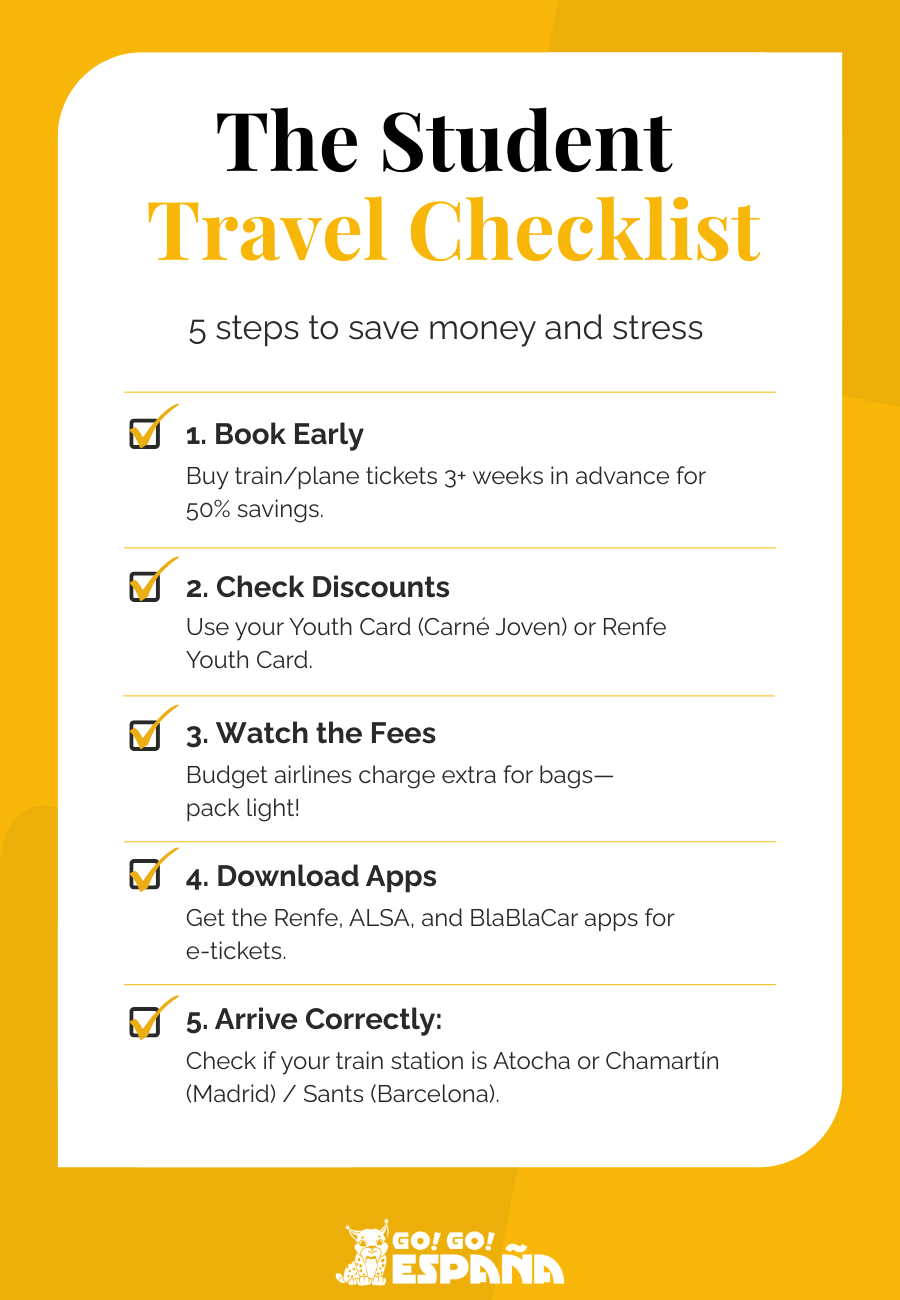
Student Travel Checklist
FAQ About Traveling in Spain
-
Do I need to book my travel in advance?
Yes, for the best prices you should always book at least a few weeks in advance. Last-minute tickets are almost always much more expensive.
-
Are there any student discounts for travel?
Yes. Renfe offers youth discount programs such as the Más Renfe Joven card for travelers under 30, which can provide significant savings on train tickets. Some bus companies also offer student or youth fares, and promotions vary by route and season. It’s always best to check official provider websites before booking, as discounts are not always advertised automatically.
-
Which website should I use to book tickets?
It’s usually best to book directly from the official websites of the providers, such as Renfe for trains and ALSA for buses.
-
Are the train and bus stations located in the city center?
Yes, one of the biggest advantages of traveling by train or bus is that the main stations are almost always located in the city center, making it very easy to arrive and depart.
-
Is it easy to take day trips from major cities?
Yes, absolutely. Cities like Madrid and Barcelona are major transportation hubs with excellent connections, making it very easy to take day trips to historic towns like Toledo or coastal spots like Sitges.
Conclusion:
Traveling around Spain is an essential and incredibly rewarding part of the study abroad experience.
With an excellent and affordable transportation system, the country’s diverse landscapes, historic cities, and beautiful coastlines are all within your reach. By planning ahead and choosing the right transport for each trip, you can see a huge amount of the country, even on a student budget.
Ready to start planning your weekend adventures? First, find your home base. Let Go! Go! España help you choose the perfect school or university!
Discover what to do when you get there in our Guide in Choosing the Best Places to Study in Spain for Your Spanish Language Study.


