 Skip to content



An in-depth guide explaining how the Volante de Inscripción Condicional works in practice, when it can be used for university access pathways, and what its legal limitations are.
The Volante de Inscripción Condicional, or Conditional Enrollment Slip, is a provisional administrative document issued by the Spanish government.
This document allows international students to integrate into the Spanish educational system while they are waiting on the formal validation of their degree, known as the Homologación al título de Bachiller process; if you’re not yet familiar with this step, you can learn all about it on our blog.
Because the Homologación process can take six-to-nine months, the Spanish Ministry of Education provides a Volante de Inscripción Condicional to serve as official proof that your application is in progress.
This document is essential because it authorizes you to meet strict university application deadlines, register for entrance exams (PCE), and secure a place in a degree program without having to wait for the final recognition certificate to be issued. It effectively bridges the gap between your arrival in Spain and the final legal validation of your academic background.
To understand how this administrative step fits into your overall academic timeline, entrance exams, and language goals, refer to our public Spanish university preparation guide.
Key Takeaways:
- The Essential Bridge: Volante de Inscripción Condicional acts as a provisional bridge during the 6-to-9-month Homologación (degree validation) waiting period. It allows you to meet university deadlines and secure your spot while the government processes your final certificate.
- Guaranteed Academic Rights: Under Real Decreto 104/1988, the slip gives you the legal right to sit for PCE exams and pre-enroll during the June-July window. This ensures you don’t lose a full academic year due to administrative delays.
- Core Document Requirements: You must submit a legalized diploma, academic transcripts, and proof of the Tasa 790-079 fee payment. Non-EU documents must include the Hague Apostille and an official sworn translation into Spanish.
- Global Issuance & Verification: The slip is issued by the Ministry in Madrid or through Spanish consulates in your home country. Digital versions are authenticated using a Secure Verification Code (CSV) to confirm legitimacy to universities.
- Avoiding Digital Bottlenecks: Common errors include uploading incomplete diploma scans (missing the back page) or paying the Tasa 790-079 via unapproved bank transfers. These technical mistakes can stall your Volante status indefinitely.
- Foundation for Residency: For non-EU students, this slip will be required to obtain documents needed to apply for your Spanish Student Visa and TIE residency card, such as a provisional acceptance letter. It also provides the “student in good standing” status necessary to maintain a 30-hour weekly work permit.
- Legal Risks & Appeals: If recognition is denied, all academic credits earned under the Volante are retroactively annulled. You have exactly one month to file a Recurso de Reposición to challenge a denial.
- Handling Application Delays: If the process exceeds the standard timeframe, you can prove your status with a portal screenshot. You may also request a formal Estado de Tramitación (Status Certificate) to prevent university enrollment cancellation.
Table of Contents
Who Needs to Obtain a Volante de Inscripción Condicional?
Obtaining a Volante de Inscripción Condicional will be necessary for students in the following situations:
- Students who are applying to have their foreign secondary studies recognized through the Spanish legal Homologación process
- Students who need to apply for university access (via UNEDasiss or direct admission) before receiving their final Homologación certificate
- Students enrolling in schools or pre-university programs in Spain while their recognition file (Homologación) is still being processed
A Volante, however, does not:
- Recognize completed university degrees
- Grant automatic admission into Spanish universities
- Replace any university-specific admission requirements
What is a Volante de Inscripción Condicional and How Does it Work?

The Volante de Inscripción Condicional is a provisional accreditation issued by the Spanish Ministry of Education confirming that an application for high school diploma homologación in Spain has been formally submitted and is currently being processed.
Its primary function is to allow the applicant to continue administrative or academic procedures (such as school enrollment or university access processes) while waiting for the final resolution.
It does not certify equivalence, only the existence of an active application.
Table: Volante de Inscripción Condicional at a Glance
| Feature | Detailed Description |
| Legal Nature | A provisional administrative accreditation confirming that a degree recognition file is currently pending. |
| Primary Utility | Allows conditional participation in academic processes (e.g., enrollment, entrance exams, or pre-registration) while the recognition file is pending. |
| Contingency | Fully conditional status. Any academic progression remains subject to the final resolution of the Homologación/Convalidación request. |
| Issuer | The Spanish Ministry of Education, Vocational Training, and Sports, or the Ministry of Science, Innovation, and Universities. |
| Scope of Use | Valid for schools, public and private universities, and official state examinations (e.g., PCE/Selectividad). |
How Does the Volante de Inscripción Condicional Work?
Instead of making you wait nearly a year for your final approval, Spanish law (under Real Decreto 104/1988) allows you to use this “Conditional Enrollment Slip” to integrate into the education system immediately. It grants you the right to:
- Register for the PCE (Selectividad) entrance exams.
- Apply for university places during the ordinary (June/July) application window.
- Enroll and begin attending classes.
Pro-Tip: It is called “conditional” because your enrollment is legally dependent on the eventual approval of your diploma. If your Homologación is later denied, your university registration can be nullified.
Very Important Note: While the Ministry’s official procession window is 6 to 9 months, recent administrative backlogs mean that the Homologación process frequently takes over 12 months. This delay makes obtaining a Volante de Inscripción Condicional an absolute necessity; without it, you are highly likely to miss your first academic year entirely.
Understanding the validity and enrollment status
The Volante is typically used within the academic year in which it is issued, but its practical validity depends on the status of the underlying Homologación file.
Its effects remain in place only while the application is actively under review, and all academic actions taken during this period remain conditional.
Provisional vs. Final Status
While on a provisional enrollment status, you are a full student for all intents and purposes (exams, grades, attendance), allowing universities to evaluate your entrance scores using the 14-point Spanish university grading system guide.
Final status is only achieved once your Homologación is granted, which then allows you to officially receive your Spanish university degree at the end of your studies.
Table: Provisional vs. Final Enrollment Status Overview
| Aspect of Status | Provisional (Conditional) | Final (Definitive) |
| Basis of Admission | Volante de inscripción condicional | Credencial de Homologación |
| Grade Security | Contingent on Ministry approval of your diploma. | Vested and permanent; no longer subject to review. |
| Duration | Valid for the academic year or until a resolution is issued. | Indefinite. |
| Annulment Risk | High; all academic results are voided if recognition is denied. | Zero risk related to entry qualifications. |
| Registry Type | Temporary/Provisional entry. | Centralized and Definitive registry. |
What Documents are Needed to Request a Volante de Inscripción Condicional?

Obtaining a Volante is not a standalone request but a secondary component of your primary degree recognition file.
Therefore, the document requirements for the Conditional Enrollment Slip mirror those of the Homologación process itself, emphasizing the authenticity and equivalence of your international credentials.
The core document set includes:
- Identity Verification: A verified photocopy of a valid passport, NIF, or NIE. If you authorize the Ministry to consult your data via the identity verification system, the physical photocopy may be omitted.
- Application Summary: The official application form generated by the Sede Electrónica, signed and dated.
- Academic Titles: A verified copy of the diploma or degree certificate for which recognition is sought.
- Transcripts: A verified copy of the certification accrediting the courses completed, including subjects, grades obtained, and the years of study.
- Tasa 790-079 Receipt: Proof of payment of the administrative fee. Note: Applicants applying for recognition of the Compulsory Secondary Education (ESO) title are exempt from this fee. To calculate this alongside total translations and tuition expenses, see our guide on the cost of studying in Spain.
- Legalization and Translation: Documents issued in non-EU countries must bear the Hague Apostille or be legalized through diplomatic channels. If the documents are not in Spanish, a sworn translator who is accredited by the Spanish Ministry of Foreign Affairs will be required. Translations done by standard agencies or notaries in your home country will be rejected.
Did You Know? The Ministry requires “verified copies” (copias cotejadas). You must bring the originals along with the copies so the official can verify them.
Where Can I Get a Volante de Inscripción Condicional Issued in Spain?
The issuance of the Volante de Inscripción Condicional (Conditional Enrollment Slip) occurs at the official points of entry for academic recognition files.
Depending on your current location, several administrative nodes are responsible for stamping and certifying this essential document.
Within Spanish Territory
If you are already in Spain, the primary locations where you can process and receive your slip are:
- The Ministry of Education General Registry: Located at Calle Los Madrazo, 15, in Madrid.
- Government Delegations: Specifically, the Área de Alta Inspección de Educación found in the capital of each province. In Madrid, the office is located at Calle García de Paredes, 65.
- Regional Registries: You can use any administrative registry of the General State Administration, Autonomous Communities, or local entities that are integrated into the Sistema de Interconexión de Registros (SIR).
Applying from Abroad
If you are applying for your degree validation before moving to Spain, the process is handled through the Diplomatic Missions and Consular Offices of Spain in your home country.
When you submit your Homologación package at a Spanish embassy or consulate (e.g., in London, Washington D.C., or New Delhi), the consular staff will review your documents for completeness and then stamp the Volante.
One stamped copy is returned to you to be used for school or university enrollment before key Spanish university application deadlines pass, while the other is bundled with the digital file transmitted to the Ministry in Madrid.
Did You Know? The stamp from a Spanish Consulate or a Government Delegation is what makes the Volante legally binding for universities.
How Do You Use the Volante de Inscripción with UNEDasiss?
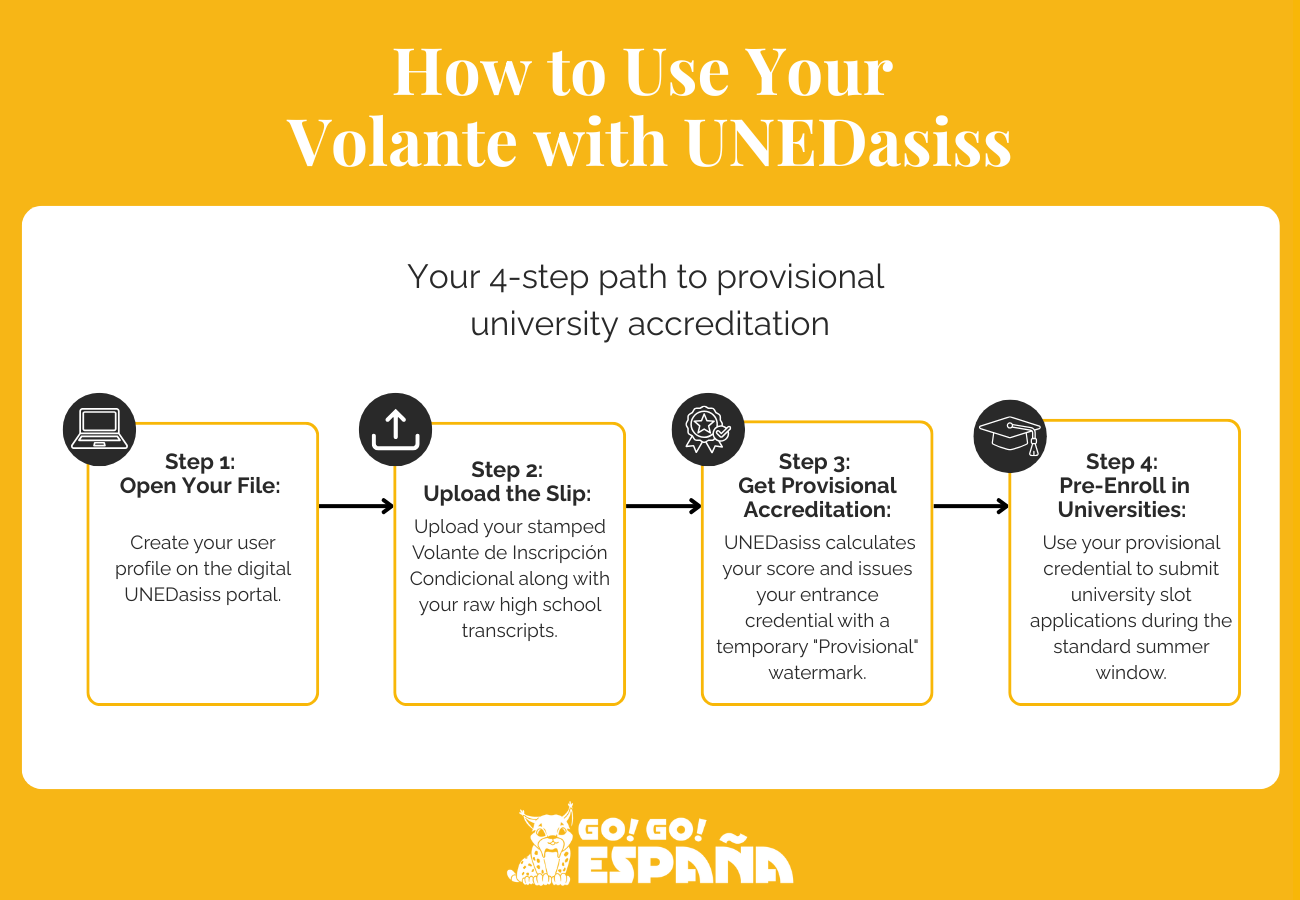
For the vast majority of international students, your path to a Spanish public university goes through UNEDasiss. Here is how your Volante interacts with this system:
Step 1: Open your UNEDasiss file
You will create an account and apply for the specific accreditation services you need, such as PCE exam registration or calculating your university entrance grade.
Step 2: Upload your Volante
In the document upload section, submit your stamped Volante de Inscripción Condicional alongside your high school transcripts.
Step 3: Receive Provisional Accreditation
UNEDasiss will issue your university entrance credential with a “Provisional” watermark.
Step 4: Apply to Universities
You use this provisional UNEDasiss credential to apply for your university spot during the summer window. Once your final Homologación arrives, you must submit it to your university to remove the conditional status.
The Legal Status and Student Rights Under the Volante de Inscripción Condicional
The Volante creates a situation of provisional administrative validity, meaning the applicant is allowed to proceed with certain academic steps while the final decision is pending.
However, this status does not create a permanent right, and all outcomes remain dependent on the final resolution issued by the Ministry.
Professional legal advisors in Spain emphasize three critical points regarding this status:
- The Principle of Retroactive Annulment: According to Real Decreto 104/1988, if your degree recognition is eventually denied, all academic acts performed under the protection of the Volante are voided. This is absolute. For example, if you complete a full year of university and your Homologación is then rejected, the credits you earned are legally erased and cannot be transferred to another institution.
- The “Negative” Administrative Silence Rule: In Spanish administrative law, if the Ministry does not respond to your application within six months, the “administrative silence” is typically considered negative. Legally, this means you can treat the lack of response as a denial for the purpose of filing an appeal. However, the Ministry is still obligated to issue an express resolution, and they frequently provide the final decision after the six-month mark.
- Avoiding Administrative Bad Faith: Attempting to use a Volante while knowing that your foreign degree does not meet Spanish equivalence standards, such as lacking the required number of academic hours or coming from a non-accredited institution, can be interpreted as administrative bad faith. To protect your investment, we recommend consulting the Ministry’s Equivalence Tables to gauge the likelihood of a positive outcome before committing financially to a Spanish university course.
Implications of a Volante de Inscripción Condicional for International Students
For international students, the Volante can play a supporting role in demonstrating that an academic process is underway. However, student visa and residency procedures require proof of admission or enrollment in an authorized educational institution, not the Volante itself.
In practice, the Volante may allow institutions to issue conditional or provisional admission letters, which can sometimes be used during visa applications depending on the consulate.
The Volante de Inscripción Condicional impacts your legal journey in three critical ways:
- The Visa Foundation: Without a final Homologación, many schools are legally unable to issue the final “Acceptance Letter” (Carta de Admisión) required for your visa interview. The Volante solves this by allowing the school to issue a Provisional Acceptance Letter, which Spanish consulates typically accept as valid documentation for visa processing.
- Securing Your TIE (Residence Card): Once you enter Spain, you must apply for your Foreigner Identity Card (TIE) within 30 days. To be successful, you must prove you are effectively studying. If your enrollment is later annulled because your diploma recognition was denied, you lose your “basis of stay.” This makes it impossible to renew your residency for the following year and, in severe cases, could lead to deportation.
- Protecting Your Right to Work: International students in Spain are permitted to work up to 30 hours per week, but this permit is inextricably tied to your status as a student.
What to do if the Volante de Inscripción is Denied?
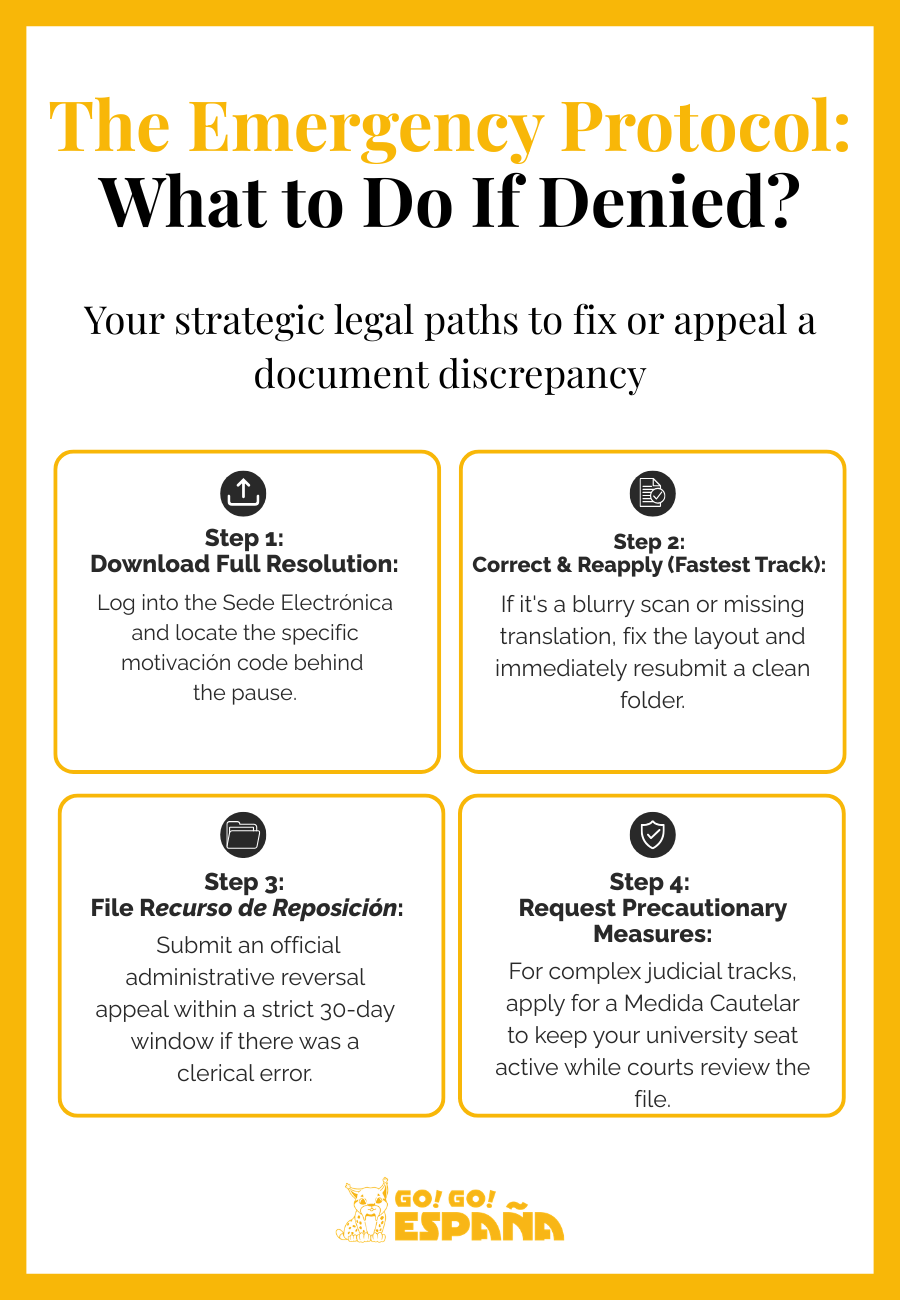
If your Homologación request is denied, the Volante loses its practical effect, and your academic pathway may be affected. However, a denial can often be challenged or clarified depending on the reason provided in the official resolution.
If you find yourself in this situation, the recommended protocol is:
- Request the Full Resolution: Do not rely on a summary notification. You must log into the Sede Electrónica and download the complete document that explains the motivación for the denial. Understanding the specific legal or academic reason for the rejection is essential for any successful challenge.
- Correct and Reapply (The Fastest Route): Most denials are due to formatting errors, missing apostilles, or insufficient curriculum hours. Instead of entering a lengthy appeals process, it is often faster to identify the missing element, correct it in your home country, pay the Tasa 790-079 fee again, and submit a completely fresh Homologación application.
- File a Recurso de Reposición (Appeals for Reversal): In many cases, this is the mandatory first step. This administrative appeal must be filed within one month of receiving the notification. It is most effective when the denial was triggered by a missing document that you can now provide, or a clerical error in how the Ministry calculated your credit hours or grades.
- Initiate the Contencioso-Administrativo Route: If the administrative appeal fails, you have the right to take the Ministry to court. While this judicial process can take 18–24 months, a specialized lawyer can request a Medida Cautelar (Precautionary Measure) from the judge. If granted, this allows you to remain enrolled and complete your current academic year while the court case is pending.
- Consider Equivalencia: If recognition to a specific academic title is denied, you may still be eligible for a “Declaration of Equivalence to an Academic Level.” For example, even if your specific degree title is not recognized, an equivalence to the “Bachelor’s Level” might still satisfy a university’s entry requirements for certain master’s programs.
Did You Know? If the appeal is rejected, your academic enrollment is usually cancelled by the university, as they cannot legally grant a degree to someone whose previous studies aren’t recognized.
What are the Common Issues when Applying for a Volante de Inscripción Condicional Digitally?
Technical bottlenecks often plague the digital application process, especially for those unfamiliar with Spanish administrative software. While the online portal is designed to be efficient, several specific errors can stall your progress:
- Document Authenticity Errors: Many applicants upload scanned copies of their diplomas without the necessary Hague Apostille or fail to include the back page of the document, which often contains essential official stamps. The system may accept the initial upload, but a human inspector will later flag it as incomplete, invalidating your Volante until the correct version is provided.
- The “Tarjeta Roja” Conflict: Asylum seekers using a “Red Card” (Tarjeta Roja) often struggle to register on the Sede Electrónica because the card does not have the “IXESP” code required for digital verification. These users usually must register manually with a passport and may face significant delays in accessing their digital file status.
- Digital Certificate Mismatches: If the name on your Spanish digital certificate (e.g., issued by FNMT) does not exactly match the name on your foreign diploma, the system may prevent the submission of the file. Even a minor spelling difference in a middle name can cause a certificate mismatch.
- Payment Gateway Failures: The Tasa 790-079 fee must be paid at a physical bank or via a specific tele-payment system provided by the Ministry. Many international students attempt to pay via a standard international bank transfer, which the Ministry’s system cannot automatically reconcile. This results in an unpaid status, leaving your Volante stalled indefinitely.
How to Renew or Extend a Volante de Inscripción Condicional if it Expires?
If the recognition process exceeds the standard timeframe and your Volante de Inscripción Condicional expires, you must take proactive steps to ensure your university enrollment is not cancelled. In most cases, a “renewal” is not a formal new document but rather an administrative extension of your existing status.
To manage an expired or expiring slip, you should follow these steps:
- Generate a Status Proof: Log into the Sede Electrónica and print the screen showing your application is “In Process” (En Tramitación). Presenting this to the university registrar serves as immediate proof that the delay lies with the Ministry and not with your application.
- Request a “Status Certificate”: If your university or school demands a formal document rather than a screenshot, you can contact the Área de Alta Inspección de Educación to request a certificate of Estado de tramitación (Ongoing Status). This official certificate confirms that your file is still under review and maintains your provisional standing.
- Check for Global Extensions: Periodically, the Ministry issues a “Resolution of General Extension” for all Volantes due to high volumes of applications. These are common during major administrative changes or high-traffic enrollment seasons. You should check the “News” section of the Ministry’s portal for these specific orders.
- Consult NARIC Spain: For students pursuing regulated professions such as Medicine or Engineering, the recognition process is subject to additional technical reports and can take longer. In these cases, the Centro NARIC España can provide specific guidance on managing extensions for these specialized files.
Pro-Tip: Most Spanish universities are familiar with Ministry delays. As long as you can provide proof that your file is still active, they will typically allow you to continue your studies under your current provisional status.
FAQs About Volante de Inscripción Condicional
1. Can I use the Volante de Inscripción Condicional to take the PCE exams?
Yes. UNEDasiss accepts this slip as provisional proof of your academic background, allowing you to register for and sit for entrance exams while your official validation is pending.
2. How long is the Conditional Enrollment Slip valid?
It is nominally valid for the academic year in which it is issued, but its legal effects persist until the Ministry issues a final resolution (approval or denial).
3. Does the Volante help me get a Spanish Student Visa?
Yes. It allows schools to issue a Provisional Acceptance Letter, which most Spanish consulates accept as the “proof of enrollment” required for Type D visa processing.
4. What happens to my university credits if my Homologación is eventually denied?
Under Real Decreto 104/1988, a denial retroactively annuls your enrollment. This means any academic results or credits earned during the conditional period are legally voided.
5. How do I verify if my Volante is authentic?
You can enter the CSV (Secure Verification Code) printed on your document into the Ministry’s online verification portal to confirm the digital signature and legitimacy of the slip.
6. Can I apply for the Volante online from outside of Spain?
Yes. You can process the application through the Ministry’s Sede Electrónica or by submitting your physical documentation package at a Spanish Consulate in your home country.
7. What should I do if my Volante expires before I receive my final resolution?
You can print an “In Process” status screen from the Ministry’s portal or request a formal Estado de Tramitación (Status Certificate) from the Área de Alta Inspección de Educación to prove your application is still active.
In Summary: Provisional Spanish University Admission
The Volante de Inscripción Condicional is a temporary administrative mechanism that allows international students to continue their academic process in Spain while their degree recognition is pending.
Its usefulness lies in enabling continuity, but its limitations must be clearly understood, as all outcomes depend on the final Homologación decision.
By acting as a Conditional Enrollment Slip, it serves as a legal bridge that protects your right to sit for entrance exams, meet university deadlines, and secure your residency status while your official documents are being processed.
Managing the complexities of the Spanish Ministry’s portal and document legalization can be difficult, but you don’t have to do it alone.
At Go! Go! España, we specialize in helping students manage these technical hurdles.
Contact our expert advisors today to secure your enrollment status and focus on your studies.
Now that you know how to use this “slip” to meet your immediate deadlines, the next logical step in your study abroad journey in Spain is mastering the primary recognition process.
Continue your preparation with our next guide: How to Get Your Homologation in Spain: Validating Your High School Diploma for University in Spain.


