 Skip to content


From Michelin-star training to Hotel Management: A guide to English-taught programs, fees, and the “Hotel-School” model.
Spain isn’t just a tourist destination; it is the world’s gastronomic classroom. With the highest density of Michelin stars per capita in cities like San Sebastián and Barcelona, studying here puts you at the center of the industry.
For years, international students assumed they had to go to Switzerland or France for top-tier hospitality training, often paying astronomical fees.
We have curated the Best Culinary and Hospitality Schools in Spain that offer the same academic prestige (QS Rankings) but with 30-50% lower tuition, a better climate, and a unique “Hotel-School” training model that immerses you in the industry from Day 1.
Key Takeaways
- The “Spain Advantage”: You don’t need to pay €40,000/year in Switzerland to get world-class training. Spain offers the same Michelin-level prestige and rigorous education for 30-50% less cost, combined with a better climate and lifestyle.
- Choose Your Lane (Kitchen vs. Office): Be clear on your goal. If you want to be a Chef, choose a technical school like EUHT StPOL or Le Cordon Bleu. If you want to manage hotels and resorts, choose a business-focused school like CETT or EU Business School.
- The “Hotel-School” Power: EUHT StPOL is unique because it is a “Hotel-School.” You don’t just learn in a classroom; you live and work in a real hotel with a Michelin-star restaurant on campus, serving real paying customers from Day 1.
- Get Paid to Study: Non-EU students often struggle to find work due to visa restrictions. Schools like StPOL solve this by building mandatory paid internships into the curriculum, allowing you to legally earn money to support your living costs.
- University vs. Private Diplomas: If you need a recognized “Official Degree” for government jobs or a PhD later, CETT (University of Barcelona) is your safest bet. For the private sector, elite private diplomas (like StPOL or Le Cordon Bleu) are often more respected by industry recruiters.
- English is the Language of Hospitality: You do not need to be fluent in Spanish to start. Top programs at StPOL, and CETT are taught 100% in English. However, learning basic Spanish is crucial for your front-of-house internships.
- Location Dictates Career: Barcelona is the hub for international tourism and corporate management; San Sebastián is the global capital for food innovation; and Sant Pol de Mar offers an immersive, focused coastal experience perfect for dedicated culinary students.
- Hospitality Programs: A range of our partners (mostly across Barcelona but also in Valencia and Madrid) such as Universidad Europea, Nebrija University, EU Business School, CETT Barcelona and C3S Business School, offer hospitality programs taught in English.
Table of Contents
Methodology: How We Ranked the Best Culinary Schools in Spain for
We have compiled a range of information sources and scored these schools based on the International Student Experience and the best Return on Investment (ROI).
Utilise our analysis to gain a more in-depth understanding of the factors you should consider if you want to study something in the Hospitality and Culinary Arts industry, and what schools we have found to be considered the “best.”
Factors You Should Consider:
- The Hotel-School Model: Does the school operate its own hotel/restaurant where students deal with real customers (not just simulations)?
- English Proficiency: Are the programs 100% English-taught?
- Employability: Do they offer mandatory paid internships to help offset living costs?
- Prestige: Do they have connections to Michelin-starred chefs or major hotel chains?
Quick Comparison: Top Hospitality & Culinary Schools at a Glance
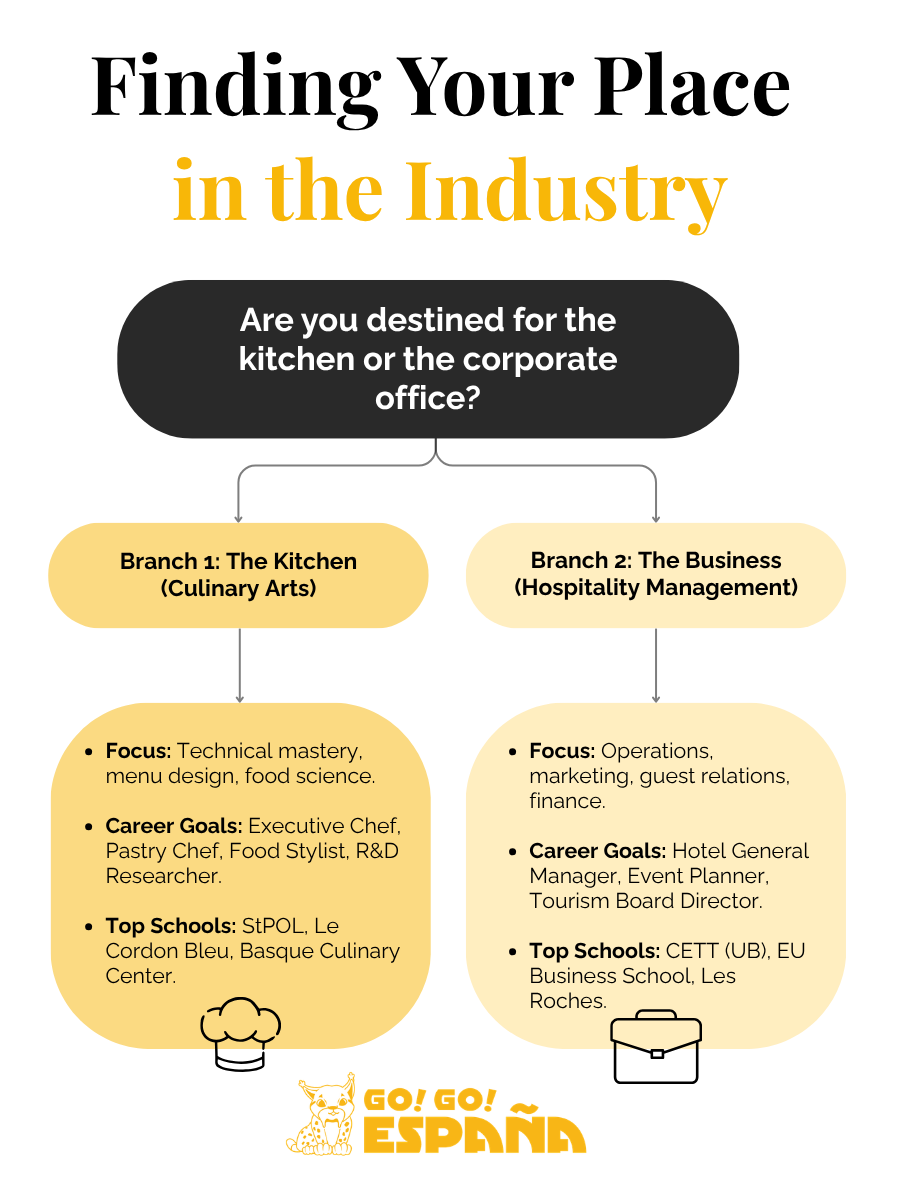
Choosing the right school depends on your budget and career goals. Use this table to compare the top options for international students.
| School Name | Type | Best For… | Internship Type | Est. Total Cost (Non-EU) |
| EUHT StPOL | Hotel-School | Michelin Chefs & Luxury Ops | Mandatory (Michelin) | ~€16,200 |
| CETT (UB) | University | Official Degree & Tourism | Partner Companies | ~€6,900 – €8,500 |
| Les Roches Marbella | Private | Hotel & Leisure Management & Hospitality | Optimal/Industry Internship | ~€16,000 – €34,000 |
| Le Cordon Bleu | Private | French Culinary Technique | Optional | ~€20,000+ |
| Basque Culinary Center | University | Food Science & Innovation | Project-based | ~€10,500 |
The Best Culinary Arts Schools

If your dream is to run a kitchen, design menus, or earn a Michelin star, these schools offer the intense, practical training you need.
1. EUHT StPOL (Sant Pol de Mar)
EUHT StPOL is a University College located on the coast of Barcelona. It consistently ranks as the #1 Hospitality School in Spain (QS Rankings) because it pioneered the “Hotel-School” model in Europe.
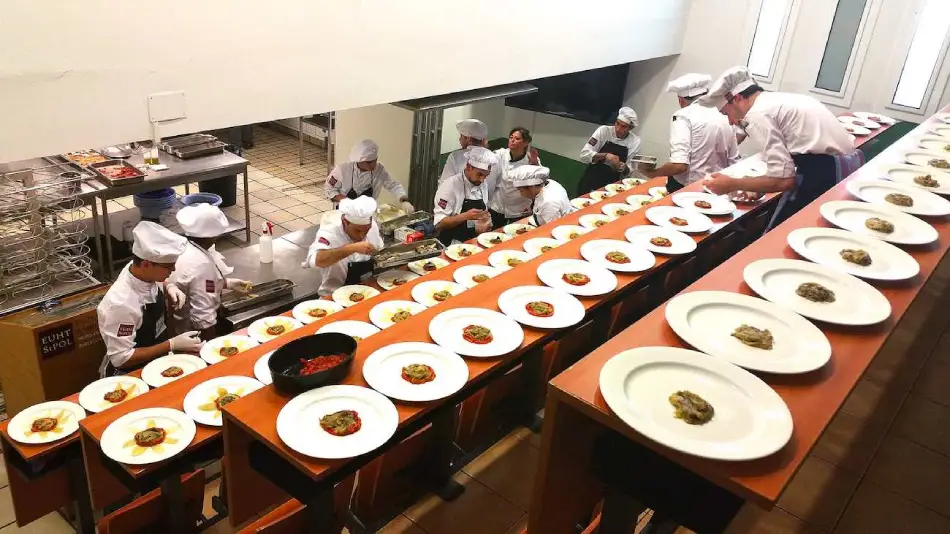
EUHT StPOL is widely considered the industry benchmark among culinary schools in Spain for international students. Its unique ‘Hotel-School’ model means you aren’t just learning in a classroom; you are running a real-world luxury hotel and restaurant from day one.
The ‘Hotel-School’ model is what sets the top culinary schools in Spain apart from traditional vocational colleges. This approach prioritizes ‘learning by doing’ in high-pressure, professional environments.
- Why it’s a top choice: It has a Michelin-star restaurant (L’Ermita) on campus. Students don’t just learn theory; they cook for real paying customers under the guidance of award-winning chefs.
- The Network: Its alumni network holds a collective 7+ Michelin stars, including world-renowned chefs like Ramon Freixa. It is the perfect environment for students who want high-end, luxury training.
2. Le Cordon Bleu (Madrid)
Located in Madrid, Le Cordon Bleu offers intense, shorter diploma programs (Grand Diplôme), focused on the mastery of French and Spanish culinary techniques.
- Why it’s a top choice: It is the gold standard for technical precision. If your goal is to master pastry or specific cuisine techniques in a military-style environment, this is the place.
- Note: Tuition is significantly higher, and the focus is purely technical rather than managerial.
Studying in the capital connects you directly with flagship luxury dining groups and high-volume leisure sectors. Check out regional transit options, lifestyle tips, and neighborhood profiles in our layout for living and studying in Madrid.
3. Basque Culinary Center (San Sebastián)
Located in San Sebastián, the foodie capital of the world, this is a heavy-hitter for students interested in food science and innovation.
- Why it’s a top choice: It focuses on the future of food,R&D, food tech, and sustainability.
- Note: While prestigious, many undergraduate degrees require high Spanish proficiency, making admission harder for non-Spanish speakers compared to StPOL or CETT.
The Best Hospitality Management Schools
If your goal is to be a General Manager at a Marriott, run a luxury resort, or manage tourism boards, choose the “Business Track.”
4. CETT School of Tourism, Hospitality and Gastronomy (Barcelona)
CETT is the academic leader in the hospitality management schools in Spain. Because it is affiliated with UB, students graduate with an Official Degree, which is a massive trust signal for international families and essential if you plan to do a PhD later.
- Why it’s a top choice: It combines vocational training with university rigor. It hosts the Tourism Exploration Lab, making it perfect for students interested in the strategic and analytical side of tourism.
- Campus Life: Located in Barcelona, it offers a vibrant student life connected to one of Spain’s top universities.
5. Les Roches (Marbella)
If money is no object and your goal is top-tier luxury hotel management, Les Roches Marbella is the heavyweight champion. It is a branch of the famous Swiss school, offering the exact same Swiss curriculum but in the sunny climate of the Costa del Sol.
- Why it’s a top choice: It attracts the children of hotel owners and the global elite. The networking here is unmatched in the luxury sector (think Louis Vuitton, Ritz-Carlton, Bloomberg).
The Cost Factor: It is significantly more expensive than CETT or StPOL (tuition can exceed €25,000/year), but for many, the brand name on the CV is worth the premium.
Admission Requirements for Hospitality Management Schools in Spain
Unlike public Spanish universities which can have complex entrance exams (EBAU), these private and hospitality schools have a streamlined admission process for international students.
- Language: If you are a non-native English speaker, you will typically need an IELTS score of 5.5 – 6.0 or a TOEFL iBT of 70-80.
- Academics: For Bachelor’s programs, a standard High School Diploma (or IB Diploma) is required.
- Motivation: Hospitality schools place heavy weight on the “Motivation Letter” and personal interview. They look for “service attitude” more than perfect grades.
The Internship Reality: Paid vs. Prestige in Spanish Hospitality
Before you apply, you must understand the two types of internships in Spain:
- The “Prestige” Stage (Unpaid)
Many top-tier culinary internships (especially at Michelin-starred restaurants via schools like BCC or Le Cordon Bleu) are often unpaid “stages.” You are paid in experience, prestige, and a recommendation letter, not cash. This is the industry standard for elite kitchens. - The “Paid” Internship (Paid)
If you need to fund your stay, choose schools like EUHT StPOL’s Hospitality track. They focus on employability and often guarantee internships that include remuneration (usually €300 – €600/month) or free room and board. This can make a huge difference to your monthly budget.
The Payoff: Graduate Salary Expectations and Global Mobility
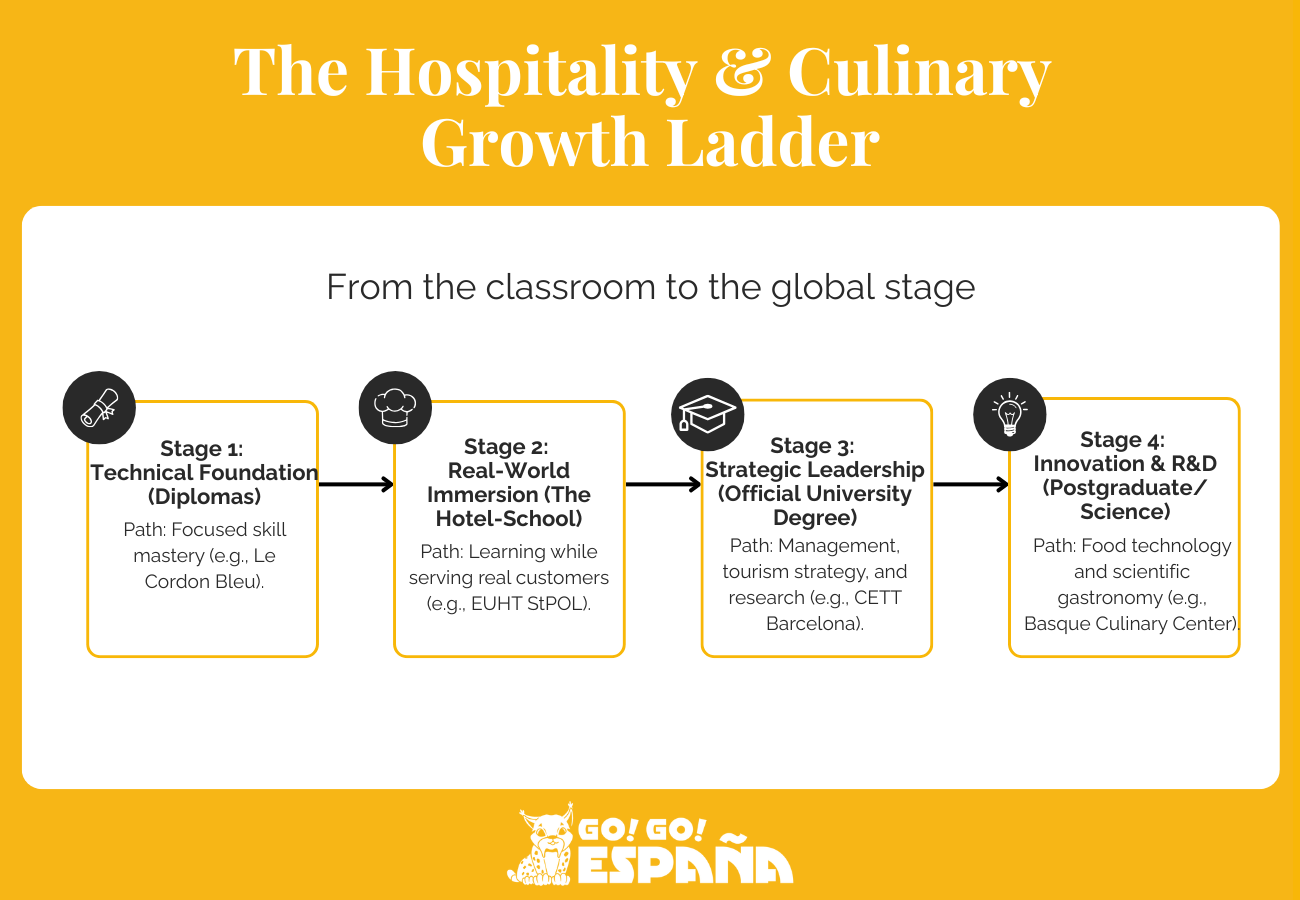
Hospitality is a ladder. While you won’t start as a CEO, the growth is rapid for graduates of these top schools.
| Role | Experience | Salary Range (Spain) | Salary Range (USA/Switzerland) |
| Junior Chef / Commis | Post-Grad | €18,000 – €24,000 | €35,000+ |
| Front Desk / Guest Relations | N/A | €22,000 – €28,000 | |
| Hotel Department Manager | 3-5 years exp | €35,000 – €55,000+ |
Global Mobility: Remember, a Spanish diploma is your ticket to global markets. Many alumni move to the USA, Dubai, or Switzerland immediately after graduation to double their starting salary.
The Language Reality: “Kitchen Spanish”
Do you need to speak Spanish? Yes and No.
Your degree at StPOL or CETT, will be 100% in English. You can graduate with honors without speaking a word of Spanish. The working language of a Spanish kitchen is Spanish.
While you can certainly graduate from English-taught culinary schools in Spain, mastering basic ‘Kitchen Spanish’ is your secret weapon for earning the respect of local chefs during your internship placements.
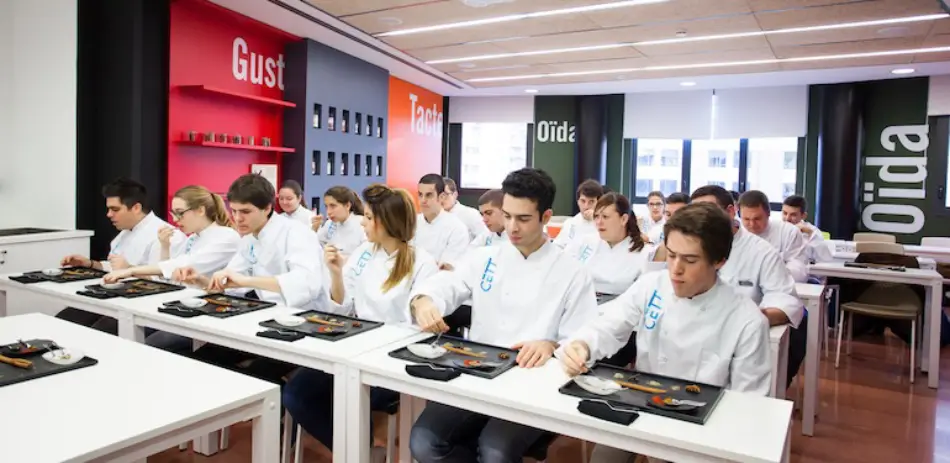
Pro Tip: We strongly recommend taking a 2-week intensive “Survival Spanish” course before your internship starts. You don’t need to be fluent, but you need to know your ingredients (e.g., pollo, cebolla) and commands (oído!) to survive the dinner rush and bond with your team.
Choosing Where to Study Hospitality in Spain
- Barcelona (Home of CETT)
- Best For: Students who want a cosmopolitan lifestyle, beach access, and international networking. It is the hub of tourism in Spain. Read about flat choices, public transport passes, and safety tips in our checklist for living and studying in Barcelona.
- Cost: High (€1,200+/month).
- Sant Pol de Mar (Home of EUHT StPOL)
- Best For: Students who want an immersive, focused campus experience. It is a stunning coastal village 45 minutes from Barcelona.
- Vibe: It’s a tight-knit community where you live and breathe hospitality. Distractions are few, which is perfect for serious chefs.
- San Sebastián (Home of BCC)
- Best For: Foodies. It has the highest concentration of Michelin stars per capita in the world.
- Cost: Very High. Rent here can rival Madrid and Barcelona.
Budgeting for Spain: Realistic Monthly Costs
Don’t rely on guesswork. Here is what a typical student spends per month in a major hub like Barcelona or Madrid (excluding tuition):
| Item | Estimated Monthly Cost (€) | Notes |
| Rent (Shared Apartment) | 500 – 750 | |
| Rent (Private Studio) | 900 – 1,200 | |
| Groceries | 200 – 300 | |
| Transport (Student Pass) | ~20 | Youth travel cards are heavily subsidized in Madrid/Barcelona |
| Leisure/Dining | 150 – 250 | |
| Total Estimated Monthly Budget | 900 – 1,400 |
Note: Smaller coastal towns like Sant Pol de Mar will offer cheaper rent, often 20 – 30% less than city centers. Look at comparison metrics for flat shares, student residences, and student housing contracts in our student accommodation Spain complete guide.
FAQ about Culinary & Hospitality Schools in Spain
1. Where to study culinary or hospitality arts in Spain?
If you want a Hotel-School experience with Michelin training, choose EUHT StPOL. For technical French technique, choose Le Cordon Bleu. For academic tourism degrees, choose CETT.
2. How long are culinary and hospitality courses in Spain?
Programs range from 9-month Diplomas (Le Cordon Bleu) to full 4-year Bachelor’s Degrees (StPOL / CETT). Master’s programs typically last 10-12 months.
3. Can I work while studying?
Yes. The student visa allows you to work up to 30 hours per week, provided it doesn’t interfere with studies. However, the easiest way to work is through Mandatory Paid Internships. Visa Pro-Tip: The “TIE” is Key Your student visa gets you into Spain, but to work legally, you must apply for your TIE (Tarjeta de Identidad de Extranjero) upon arrival. Recent laws have streamlined this, often allowing the work authorization to be automatically included with your study permit for up to 30 hours a week. However, you must have the physical TIE card in hand to sign a labor contract with a company that isn’t your university internship provider. Look at necessary monetary limits, background check rules, and application filing paths in our Spanish student visa guide.
4. What are the cheapest culinary schools for international students?
CETT (University of Barcelona) is very competitively priced compared to private competitors.
5. Can I stay in Spain after I graduate from culinary school?
Yes. If you complete an official degree or a recognized higher education program (like those at CETT or EUHT StPOL), you are eligible to apply for the Post-Study Work Visa (Visado de Búsqueda de Empleo). This allows you to stay in Spain for 12 additional months to find a job or start your own food business.
6. Do I need previous cooking experience to apply?
For most Bachelor’s degrees and Diploma programs (like the ones at Le Cordon Bleu or StPOL), no prior experience is required. These programs are designed to take you from beginner to professional. However, Master’s programs or specialized “Advanced” courses usually require either a previous degree or 1-2 years of kitchen experience.
7. Are Spanish culinary diplomas recognized worldwide?
Absolutely. Spain is currently considered the world leader in modern gastronomy. Degrees from EUHT StPOL (a member of the exclusive Hotel Schools of Distinction) and CETT (University of Barcelona) are highly respected by international hotel chains and restaurant groups globally, often opening doors faster than generic certificates.
In Summary: Culinary & Hospitality Schools in Spain for International Students
Finding the perfect fit among the top culinary & hospitality schools in Spain for international students depends entirely on your end goal:
- If you crave the intensity of a Michelin kitchen, EUHT StPOL is the industry leader.
- If you prefer the strategic side of tourism with an official degree, CETT is your best path.
- If you need flexibility and a way to earn while you learn, choose a school that offers the smartest ROI.
Dreaming of a career in hospitality? Don’t navigate the options alone. Contact Go! Go! España for a free profile assessment. We can help you choose the right school and manage your Student Visa application to ensure a smooth arrival in Spain.
If you decide that a specialized hotel or kitchen academy does not fit your academic priorities, you can target general tracks instead. Review structural options, campus student offices, and international student services in our overview of the recommended universities in Spain for international students.


