 Skip to content



A Step-by-Step walkthrough for international students: Registration, Subjects, Scoring, and latest Updates.
The Pruebas de Competencias Específicas (PCE) are official entrance exams that international students must take to access public universities in Spain.
They test knowledge in specific subjects to calculate an admission score of up to 14 points, acting as the equivalent of the Spanish EBAU/Selectividad exam for foreign students.
For the 2026 academic year, the rules have shifted slightly. The new “Competency-Based” model means a “Pass” (5/10) requires more than just memorizing facts; you now need to demonstrate real-world application.
Whether you are aiming for Medicine, Engineering, or Business, understanding this new format is critical.
This guide provides a step-by-step walkthrough of the UNEDasiss registration process, the 2026 exam dates, and the strategy you need to maximize your score up to 14 points.
(Last Updated: April 2026)
Key Takeaways
- Selectivity Strategy: Choose 4 subjects to maximize your score. Ensure at least two of them have a 0.2 weighting for your target degree.
- Competency Shift: The 2026 exams include more “application” questions (25%) and less memorization.
- Strict Deadlines: Registration closes on April 28, 2026. There is no late registration period for the main session.
- In-Person Only: You cannot take the exams online. You must travel to a UNED center in Spain or your home country.
- Calculators: You can use non-programmable scientific calculators for Math, Physics, and Chemistry.
- Language: Exams are in Spanish. If you are not fluent, you must factor language learning into your study plan.
- Cost: Budget around €300 for the exam fees, separate from any academy preparation or Spanish learning costs.
Table of Contents
What is the Format for the Pruebas de Competencias Específicas?

For 2026, the exam retains its 90-minute duration but introduces a new focus: 25% of questions are now “Competency-Based.”
This means you won’t just be asked to “define a concept.” You will be asked to apply that concept to solve a problem or analyze a text.
Understanding the New PCE Exam Competency-Based Evaluation
Starting in 2026, the Pruebas de Competencias Específicas have moved away from traditional rote memorization toward a “competency-based” model where 25% of the exam grade now depends on your ability to apply theoretical knowledge to real-world scenarios.
This change means that simply memorizing dates or formulas is no longer enough to achieve a top score. Examiners are now looking for critical thinking and the ability to connect concepts across different themes within each subject.
How to Maximize Your Pruebas de Competencias Específicas Score?
You can take a maximum of 6 subjects, but most international students choose 4 subjects to balance workload and scoring potential.
- Core Subjects (Troncales Generales): English, Spanish Language and Literature, History of Spain, History of Philosophy.
- Modality Core (Troncales de Modalidad): Mathematics II, Math for Social Sciences, Fundamentals of Art, Latin.
- Specific Subjects (Específicas): Physics, Chemistry, Biology, Business & Business Model Design, Geography, History of Art, etc.
Regional PCE Requirements
Spain’s admission rules are not centralized. The number of subjects you must take and the “Modality” rules depend entirely on the region of your target university.
| Region | Recommended Subjects | Modality Requirement? | Key Strategic Detail |
| Madrid | 4 Subjects | Yes (Strict) | You must pick a specific combination (ex: Science or Social Science) to “Accredit Modality.” |
| Catalonia | 6 Subjects | No | To reach a competitive Nota de Corte in Barcelona, you generally need to take 6 subjects. |
| Andalusia | 6 Subjects | No | Like Catalonia, taking 6 subjects is the standard way to maximize your points up to 14. |
| Valencia | 4 Subjects | No | One of the most flexible regions; you can often pick your 4 subjects without strict modality rules. |
Pro Tip: Always check the “Distrito Único” website of the specific region you are applying to before choosing your PCE subjects.
How Many Subjects Should I Take?
Strategic subject selection for the Pruebas de Competencias Específicas is the key to maximizing your admission score, as specific subjects can effectively double your points in the 14-point scale.
- The “Safe Bet” (Recommended): 4 Subjects. (1 Core + 1 Modality + 2 Specifics). This ensures you meet the criteria for all public universities in Madrid, Barcelona, and Valencia.
- The “Minimum”: 2 Subjects. Only recommended for EU students who just need to raise their grade slightly.
- The “Maximum”: 6 Subjects. Only recommended if you are unsure which subjects you will pass. The university will only count your top 2 grades for the bonus weighting.
How is the Final PCE Score Calculated?
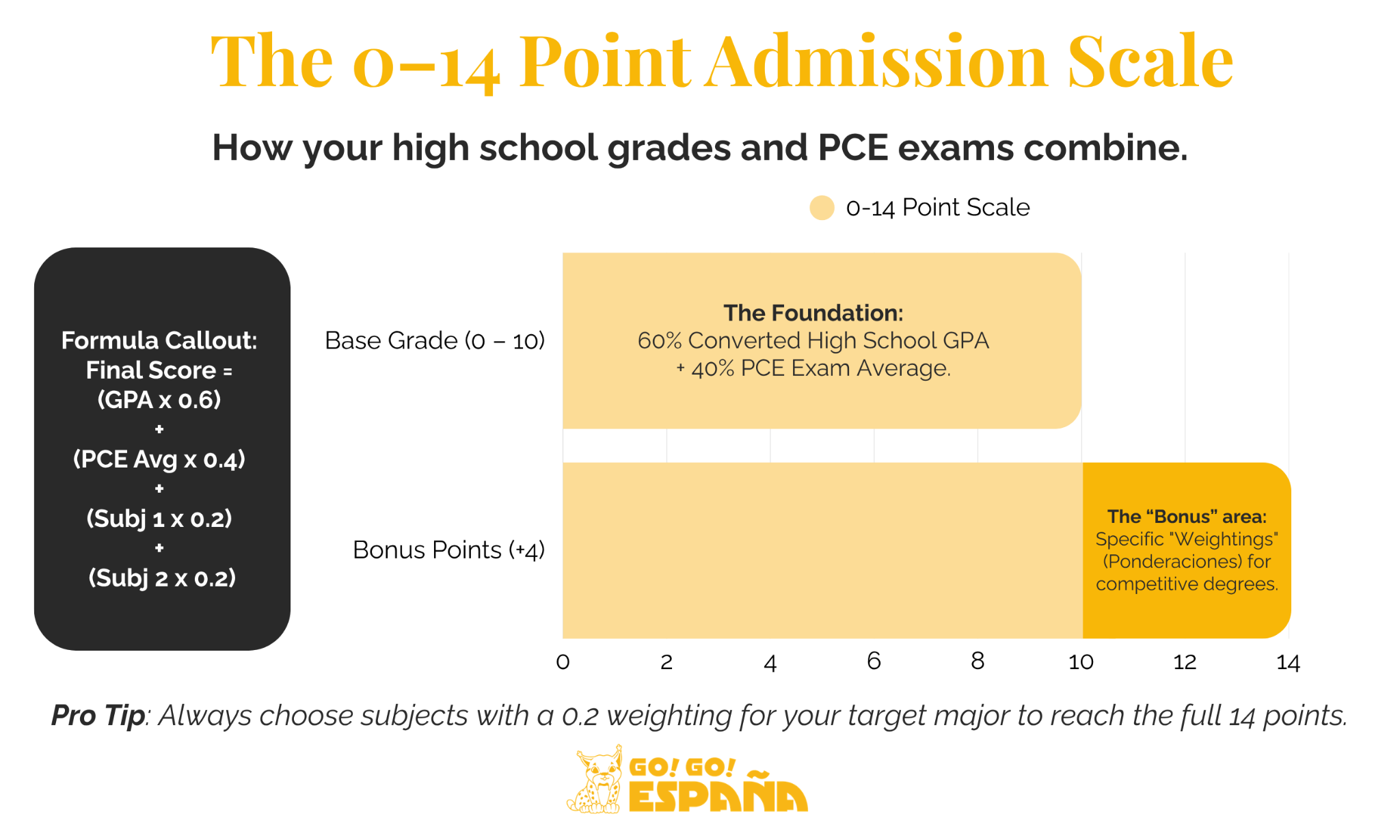
Your final admission grade is a mix of your high school records (60%) and your PCE exam results (40% + Bonuses).
The Spanish system uses a 0–14 scale.
- 0–10: Your “Base Grade” (Calificación de Acceso).
- 10–14: Your “Bonus Points” (Nota de Admisión).
The Calculation: Official Formula

Final Grade = (High School GPA × 0.6) + (PCE Exam Average × 0.4) + (Subject 1 × 0.2) + (Subject 2 × 0.2)
Source: Official PCE Formula
The “Weighting” Secret (Ponderaciones)
Not all subjects are equal. Universities assign a “weighting matrix” of 0.1 or 0.2 to subjects depending on their relevance to the degree.
- Example: If you want to study Engineering:
- Math II: Weight 0.2 (Score of 10 = +2 extra points).
- History of Art: Weight 0.1 (Score of 10 = +1 extra point).
- Strategy: Always choose subjects with a 0.2 weighting for your specific target degree.
Step-by-Step Registration Guide for UNEDasiss
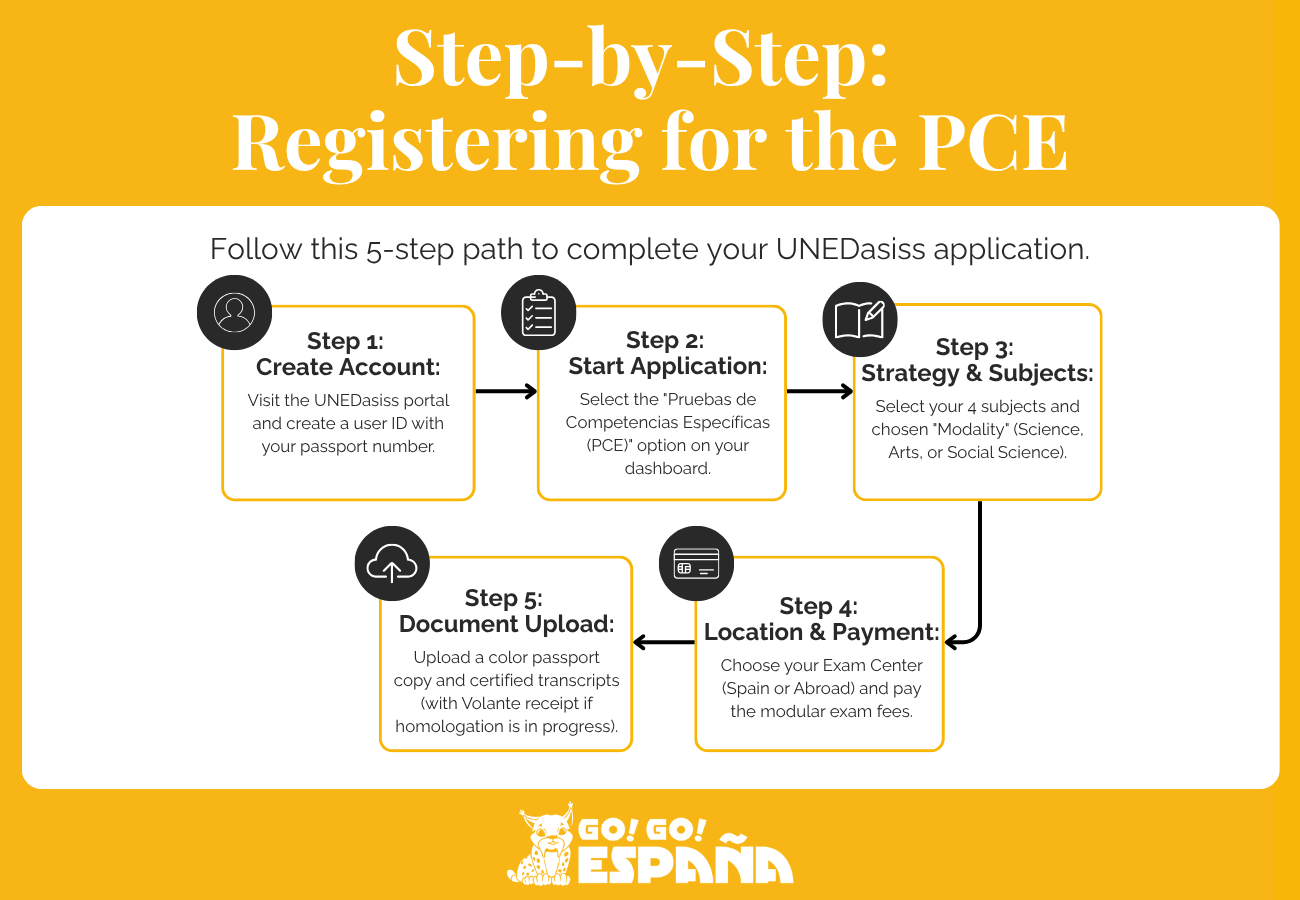
Registration is done entirely online through the UNEDasiss portal. You do not register with the university directly.
Follow this process to ensure your application is valid for the 2026 session.
Step 1: Create a UNEDasiss Account
- Go to the official UNEDasiss website.
- Select “Student” and create a new user ID using your passport number.
Step 2: Start a “Solicitud” (Application)
- Select the option: “Pruebas de Competencias Específicas (PCE).”
- Note: If you haven’t homologated your diploma yet, select “Accreditation + PCE.”
Step 3: Choose Your Subjects
- Select your 4 subjects from the drop-down menu.
- Warning: Ensure you select the correct “Modality” (Science, Social Science, Arts) that matches the degree you want to study.
Step 4: Select Your Exam Center
- A drop-down menu will ask for your “Exam Center.”
- You can choose an exam center in Spain (ex: Madrid, Valencia) or abroad (ex: New York, Bogota, London etc.).
Step 5: Payment & Documentation
- Pay the fees online (credit card is fastest).
- Upload your color passport copy and certified high school transcripts.
Pro Tip: You Don’t Need the Final Homologation Yet. Many students panic because the Spanish Ministry takes 6–12 months to process the “Homologación” of their high school diploma. Do not wait for the final certificate.
You only need to upload the “Volante de Inscripción Condicional” (the receipt proving you have started the homologation process) to sit the exams. UNEDasiss will release your grades provisionally until your official homologation arrives.
Do not wait for the final certificate to submit your files. You can use provisional application receipts to secure your test slot while the ministry reviews your high school credentials. Check the complete document checklist and filing timelines in our step-by-step guide to foreign qualifications in Spain homologation.
PCE Exam Dates and Costs

The 2026 PCE season runs from February to June. Missing a deadline in the Spanish university system can delay your education by an entire year. Use this schedule to track the 2026 registration and examination windows.
Table: 2026 Timeline of Key Dates (Confirmed)
| Milestone | 2026 Date / Deadline |
| Registration Opens | March 16, 2026 |
| Registration Deadline | April 28, 2026 (Strict) |
| PCE Exams (Spain Centers) | May 25 – May 29, 2026 |
| PCE Exams (International Centers) | Vary depending on what city, check here. |
| Results Publication | Late June 2026 |
| Extraordinary Session (Retakes) | September 2026 |
What is the cost of taking the PCE exam?
Budget approximately €250–€350 total.
- File Opening Fee: ~€170 (One-time administrative fee).
- Per Subject Fee: ~€35 per exam.
- International Center Surcharge: ~€90–€100 extra if taking the exam outside of Spain.
To calculate how these fees affect your wider study abroad budget, read our breakdown of the cost of university in Spain.
Can I take the PCE exam online?
No. The PCE exams are 100% in-person, pen-and-paper exams. You must physically travel to a UNED center, even if you are an international student.
What are the Prohibited Calculators for the PCE Exam?
Success in the Pruebas de Competencias Específicas isn’t just about what you know, it’s about following the strict technical protocols of UNEDasiss. Using a prohibited tool can lead to immediate disqualification.
Not all scientific calculators are permitted. The general rule is: if it can solve equations, show graphs, or store text, it is prohibited.
Table: The Calculator Guide: What is Allowed?
| Calculator Type | Status | Features / Common Models |
| Basic Scientific | ✅ ALLOWED | Non-programmable. Performs basic trig/logs only. (ex: Casio fx-82, fx-85 series). |
| Standard Scientific | ❌ PROHIBITED | Models with “SOLVE” functions or equation solvers. (ex: Casio fx-991, fx-570). |
| Graphing / Programmable | ❌ PROHIBITED | Any calculator with a screen capable of plotting graphs or storing formulas. |
Warning: The Casio fx-991 (all versions) is the most common reason international students are removed from the exam hall. Even though it looks “standard,” its ability to solve systems of equations makes it illegal for the Pruebas de Competencias Específicas. Buy a basic fx-82MS to be 100% safe.
Note: If you bring a banned calculator, it will be confiscated, and you will have to take the Math/Physics exam without one.
How to Prepare for the Pruebas de Competencias Específicas?
To succeed in the 2026 Pruebas de Competencias Específicas, students must transition from note memorization to a “competency-based” study model that focuses on applying theoretical knowledge to real-world scenarios.
Because at least 25% of your score now depends on open-ended “Competency” questions, your study plan must include practicing with 2025 and 2026 mock exams. Relying on outdated textbooks from previous years is a common mistake that can lead to lower marks in the new format.
We strongly recommend enrolling in a specialized PCE Academy (online or in-person) for at least 5–6 months. Academies like Academia Guiu or Costa de Valencia update their materials annually to match these new formats and have high success rates for international students.
If you require more flexibility, Go! Go! España also offers a comprehensive online option designed specifically for those studying from their home countries.
- Master Technical Spanish: Remember that the Pruebas de Competencias Específicas are conducted in Spanish. Even if you are applying for an English-taught degree, your preparation must include mastering the technical vocabulary required for subjects like Biology, Chemistry, or Mathematics in Spanish.
- The 5-6 Month Rule: Starting your prep at least half a year in advance allows you to cover the extensive Spanish “Bachillerato” curriculum without rushing, ensuring you have time to master the specific exam techniques used by UNEDasiss. To find a program that fits your study timeline and budget, check out our reviews of the best PCE exam preparation courses.
Understanding Your PCE Exam Results and Retake Options
Once you complete the Pruebas de Competencias Específicas, your results will be published on the UNEDasiss portal within three weeks, allowing you to download the official “Papeleta de Calificaciones” needed for university pre-enrollment.
If your final score falls below the required “Nota de Corte,” you have the option to enter the Extraordinary Session in September. However, it is important to note that many high-demand degrees in Spain close their enrollment after the June session.
- Grade Validity: Your Pruebas de Competencias Específicas exam scores are valid for two academic years, while your high school base grade (the 60%) never expires.
- The September Strategy: Use the September retake to improve your score for the following year’s intake if your dream university is already full.
FAQ: Pruebas de Competencias Específicas
1. What is the passing score for the PCE exam?
Technically, a 5 out of 10 is a “Pass.” However, to be competitive for university admission, you generally need a final weighted grade of at least 8 or 9 out of 14. For Medicine, you often need a 13/14.
2. How many questions are there in the PCE exam?
It varies by subject. Most science exams (Math, Chemistry) have roughly 10 multiple-choice questions plus 2-3 problem-solving development questions. The new competency model may introduce more “case study” style questions.
3. What subjects are available for PCE exams?
You can choose from over 15 subjects, including: Mathematics II, Math for Social Sciences, Physics, Chemistry, Biology, Technical Drawing, Business Economics, Geography, History of Art, History of Philosophy, English, French, and Spanish Language.
4. How do I register for the PCE exams from my home country?
You register online via the UNEDasiss website. During the registration process, a drop-down menu will ask for your “Exam Center.” Select the city nearest you (ex: “New York,” “Sao Paulo,” “London”).
5. How to sign up for a PCE preparation course online?
Many specialized academies offer online courses tailored to the PCE. Look for academies that specifically mention “UNEDasiss Preparation” (Go! Go! España recommends trusted partners like Costa de Valencia or Academia Guiu).
6. What are the advantages of studying at a prep school to prepare for the exams?
There are a range of advantages; they help you choose subjects, find the right public university based on your desired major, they assis
7. Can I retake the PCE exams if I don’t pass?
Yes. You can retake the exams as many times as you want. You can try again in September (though university spots are limited) or wait until the next May/June session. UNED will always keep your highest grade.
In Summary: PCE Exams and EBAU Exams
The Pruebas de Competencias Específicas are your gateway to the Spanish university system. Success requires more than just knowledge; it requires the strategic selection of subjects and a clear understanding of the new 2026 competency-based format. By registering on time through UNEDasiss and preparing with the right curriculum, you can turn your foreign diploma into a competitive ticket for Spain’s top universities.
Need help with registration? The UNEDasiss portal can be confusing. Contact Go! Go! España for assistance with your application and document uploads.
Looking for a study partner? Check out our recommended PCE Preparation Courses to find an academy that will help you ace the exams.


