 Skip to content
Home - Spanish Universities Guide - Cost of University in Spain
Cost of University in Spain: Financial Guide for International Students
High-quality education shouldn’t result in a lifetime of debt. Here is the real cost of university in Spain.

In the United States, the average student graduates with over $30,000 in debt. In Spain, you can often earn an entire degree for less than the cost of one semester back home.
But affordability does not mean low quality. Spain offers a unique “education arbitrage,” the opportunity to earn a world-class, globally recognized degree at a fraction of the international price.
Whether you are looking at a government-subsidized public university or a prestigious private business school, the financial equation almost always works in your favor.
However, the price tag you see on the website is rarely the final number. From “file opening fees” to “non-EU pricing tiers,” there are nuances to the Spanish system that catch many families off guard.
This guide will break down the real cost of university in Spain, helping you build a budget that works.
To build a foundational understanding of the entire academic landscape before analyzing specific fees, review our complete guide to spanish universities for international students.
(Last Updated: March 2026)
Key Takeaways
- The Price Gap: Tuition varies drastically. Public universities cost between €750 and €8,000 per year, while private universities range from €8,000 to €25,000.
- Nationality Matters: At public universities, non-EU students often pay a higher “3rd or 4th tier” tuition rate than EU citizens, though it is still significantly cheaper than in the US or UK.
- The “Free” Myth: Unlike Germany, university in Spain is not free. Everyone pays tuition fees, but public degrees are heavily subsidized by the government (up to 80-90%).
- Hidden Admin Fees: Budget an extra €300–€500 initially for “invisible” costs like the university file opening fee (apertura de expediente), ID cards, and homologation taxes.
- High ROI: A Spanish degree offers an exceptional Return on Investment. You can earn a globally recognized diploma for less than the cost of one semester at an American state college.
- Cost vs. Bureaucracy: Public universities save you money but cost you time in bureaucracy. Private universities cost more money but save you time with dedicated English-speaking support.
- Visa Financial Requirements: To get your student visa, you must prove you have approximately €7,200 (100% of IPREM) in the bank for living expenses, separate from your tuition payments.
Our sources and methodology
Sources and Methodology: How We Calculated These Ranges
This guide combines official university price tables, regional tuition decrees, and government visa rules to estimate costs for the 2025–2026 academic year.
Where universities publish per-credit or per-year prices, we used those figures directly. Where regional decrees set price bands, we calculated tuition based on the posted price per ECTS credit.
For visa and financial-means requirements, we relied on the IPREM benchmark used by Spanish consulates to determine proof-of-funds guidelines.
Primary sources referenced in this article include:
- University fee pages, ex: UC3M, UCM, UPC
- UNEDasiss accreditation and examination fees
- Regional price decrees from Generalitat de Catalunya, Comunidad de Madrid, and others
- IPREM guidance for student visas
Cost of university study in Spain
How Much Does It Cost to Study at a University in Spain?
The cost of university in Spain ranges from as little as €750 per year for some public degrees to €25,000+ per year at top-tier private business schools.
The price gap between public and private institutions is significant. Public universities are heavily subsidized by the Spanish government, which covers approximately 80 to 90 percent of the actual cost of education, according to official tuition statistics published by the Spanish Ministry of Universities.
For international students, there are typically two financial paths to consider.
- The Public Track: Low tuition, high bureaucracy, and competitive entrance exams (PCE).
- The Private Track: Higher tuition, streamlined admission, and extensive English-speaking support.
Spanish public university cost
How much is Public University in Spain?

Public university tuition in Spain typically ranges from €700 to €1,200 per year for EU residents, and between €1,500 and €8,000 per year for non-EU international students.
Public university tuition fees in Spain are set by each Comunidad Autónoma (regional government), which means the cost of the same degree can vary depending on where you study. For example, studying in Madrid may cost more than in Andalusia, based on the official tuition framework set by the Comunidad de Madrid.
For international students, there’s an important factor to keep in mind: residency status. Some regions charge all students the same rate, while others apply a higher “3rd or 4th Tier” price for non-EU students who are not permanent residents. Here’s a quick breakdown:
- EU Citizens and Residents: €700 – €1,200 per year
- Non-EU International Students: €1,500 – €8,000 per year
Even if you’re paying the higher non-EU rate, Spanish public universities remain a very affordable option for a full year of university compared to many other countries.
How Public Tuition Is Calculated
Public universities charge per credit, not a flat annual fee. A standard academic year is 60 ECTS credits, and tuition is the price per credit multiplied by the number of credits you take.
Student Category | Rate Type | Estimated Price Per Credit | Annual Total (60 Credits) |
EU Students | Subsidized Rate | ~€20 | €1,200 |
Non-EU Students | Full Cost Rate | €80–€120 (example €115) | €6,900 |
Is University Education Free in Spain?
No, university in Spain is not free, even for public students. Unlike Germany or France, where tuition can be zero, Spain operates on a “pay-per-credit” system. Every student must pay a portion of their education costs.
However, there is a notable exception in the region of Andalusia. The regional government has a policy where if you pass 100% of your credits in Year 1, your tuition for Year 2 is effectively free (99% subsidized). This “Bonification” applies primarily to residents, but it highlights the heavily subsidized nature of the Spanish system.
How Much Does It Cost to Retake a Class in Spain?
If you fail a class, you must retake the credits at a higher rate, which can double on the second attempt and triple on the third.
For example, a standard 6-credit course priced at €20 per credit costs €120 initially. However, if you need to repeat that exact same class, it could cost you between €240 and €360. This makes passing your classes on the first try highly important for your budget!
Estimated Public Tuition Ranges (Per Year)
Understanding the per-credit system, regional pricing, and the “failure tax,” you can plan your budget effectively and focus on making the most of your studies without financial surprises.
Region | EU Student Cost | Non-EU Student Cost | Notes |
Andalusia (Granada, Seville) | ~€820 | ~€820 | One of the cheapest regions; often same price for non-EU. |
Madrid (UCM, UC3M) | ~€1,200 | €3,000 – €8,000 | Madrid charges significantly higher rates for non-EU students. |
Catalonia (UB, UAB) | ~€1,100 | ~€2,500 – €6,000 | Pricing depends heavily on the specific degree (e.g., Medicine is higher). |
Valencia (UPV, UV) | ~€1,000 | ~€1,500 – €2,500 | Moderate pricing for internationals. |
Spanish private university cost
How much is Private University in Spain?

Private university prices in Spain generally cost €8,000 to €25,000 per year, but they offer an all-inclusive experience with much less bureaucracy than public institutions.
If you are looking for English-taught programs, small class sizes, and a “soft landing” into Spanish life, private universities are the standard choice. Unlike public schools, private fees are usually fixed regardless of your nationality. Look at the academic differences between state degrees and specialized corporate diplomas by reviewing our guide on English universities in Spain.
- Standard Private University: €8,000 – €14,000 per year (e.g., UCAM, Nebrija).
- Top-Tier Business School: €18,000 – €30,000 per year (e.g., IE University, ESADE, EU Business School).
Why pay more?
- No PCE Exams: Most private schools do not require the difficult Selectividad entrance exams.
- English Programs: They offer the vast majority of 100% English degrees.
- Career Services: Stronger partnerships with multinational companies for internships.
In short, private universities come at a higher price, but they make up for it with convenience, international support, and career-focused resources.
University extra fees
Are There Extra Fees for Universities in Spain?
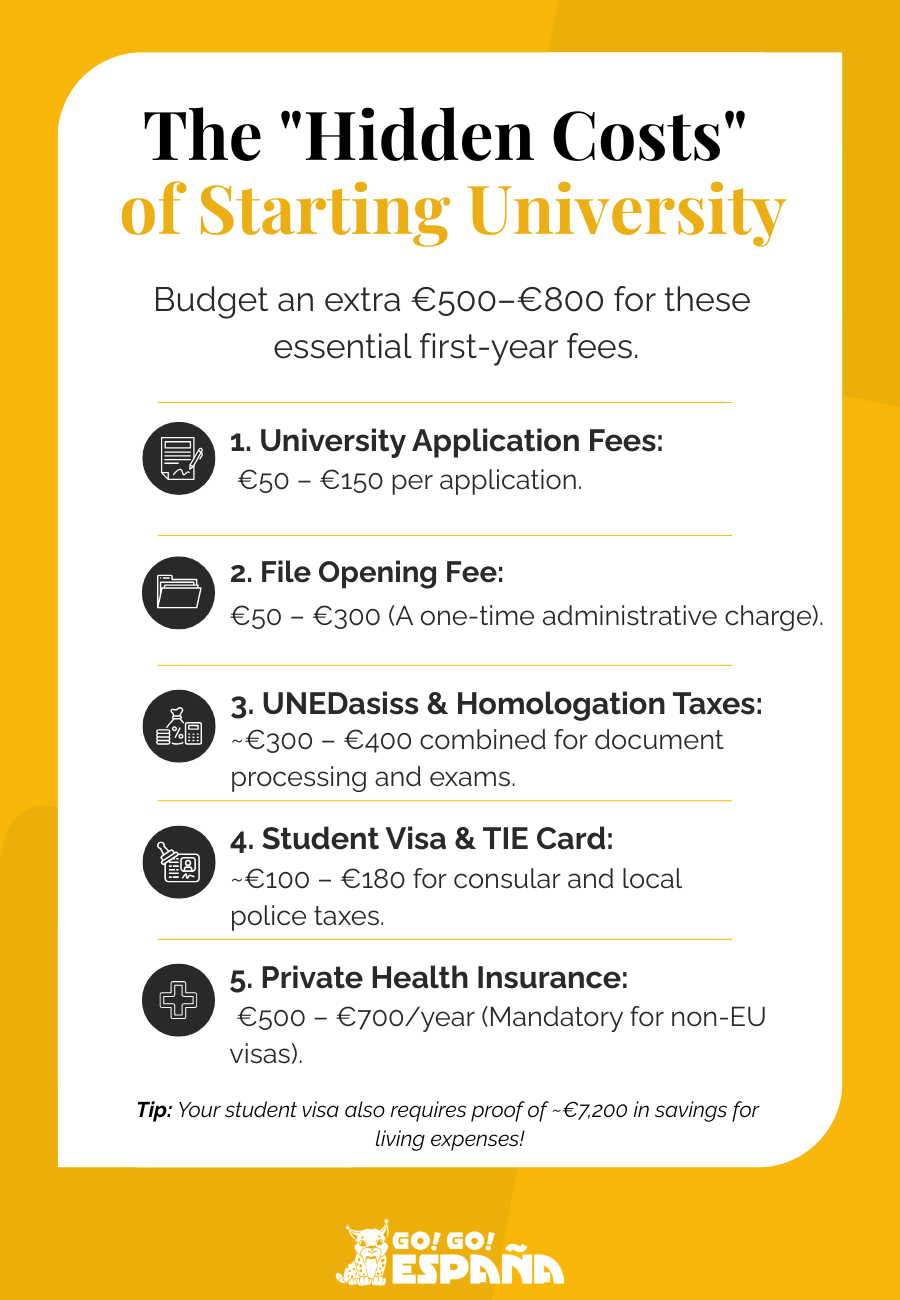
When calculating the total fees of university in Spain, remember that the “sticker price” is never the final price. You must budget an extra €500–€800 for administrative fees in your first year.
When planning your finances, do not forget these “invisible” costs that appear during the application and arrival process.
- University Application Fees: Public universities charge a small administrative fee (approx. €30–€70), while private universities often charge an “Admission Fee” of €100–€150.
- File Opening Fee (Apertura de Expediente): A one-time administrative charge of €50–€300 to open your academic record (see the official tuition and administrative fee page of Universidad Complutense de Madrid for a real example).
- Homologation and UNEDasiss:
- Homologation Tax: ~€160 (paid to the government).
- UNEDasiss Accreditation: ~€150–€250 depending on how many exams you take, based on the official UNEDasiss accreditation and examination fees.
- Student Visa and TIE:
- Visa Fee: ~€80–€160 (varies by US/UK/Canada consulate).
- TIE Card Tax: ~€16.08 (Tasa 790-012).
- Private Health Insurance: Mandatory for the visa. Expect to pay €500–€700 per year for a compliant policy with no copayments.
Check our detailed list of consular processing fees and documentation steps in our updated Spanish student visa guide.
Total cost to attend a university in Spain
How Much Is the Total Cost to Attend a University in Spain?

Depending on your lifestyle, the total cost to attend a university in Spain means you should budget between €10,000 and €25,000 per year.
This table combines tuition with the average cost of living (housing, food, transport) to give you the real “bottom line.”
Student Profile | University Type | Living Style | Est. Annual Total |
The Saver | Public (Andalusia) | Shared Room | €11,000 – €13,000 |
Budget-Conscious | Private (UCAM) | Shared Room | €14,000–€16,000 |
The Urbanite | Public (Madrid/BCN) | Shared Room | €16,000 – €19,000 |
The Premium | Private University | Studio Apt | €35,000 – €45,000 |
Note:
Adding the budget-conscious private option shows that private universities are not always more expensive than public universities in big cities. For example, UCAM, a popular choice for Go! Go! España students, offers affordable tuition and shared accommodations that can sometimes cost less than a public university in Madrid or Barcelona.
Sample Annual Budget: Shared Room, Public University (Medium City)
Here’s a realistic example of what a first-year budget might look like for a non-EU student attending a public university in a medium-sized city:
Expense | Estimated Cost | Notes |
Tuition (Public, Non-EU) | €4,500 | Based on typical per-credit rates |
Rent (Shared Room) | €4,800 | ~€400 per month |
Food and Groceries | €3,000 | ~€250 per month |
Transport and Phone | €720 | ~€60 per month for local transport and mobile plan |
Insurance and Administrative Fees (First Year) | €900 | Includes health insurance and file opening fees |
Total Estimated Annual Budget | €13,920 | Covers tuition + living expenses |
This example highlights how living costs can add up and why it’s important to budget beyond tuition.
To organize your housing, grocery, and travel overheads across different regions, see our detailed guide on the cost of studying in Spain.
Financial aid
How Can You Get Financial Aid to Fund Your Studies in Spain?

While Spanish universities offer limited full-ride scholarships for international applicants, you can successfully fund your education through a strategic mix of regional grants, home-country financial aid, and part-time employment.
Can US University Students Use FAFSA Loans in Spain?
Yes, several top-tier Spanish universities participate in the US Federal Student Aid (FAFSA) program, allowing you to use federal loans to finance your tuition just as you would at home.
Many families assume that studying in Europe requires paying entirely out of pocket, but that is a myth. If you are an American student, you can often use federal loans, including Direct Subsidized, Direct Unsubsidized, or PLUS loans, to cover your educational costs.
As of Q1 2026, some FAFSA-eligible Spanish institutions include:
- Universidad de Navarra in Pamplona
- Universidad Politécnica de Valencia in Valencia
- Universidad Pontificia Comillas in Madrid
- Universitat Jaume I (UJI) in Castellón de la Plana
- ESADE
However, you must verify the specific approval status of each institution.
Some of these universities, such as Valencia, Comillas, and UJI, are listed as “Deferment Only”. This means you can pause payments on existing US loans while studying there, but you cannot take out new federal loans to pay your Spanish tuition.
Important Note:
The US Department of Education updates its International Schools in Federal Loan Programs list quarterly in March, June, September, and December. You should always check the school’s current status before applying.
Can You Work to Pay for Your University Tuition in Spain?
Yes, you can work part-time, but you should never rely on a student job to cover your full cost of university in Spain.
Recent updates to Spanish immigration law now grant student visa holders automatic work authorization for up to 30 hours per week. Employers no longer need to apply for a separate work permit. They simply register you with Social Security, which removes much of the bureaucracy.
Even with legal authorization, it’s challenging to find a job that fits a typical Spanish university schedule, which often includes split shifts or irregular class times. Wages for part-time student jobs are usually enough to cover extra living expenses like food, transport, or small travel, but not full tuition or rent.
Think of work income as “pocket money” rather than a way to pay for your degree, and make sure your tuition savings are ready before arriving in Spain.
The Value of a Spanish University Degree
Is a Degree from Spain Worth the Cost?
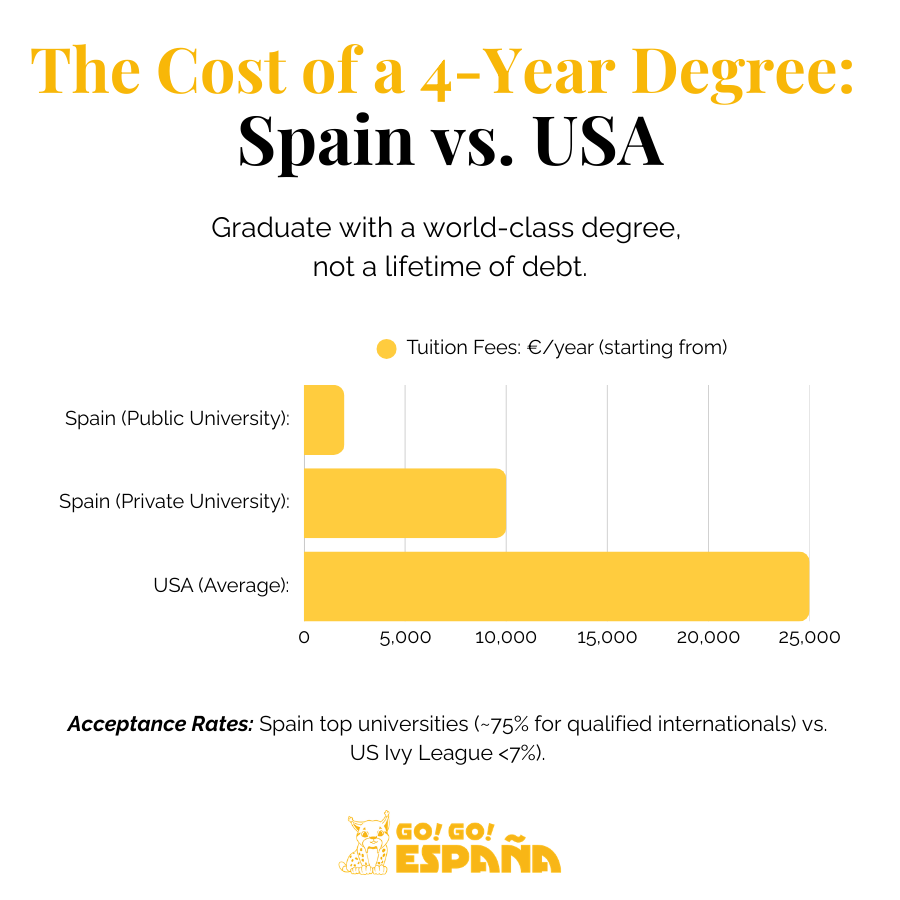
A Spanish degree offers a high Return on Investment (ROI) by minimizing debt while maximizing global employability.
Spain is consistently listed as one of the most affordable higher-education destinations in Western Europe, according to the European Commission’s official Study in Spain profile.
When you compare Spain to the US or UK, the financial logic is undeniable.
1. Higher Acceptance Rates at Prestigious Universities
Top US universities like Harvard or Stanford have acceptance rates below 7%. In Spain, equally prestigious global institutions like the University of Barcelona (UB) or Autonomous University of Madrid (UAM) have acceptance rates closer to 75% for qualified international students. You gain access to elite education without the lottery-ticket odds.
Look at a detailed breakdown of historical state and private institutional criteria in our analysis of the acceptance rate of the Spanish universities.
2. Graduating Without the Burden of Student Loans
In the US, average tuition can exceed $25,000 per year, often leaving students with over $100,000 in debt after four years. In Spain, public university tuition averages around €2,000 per year, totaling roughly €8,000 for a full degree. Starting your career without massive debt is a major financial advantage.
3. Direct Pathways to the European Job Market
Spanish universities are career-focused. Flagship institutions like Universidad Europea and UC3M report graduate employability rates above 90 percent.
Private business schools, such as EU Business School, offer strong international networks, giving students an early boost in global opportunities.
A Spanish degree combines affordability, accessibility, and career readiness, making it a smart choice for students seeking both value and opportunity.
FAQ
FAQ: The Cost of University in Spain
- Why do non-EU students pay more at public universities?
Public university fees are set by regional governments. Many regions apply a “non-resident” pricing tier for students from outside the EU/EEA, which can be 2-3 times higher than the price for local students. However, some regions (like Andalusia) maintain lower prices for everyone. - Can I pay my tuition in installments?
Yes. Almost all Spanish universities (both public and private) allow you to split your tuition into installments. Usually, you pay an initial deposit (reservation fee) and then split the rest into 2 to 9 monthly payments throughout the academic year. - Are there scholarships for international students?
Yes, but they are competitive. The Spanish government offers some scholarships (Becas MAEC-AECID), but they are hard to get. Private universities are more generous, often offering “Talent Scholarships” or “Early Bird Discounts” of 10-30% off tuition for high-achieving applicants. - What is the cheapest region to study in Spain?
For US and international students looking to minimize expenses, knowing the cost of university in Spain by region is essential.
Generally, the south (Andalusia) and the west (Galicia/Salamanca) are cheaper for both tuition and rent. Cities like Granada, Seville, and Salamanca offer a full student lifestyle for significantly less money than Madrid or Barcelona. - Do I need to pay the full tuition before I get my visa?
Usually, no. For the student visa application, consulates typically require proof that you have paid the reservation fee or the first installment (often €500–€2,000) and that you have the financial means to pay the rest. Private universities may require a higher initial deposit to issue your acceptance letter.
Summary
In Summary: English Universities in Spain for International Students
The cost of university in Spain offers one of the best financial advantages in global higher education, allowing you to graduate with a prestigious degree and minimal debt.
Studying in Spain is highly affordable compared to other Western nations. Public tuition starts around €750 per year for EU residents, while private universities generally range from €8,000 to €25,000, offering excellent English-taught programs and straightforward admissions.
When you factor in the low tuition, reasonable living expenses, and the ability to work part-time or use home-country financial aid, the total cost of university in Spain makes studying abroad a realistic financial decision rather than a lifelong burden. If you want to keep your tuition expenses as low as possible, look at our curated list of the cheap universities in spain international students use to stay within their budgets.
You do not have to figure out the finances, visas, or university paperwork alone. Contact Go! Go! España for a free consultation, and let us help you plan your budget and apply to the right program.
Learn more about building your overall lifestyle budget in our complete guide to the Cost of Studying in Spain.